
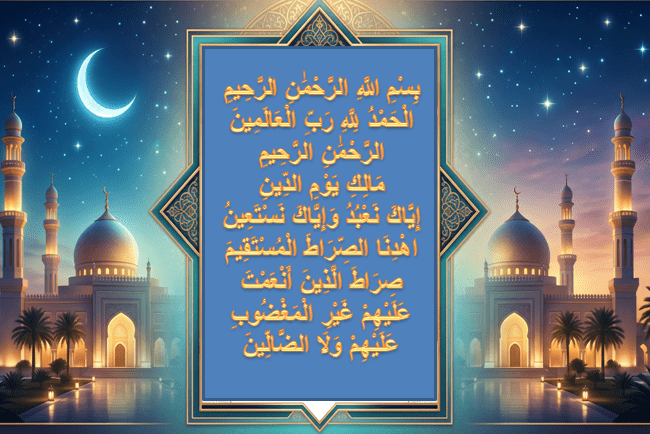
Surah Fatiha is one of the most recited and revered chapters of the Holy Quran. Known as ‘The Opening,’ it is the very first Surah of the Quran and holds an unparalleled position in Islamic worship. Every Muslim recites this Surah a minimum of 17 times daily across five obligatory prayers. Whether you are a new Muslim, a student of the Quran, or a lifelong believer seeking deeper understanding, this comprehensive guide on Surah Fatiha will provide you with everything you need — from the original Arabic text, transliteration, translation in multiple languages, word-by-word meaning, Tafsir, benefits, and much more.
Surah Al-Fatiha Reader & Audio
Select an Ayah number to read and listen
Please select an Ayah number to view text and listen to recitation.
Surah Fatiha Audio Recitation (MP3) and download
What Is Surah Fatiha?
Surah Fatiha (سورة الفاتحة) is the first chapter of the Holy Quran. It consists of seven verses (Ayat) and is categorized as a Makki Surah — revealed in Makkah before the Prophet Muhammad’s (ﷺ) migration to Madinah. It is the most frequently recited Surah in the Quran and forms the essential foundation of Islamic prayer (Salah).
Meaning of Surah Fatiha in English
The word ‘Fatiha’ (فاتحة) is derived from the Arabic root ‘Fataha’ (فَتَحَ), which means ‘to open,”to reveal,’ or ‘to conquer.’ Therefore, Surah Fatiha literally translates to ‘The Opening Chapter.’ Its meaning goes far beyond a simple title — it symbolizes the opening of the Quran, the opening of the heart to divine guidance, and the opening of the path to Allah’s mercy and blessings.
Why Surah Fatiha Is Called ‘The Opening’
Surah Fatiha is called ‘The Opening’ for several profound reasons:
• It is the first Surah in the Quran, opening the divine scripture.
• It opens (begins) every unit (Rakat) of Islamic prayer.
• It opens the heart and mind to the worship of Allah.
• It opens every important matter — Muslims recite it to begin significant undertakings.
• It is described in Hadith as the ‘opener of the heavens’ because of its spiritual power.
Surah Fatiha is also known by many other names, including Umm al-Quran (Mother of the Quran), Umm al-Kitab (Mother of the Book), As-Sab’u al-Mathani (The Seven Oft-Repeated Verses), Al-Asas (The Foundation), and Al-Shifa (The Cure).
Surah Fatiha in Arabic Text
Reading the Quran in Arabic is highly encouraged in Islam. The Arabic language is the language of divine revelation, and reciting Surah Fatiha in its original Arabic form is an obligation for every Muslim performing Salah. Below is the complete Arabic text of Surah Fatiha.
Surah Fatiha with Tajweed
Tajweed refers to the set of rules governing the correct pronunciation and recitation of the Quran. Applying Tajweed to Surah Fatiha ensures that each letter is pronounced from its correct articulation point (Makhraj) and with the proper characteristic (Sifah). Key Tajweed rules applied in Surah Fatiha include:
• Ghunnah (nasalization) — applied on Noon and Meem with Shaddah, such as in ‘Ar-Rahmaani’ and ‘Ar-Raheem.’
• Idghaam (merging) — letters merge when a Noon Saakin or Tanween is followed by specific letters.
• Qalqalah (echo) — slight echo sound on letters like Dal and Ba when they appear with Sukoon.
• Madd (prolongation) — elongation of specific vowels, such as the ‘aa’ sound in ‘Maaliki.’
• Alif Laam Shamsiyya and Qamariyya — the ‘Al’ prefix is pronounced differently depending on the following letter.
Learning to recite Surah Fatiha with proper Tajweed is a highly rewarding act. Scholars of Islam recommend learning Tajweed from a qualified teacher or through authentic audio resources.
Surah Fatiha Transliteration (English Pronunciation)
Transliteration is the representation of Arabic words using English (Roman) letters, making it easier for non-Arabic speakers to pronounce Surah Fatiha correctly. While learning the original Arabic script is always recommended, transliteration serves as a helpful starting point for beginners.
Line-by-Line Transliteration
Bismillaahir Rahmaanir Raheem — Verse 1 – Bismillah
Alhamdu lillaahi Rabbil ‘aalameen — Verse 2
Ar-Rahmaanir-Raheem — Verse 3
Maaliki Yawmid-Deen — Verse 4
Iyyaaka na’budu wa Iyyaaka nasta’een — Verse 5
Ihdinas-Siraatal Mustaqeem — Verse 6
Siraatal lazeena an’amta ‘alayhim ghayril maghdoobi ‘alayhim wa lad-daaaalleen — Verse 7
Easy Pronunciation Guide for Beginners
For those new to Arabic pronunciation, here are some key tips to help you pronounce Surah Fatiha correctly:
• The ‘kh’ sound (خ) is a guttural sound produced at the back of the throat — similar to the Scottish ‘loch.’
• The double ‘a’ (aa) indicates a long vowel, held for approximately two counts.
• The ‘ayn’ (ع) is a unique Arabic sound produced deep in the throat with a slight squeeze — practice with a teacher.
• The ‘gh’ sound (غ) resembles the French ‘r’ — a voiced guttural fricative.
• Emphasis on the letter ‘Dhaad’ (ض) in ‘Ad-Daaalleen’ — this is a uniquely Arabic sound not found in other languages.
• Always pause at the end of each verse (Ayah) for proper recitation.
Surah Fatiha Translation in Different Languages
The Quran has been translated into hundreds of languages to allow Muslims worldwide to understand the divine message. Here are the translations of Surah Fatiha in English, Hindi, and Urdu.
Surah Fatiha in English Translation
| In the name of Allah, the Most Gracious, the Most Merciful. (1) All praise is due to Allah, Lord of all the worlds. (2) The Most Gracious, the Most Merciful. (3) Master of the Day of Judgment. (4) You alone we worship, and You alone we ask for help. (5) Guide us to the straight path. (6) The path of those upon whom You have bestowed favor, not of those who have evoked Your anger or of those who are astray. (7) |
This is the most widely referenced English translation of Surah Fatiha. Different scholarly translations may use slightly different wording (e.g., ‘Sovereign’ vs. ‘Master’ for Maalik), but the meaning remains consistent across all reputable translations.
Surah Fatiha in Hindi Translation
शुरू अल्लाह के नाम से, जो बड़ा ही मेहरबान और रहम वाला है। (1) सब तारीफें अल्लाह ही के लिए हैं, जो सारे जहान का रब है। (2) जो बड़ा मेहरबान और दयावान है। (3) जो रोज़े-जज़ा (क़यामत के दिन) का मालिक है। (4) हम तेरी ही इबादत करते हैं और तुझसे ही मदद मांगते हैं। (5) हमें सीधे रास्ते पर चला। (6) उन लोगों के रास्ते पर जिन पर तूने नेमत की, न उनके जिन पर गज़ब हुआ और न उनके जो भटके हुए हैं। (7)
Surah Fatiha in Urdu Translation
اللہ کے نام سے جو بڑا مہربان اور نہایت رحم والا ہے۔ (1) تمام تعریفیں اللہ ہی کے لیے ہیں جو تمام جہانوں کا رب ہے۔ (2) جو بڑا مہربان اور نہایت رحم کرنے والا ہے۔ (3) جو روزِ جزا کا مالک ہے۔ (4) ہم تیری ہی عبادت کرتے ہیں اور تجھ ہی سے مدد مانگتے ہیں۔ (5) ہمیں سیدھا راستہ دکھا۔ (6) ان لوگوں کا راستہ جن پر تو نے انعام کیا، نہ کہ ان لوگوں کا راستہ جن پر غضب ہوا اور نہ ان کا جو گمراہ ہوئے۔ (7)
Word-by-Word Meaning of Surah Fatiha
Understanding Surah Fatiha at the word level deepens spiritual connection and enhances comprehension during prayer. Here is a detailed word-by-word breakdown of each verse.
Breakdown of Each Verse
Verse 1 – Bismillaahir Rahmaanir Raheem:
• Bismi (بِسۡمِ) — In the name of
• Allaah (ٱللَّهِ) — Allah (the one God)
• Ar-Rahmaan (ٱلرَّحۡمَٰنِ) — The Most Gracious (encompassing mercy for all creation)
• Ar-Raheem (ٱلرَّحِيمِ) — The Most Merciful (special mercy for believers)
Verse 2 – Alhamdu lillaahi Rabbil ‘aalameen:
• Al-Hamdu (ٱلۡحَمۡدُ) — All praise / All gratitude
• Lillaahi (لِلَّهِ) — Belongs to Allah
• Rabbi (رَبِّ) — Lord / Sustainer / Cherisher
• Al-‘Aalameen (ٱلۡعَٰلَمِينَ) — Of all the worlds (mankind, jinn, angels, all existence)
Verse 3 – Ar-Rahmaanir-Raheem: Repeating Allah’s attributes of ultimate grace and mercy.
Verse 4 – Maaliki Yawmid-Deen:
• Maaliki (مَٰلِكِ) — Master / Owner / Sovereign
• Yawmi (يَوۡمِ) — Of the Day
• Ad-Deen (ٱلدِّينِ) — Of Judgment / Recompense / Religion
Verse 5 – Iyyaaka na’budu wa Iyyaaka nasta’een:
• Iyyaaka (إِيَّاكَ) — You alone (emphasis on exclusivity)
• Na’budu (نَعۡبُدُ) — We worship
• Wa (وَ) — And
• Nasta’een (نَسۡتَعِينُ) — We seek help
Verse 6 – Ihdinas-Siraatal Mustaqeem:
• Ihdina (ٱهۡدِنَا) — Guide us
• As-Siraat (ٱلصِّرَٰطَ) — The path / the way
• Al-Mustaqeem (ٱلۡمُسۡتَقِيمَ) — The straight / upright / correct
Verse 7 – Siraatal-lazeena an’amta ‘alayhim…
• Siraatal-lazeena (صِرَٰطَ ٱلَّذِينَ) — The path of those
• An’amta ‘alayhim (أَنۡعَمۡتَ عَلَيۡهِمۡ) — Upon whom You have bestowed favor
• Ghayril Maghdoobi ‘alayhim (غَيۡرِ ٱلۡمَغۡضُوبِ عَلَيۡهِمۡ) — Not of those who have earned anger
• Wa lad-Daaalleen (وَلَا ٱلضَّآلِّينَ) — And not of those who are astray
Key Islamic Terms Explained
• Rabb (رَبّ): Lord, Sustainer, and Cherisher — one who creates, nourishes, and guides all.
• Rahmaanir-Raheem: Two different attributes of Allah’s mercy. Rahmaan denotes Allah’s mercy for all creation, while Raheem is His special, continuous mercy for believers.
• Yawm al-Deen: The Day of Judgment — when all souls will be held accountable for their deeds.
• Ibaadah: Worship in Islam encompasses all acts of devotion including prayer, fasting, charity, and remembrance of Allah.
• As-Siraat al-Mustaqeem: The straight path — the way of the Prophets, the truthful, the martyrs, and the righteous.
Tafsir (Explanation) of Surah Fatiha
Tafsir is the scholarly interpretation and explanation of the Quran. The Tafsir of Surah Fatiha is considered one of the most important topics in Islamic scholarship, studied extensively by scholars throughout Islamic history.
Detailed Explanation of Each Ayah
Ayah 1 – Bismillah (The Basmalah): The opening verse establishes that all actions — including the reading of the Quran — should begin with the name of Allah. It acknowledges Allah’s dual attributes of mercy: Rahmaan (universal mercy encompassing all of creation) and Raheem (specific and eternal mercy for the believers). Scholars note that beginning with Bismillah sanctifies the act and draws divine blessings.
Ayah 2 – Praise Belongs to Allah: This verse declares that all forms of praise, gratitude, and recognition belong exclusively to Allah. The word ‘Al-Hamdu’ uses the definite article ‘Al,’ signifying totality — ALL praise, without exception. Allah is declared ‘Rabb al-‘Aalameen’ — the Lord not just of humans or Muslims, but of every world, dimension, and created existence.
Ayah 3 – The Repetition of Mercy: By repeating ‘Ar-Rahmaanir-Raheem,’ the Quran reinforces the centrality of Allah’s mercy to the Islamic concept of God. Ibn Kathir notes that this repetition after praise demonstrates that Allah’s mercy is not a secondary attribute but an essential and central aspect of His nature.
Ayah 4 – Sovereignty on the Day of Judgment: ‘Maalik Yawmid-Deen’ places ultimate sovereignty in Allah’s hands — especially on the Day of Judgment when all false powers and authorities will be stripped away. This verse instills both awe and hope in the believer, remembering that the One they worship is the ultimate Judge.
Ayah 5 – The Covenant of Worship: This is a pivotal verse where the supplicant makes a personal covenant directly with Allah: ‘You alone we worship and You alone we seek help from.’ The shift to the second person (‘You’) indicates a direct address and intimate connection. This verse is the spiritual heart of Surah Fatiha and of all Islamic worship.
Ayah 6 – The Great Supplication: ‘Guide us to the straight path’ is perhaps the most comprehensive prayer a human being can make. It is a prayer for guidance — not just for today, but continuously. Scholars note that despite praying this at least 17 times daily, Muslims continue to ask for guidance because the need for divine direction is constant.
Ayah 7 – Defining the Straight Path: The final verse defines what the straight path is — it is the path of those upon whom Allah has bestowed His favor. A Hadith identifies these as the Prophets, the truthful (Siddiqeen), the martyrs (Shuhadaa), and the righteous (Saaliheen). The verse also defines what to avoid: the path of those who earned Allah’s anger through knowing the truth and rejecting it, and those who went astray through ignorance.
Lessons and Messages from Surah Fatiha
• Tawheed (Monotheism): The entire Surah revolves around the exclusive worship of one God, Allah — this is the foundation of Islamic faith.
• Gratitude and Praise: Beginning with Alhamdulillah cultivates an attitude of continuous gratitude toward Allah.
• Trust in Allah’s Mercy: The emphasis on Rahmaan and Raheem reassures believers of Allah’s limitless compassion.
• Accountability: The mention of the Day of Judgment reminds Muslims that this life is a test with eternal consequences.
• The Path of the Righteous: Muslims are guided to follow the examples of the Prophets and righteous believers.
• The Power of Supplication: Surah Fatiha teaches that asking Allah directly for guidance and help is an act of worship itself.
Benefits (Fazilat) of Surah Fatiha
The benefits of Surah Fatiha are extensively documented in authentic Hadith and Islamic scholarship. Its virtues span spiritual, physical, and psychological dimensions.
Spiritual Benefits of Reciting Surah Fatiha
The Prophet Muhammad (ﷺ) said: ‘The best Surah in the Quran is Al-Fatiha.’ (Bukhari). This alone testifies to its supreme spiritual status. Among its many spiritual benefits:
• Reciting Surah Fatiha in every Rakat of Salah ensures the validity and spiritual completeness of prayer.
• It is described as a dialogue between Allah and His servant — with each verse receiving a divine response from Allah (Muslim).
• It strengthens Iman (faith) and deepens the believer’s connection to Allah.
• It is an essential component of Dhikr (remembrance of Allah) and Dua (supplication).
• Consistent recitation increases tawakkul (reliance on Allah) and reduces anxiety and spiritual confusion.
• It is recited during the Fatiha ceremony in Muslim weddings and important occasions to seek Allah’s blessings.
Surah Fatiha for Healing and Protection
Surah Fatiha is widely known in Islamic tradition as Al-Shifa — ‘The Cure.’ This title is derived from authentic Hadith. Abu Sa’id al-Khudri (RA) narrated that the Prophet (ﷺ) confirmed that Surah Fatiha is a cure for every disease (Abu Dawud). Regarding its healing and protective benefits:
• The Prophet (ﷺ) taught the companions to use Surah Fatiha as Ruqyah — reciting it over the sick as a form of spiritual healing.
• It provides protection from evil, spiritual harm, and the whispers of Shaytan when recited with full concentration.
• Reciting it over water and drinking or using that water for blessing purposes is a well-known Islamic practice.
• It helps relieve anxiety, depression, and feelings of helplessness when recited with sincere understanding.
• Reciting Surah Fatiha 41 times is a widely practiced remedy recommended by scholars for illness and difficulties (with the understanding that healing ultimately comes from Allah).
When and How to Recite Surah Fatiha
Surah Fatiha in Daily Prayers (Salah)
Surah Fatiha must be recited in every unit (Rakat) of every prayer. A Muslim who prays all five daily prayers will recite Surah Fatiha at least 17 times in a single day — and if they include Sunnah and Nafl prayers, this number increases significantly. The procedure for reciting Surah Fatiha in Salah is:
• After making the intention (Niyyah) and saying ‘Allahu Akbar’ (Takbeer al-Ihram), the imam or individual praying recites the opening supplication (Thana).
• Then, ‘A’udhu Billahi minash-Shaytanir-Rajeem’ (seeking refuge from Shaytan) is recited silently.
• Followed by ‘Bismillaahir-Rahmaanir-Raheem.’
• Then Surah Fatiha is recited completely.
• After the completion of Surah Fatiha, ‘Ameen’ is said — either silently or aloud depending on the school of Islamic law.
Best Times to Recite Surah Fatiha
While Surah Fatiha is obligatory in every Rakat of Salah, there are additional highly recommended times to recite it:
• After every Fard (obligatory) Salah as part of post-prayer dhikr.
• Before beginning an important task, journey, or meeting — to seek Allah’s blessings.
• For the healing of a sick person — recite over them as Ruqyah.
• At the start and end of making Dua — Surah Fatiha enhances the acceptance of supplications.
• Before sleeping at night for protection and blessings.
• During difficult times, hardships, and periods of anxiety.
• To send blessings to the deceased — scholars have varying opinions, but many accept this as a valid practice.
Importance of Surah Fatiha in Namaz
Is Salah Valid Without Surah Fatiha?
The question of whether Salah is valid without Surah Fatiha is a matter of scholarly discussion in Islamic jurisprudence. However, the majority position — based on the well-known Hadith of the Prophet (ﷺ) — is that Salah is not complete without Surah Fatiha. The Prophet (ﷺ) said: ‘There is no Salah for one who does not recite the Opening Chapter of the Book.’ (Bukhari and Muslim)
This narration is considered Sahih (authentic) and forms the basis for the ruling that Surah Fatiha is Fard (obligatory) in Salah for those who are able to recite it. For those who are new to Islam and have not yet memorized it, alternative phrases of praise to Allah may be used temporarily while they learn it.
Role of Surah Fatiha in Every Rakat
Surah Fatiha plays a multidimensional role in every Rakat of Salah. It is recited in all units of prayer — Fajr, Dhuhr, Asr, Maghrib, and Isha — as well as in Jumu’ah, Taraweeh, Tahajjud, and all other prayers. Its recitation:
• Establishes the connection between the worshipper and Allah at the very start of each unit.
• Affirms the believer’s submission, trust, and reliance on Allah.
• Serves as the essential supplication asked of Allah — especially the dua for guidance.
• Creates the spiritual atmosphere for the rest of the Rakat, including the recitation of additional Quranic verses.
• According to a Hadith Qudsi, Allah responds to each verse of Surah Fatiha as the servant recites it, making it a unique dialogue in all of Islamic worship.
Surah Fatiha for Kids and Beginners
Teaching children Surah Fatiha is one of the first and most important responsibilities of Muslim parents and teachers. Its seven verses make it achievable for children to memorize, and its daily repetition in prayer reinforces retention naturally.
Easy Way to Memorize Surah Fatiha
Here are effective and child-friendly methods to memorize Surah Fatiha:
• Listen and Repeat: Play audio recordings of a beautiful Qari reciting Surah Fatiha daily. Children naturally absorb sounds they hear repeatedly.
• One Verse at a Time: Learn one Ayah per day. By the end of a week, the entire Surah is memorized.
• Morning and Night Routine: Recite Surah Fatiha together as a family every morning and night.
• Visual Aids: Use colorful Arabic flashcards with transliteration to associate sounds with symbols.
• Prayer Participation: Encourage children to join family prayers, even before they formally pray, so they absorb the Surah through listening.
• Storytelling: Explain the beautiful meaning of each verse through simple, age-appropriate stories about Allah’s love and mercy.
Learning Surah Fatiha Step by Step
Step 1: Listen to a clear recording of Surah Fatiha by a reputable Qari multiple times without trying to repeat.
Step 2: Learn the transliteration (Roman text) for each verse and practice pronunciation.
Step 3: Learn the meaning of each verse so that recitation becomes a heartfelt act rather than mechanical repetition.
Step 4: Begin memorizing Verse 1 (Bismillah) until it flows naturally.
Step 5: Add Verse 2 (Alhamdulillah…) and practice Verses 1 and 2 together.
Step 6: Continue adding one verse at a time, always reviewing from the beginning.
Step 7: Once fully memorized, practice applying Tajweed rules with the guidance of a teacher or high-quality audio resource.
Audio and Video Resources for Surah Fatiha
Surah Fatiha MP3 Recitation
Listening to high-quality audio recitations of Surah Fatiha is one of the most effective ways to learn correct pronunciation and internalize the spiritual beauty of this Surah. Many reputable Islamic websites offer free MP3 downloads of Surah Fatiha recited by world-renowned Qaris. These are widely available on platforms such as:
• Quran.com — Free streaming and download with multiple reciters
• Sunnah.com — Authentic resources with Quranic audio
• YouTube — Search for ‘Surah Fatiha with Tajweed’ for educational videos
• IslamicFinder.org — MP3 recitations with transliteration
• Mishary Rashid Al-Afasy’s official channel and platform
Best Qari Recitations to Listen
The following Qaris are internationally acclaimed for their beautiful and technically precise recitation of Surah Fatiha:
• Sheikh Mishary Rashid Al-Afasy (Kuwait) — Known for his melodious and emotionally moving recitation style.
• Sheikh Abdul Basit Abdul Samad (Egypt) — Legendary Qari with unparalleled Tajweed and spiritual depth.
• Sheikh Mahmoud Khalil al-Husary (Egypt) — Highly recommended for learning Tajweed due to his precise pronunciation.
• Sheikh Saad al-Ghamdi (Saudi Arabia) — Widely listened to for his clear and accessible recitation style.
• Sheikh Maher al-Muaiqly (Saudi Arabia) — Known for his Taraweeh recitations in Masjid al-Haram, Makkah.
Common Mistakes While Reciting Surah Fatiha
Tajweed Mistakes to Avoid
Many Muslims unknowingly make errors in reciting Surah Fatiha that alter the correct pronunciation of Arabic letters. Being aware of these common mistakes is the first step toward improvement:
• Mispronouncing ‘Ad-Daaalleen’ (الضَّآلِّينَ): The letter Daad (ض) has a unique sound. A common error is pronouncing it as a simple ‘D’ or as the letter ‘Dhaal’ (ظ). They are distinct letters with different sounds.
• Shortening long vowels: In ‘Maaliki,’ the ‘aa’ sound must be elongated (two counts). Shortening it changes both pronunciation and potentially meaning.
• Omitting the Ghunnah: The nasalization (Ghunnah) on letters with Shaddah, such as in ‘Ar-Rahmaani,’ is often skipped by non-Arabic speakers.
• Incorrect ‘Ayn sound: The letter Ayn (ع) in ‘Iyyaaka na’budu’ must be pronounced from the throat. Skipping or softening it is a common mistake.
• Swallowing the final letters: Endings of verses, especially in ‘Ar-Raheem’ and ‘Ad-Daaalleen,’ must be pronounced fully — not swallowed or blurred.
• Rushing through recitation: Prayer is a conversation with Allah. Rushing denies the heart the opportunity to reflect and connect.
Correct Pronunciation Tips
• Record yourself reciting Surah Fatiha and compare it to a master Qari’s recitation to identify specific areas for improvement.
• Use a Tajweed-color-coded Quran (Mushaf) — different colors highlight different rules visually.
• Take at least one or two sessions with a qualified Quran teacher or Tajweed tutor to get personalized feedback.
• Practice each Ayah slowly and deliberately before attempting to recite at a normal pace.
• Focus on your breathing — pausing at the end of each verse is both Sunnah and helps with proper pronunciation.
Namaz-related post
| Namaz Rakat Guide Table |
| fajr namaz rakat |
| zohar namaz rakat |
| asr namaz rakat |
| maghrib namaz rakat |
| isha namz rakat |
| practicaly method namaz |
| witr namaz |
| sunnat namaz |
| jumma namaz rakat |
| nafl namaz |
Frequently Asked Questions About Surah Fatiha
How Many Verses Are in Surah Fatiha?
Surah Fatiha consists of 7 verses (Ayaat). These seven verses include the Basmalah (Bismillah) as the first verse. The Surah contains 29 words and 139 letters in total. It is the shortest complete chapter of the Quran that contains a comprehensive prayer covering all aspects of the relationship between humanity and Allah.
Why Is Surah Fatiha So Important?
Surah Fatiha holds supreme importance in Islam for multiple reasons. It is the only Surah that is recited as an obligation in every single unit of every prayer — making it the most frequently recited passage in the Quran for any practicing Muslim. The Prophet Muhammad (ﷺ) described it as the greatest Surah in the Quran. Furthermore, it encapsulates the entire Islamic theological worldview — Tawheed, mercy, accountability, worship, and the prayer for guidance — in just seven short but profoundly deep verses.
Can Surah Fatiha Be Recited for Dua?
Yes, Surah Fatiha can and should be recited as a Dua. In fact, it is arguably the most powerful Dua in the Islamic tradition. Its verse ‘Ihdinas-Siraatal Mustaqeem’ — ‘Guide us to the straight path’ — is itself a comprehensive supplication for guidance in all matters of life. Many scholars recommend reciting Surah Fatiha at the beginning and end of personal supplications to increase the likelihood of their acceptance. Additionally, it can be recited as Ruqyah (spiritual cure) for the sick.
Deep Insights and Hidden Meanings of Surah Fatiha
Beyond its surface meaning, Surah Fatiha contains layers of profound spiritual, theological, and philosophical wisdom that scholars have explored for centuries.
Spiritual Reflection on Each Ayah
Imam al-Ghazali, one of the greatest scholars in Islamic history, wrote extensively about Surah Fatiha as a microcosm of the entire Quran. He described it as a complete journey of the soul — from recognizing Allah’s nature (Verses 1–3), to acknowledging His ultimate authority (Verse 4), to making a personal covenant (Verse 5), to asking for direction (Verse 6), to understanding where true success lies (Verse 7).
The structure of Surah Fatiha itself is deeply intentional. The first three verses (Alhamdulillah, Ar-Rahmaan, Maaliki) praise Allah and affirm His attributes. The fourth verse (Iyyaaka na’budu) serves as the turning point — the pivot from theology to practice, from acknowledging Allah to declaring one’s relationship with Him. The final verses are the culminating supplication. This structure mirrors the Islamic understanding that correct belief (Aqeedah) must naturally lead to correct practice (Ibadah) and sincere seeking of guidance.
Connection Between Surah Fatiha and the Quran
Scholars across Islamic history have described Surah Fatiha as ‘Umm al-Quran’ — the Mother of the Quran — because it contains within it the seeds of everything the Quran discusses in detail. Every major theme of the Quran — Tawheed, the attributes of Allah, the Day of Judgment, proper worship, divine guidance, the stories of those who were blessed and those who went astray — is present in condensed form within the seven verses of Surah Fatiha.
Furthermore, Surah Fatiha and the rest of the Quran exist in a unique dialogic relationship. In the Hadith Qudsi narrated in Sahih Muslim, Allah says that He has divided Surah Fatiha between Himself and His servant into two halves — the first three verses belong to Allah (His praise), the final three verses belong to the servant (their supplication), and verse 5 is shared between them. This makes Surah Fatiha the only Surah in the Quran that is explicitly described as a conversation with Allah — making every Rakat of Salah a direct, personal audience with the Divine.
Conclusion – Why Every Muslim Should Learn Surah Fatiha
Surah Fatiha is not merely a collection of seven verses to be memorized and recited mechanically. It is the spiritual heartbeat of a Muslim’s relationship with Allah — recited in every prayer, every day, for an entire lifetime. It is simultaneously theology, supplication, covenant, and guidance. It contains within it the complete essence of Islam: acknowledging Allah’s oneness and mercy, recognizing His ultimate authority, pledging exclusive worship and complete reliance, and humbly asking for guidance on the straight path.
Every Muslim — whether a child taking their first steps in Islamic education, a new convert beginning their journey, or a lifetime believer seeking deeper connection — stands to gain immeasurably from studying Surah Fatiha beyond simple memorization. Understanding its meaning transforms obligatory recitation into a living conversation with Allah. Reflecting on its Tafsir deepens faith and clarity. Applying its lessons strengthens character and devotion.
May Allah bless every reader of this guide with the ability to recite Surah Fatiha with beauty, understand it with depth, and experience its divine blessings in every Rakat. Ameen.
| ‘Indeed, We have given you the seven oft-repeated verses and the great Quran.’ — Quran 15:87 (referring to Surah Fatiha) |