
Whether you are a new Muslim, a parent teaching your child, or someone wanting to strengthen your faith, understanding the 6 Kalimas in Islam is one of the most foundational steps in your Islamic journey. This complete guide covers every Kalma — its Arabic text, transliteration, English meaning, explanation, and spiritual benefits — all in one place.
6 Kalimas in Arabic Text (Full List)
Here is a quick reference of all 6 Kalmas in Arabic:
1st Kalma Tayyab:
لَا إِلٰهَ إِلَّا اللّٰهُ مُحَمَّدٌ رَّسُولُ اللّٰهِ
2nd Kalma Shahadat:
أَشْهَدُ أَنْ لَّا إِلٰهَ إِلَّا اللّٰهُ وَحْدَهُ لَا شَرِيكَ لَهُ وَأَشْهَدُ أَنَّ مُحَمَّدًا عَبْدُهُ وَرَسُولُهُ
3rd Kalma Tamjeed:
سُبْحَانَ اللّٰهِ وَالْحَمْدُ لِلّٰهِ وَلَا إِلٰهَ إِلَّا اللّٰهُ وَاللّٰهُ أَكْبَرُ وَلَا حَوْلَ وَلَا قُوَّةَ إِلَّا بِاللّٰهِ الْعَلِيِّ الْعَظِيمِ
4th Kalma Tauheed:
لَا إِلٰهَ إِلَّا اللّٰهُ وَحْدَهُ لَا شَرِيكَ لَهُ، لَهُ الْمُلْكُ وَلَهُ الْحَمْدُ يُحْيِيْ وَيُمِيتُ وَهُوَ حَيٌّ لَا يَمُوتُ أَبَدًا أَبَدًا، ذُو الْجَلَالِ وَالْإِكْرَامِ، بِيَدِهِ الْخَيْرُ وَهُوَ عَلَى كُلِّ شَيْءٍ قَدِيرٌ
5th Kalma Astaghfar:
أَسْتَغْفِرُ اللّٰهَ رَبِّيْ مِنْ كُلِّ ذَنْبٍ أَذْنَبْتُهُ عَمَدًا أَوْ خَطَأً سِرًّا أَوْ عَلَانِيَةً وَأَتُوبُ إِلَيْهِ مِنَ الذَّنْبِ الَّذِيْ أَعْلَمُ وَمِنَ الذَّنْبِ الَّذِيْ لَا أَعْلَمُ إِنَّكَ أَنْتَ عَلَّامُ الْغُيُوبِ وَسَتَّارُ الْعُيُوبِ وَغَفَّارُ الذُّنُوبِ وَلَا حَوْلَ وَلَا قُوَّةَ إِلَّا بِاللّٰهِ الْعَلِيِّ الْعَظِيمِ
6th Kalma Radd-e-Kufr:
اَللّٰهُمَّ إِنِّيْ أَعُوذُ بِكَ مِنْ أَنْ أُشْرِكَ بِكَ شَيْئًا وَأَنَا أَعْلَمُ بِهِ وَأَسْتَغْفِرُكَ لِمَا لَا أَعْلَمُ بِهِ تُبْتُ عَنْهُ وَتَبَرَّأْتُ مِنَ الْكُفْرِ وَالشِّرْكِ وَالْكِذْبِ وَالْغِيبَةِ وَالْبِدْعَةِ وَالنَّمِيمَةِ وَالْفَوَاحِشِ وَالْبُهْتَانِ وَالْمَعَاصِيْ كُلِّهَا وَأَسْلَمْتُ وَأَقُولُ لَا إِلٰهَ إِلَّا اللّٰهُ مُحَمَّدٌ رَّسُولُ اللّٰهِ
What Are the 6 Kalimas in Islam?
The 6 Kalmas (also spelled Kalima or Kalmay) are six short but powerful declarations of faith that hold a central place in Islamic practice, particularly in the Hanafi school of thought followed across South Asia, including Pakistan, India, and Bangladesh.
Each Kalma carries a distinct meaning and purpose — from affirming the oneness of Allah and the prophethood of Muhammad ﷺ, to seeking forgiveness and rejecting disbelief. Together, they serve as a spiritual roadmap for a Muslim’s daily life and inner conviction.
The word Kalma (کلمہ) comes from the Arabic root kalima, meaning “word” or “statement.” In Islamic usage, it refers specifically to these formal declarations of faith.
Meaning and Importance of 6 Kalimas in Islam
The Kalmas are not merely ritual phrases. They are living expressions of Tawheed (the oneness of Allah), Risalat (prophethood), Tasbih (glorification), Istighfar (seeking forgiveness), and Bara’at (rejection of shirk and disbelief).
Reciting the Kalmas with sincerity:
- Strengthens your connection with Allah
- Reinforces the pillars of Islamic belief (Aqeedah)
- Cleanses the heart of doubt and spiritual impurity
- Serves as protection from shirk (associating partners with Allah)
- Earns immense reward (sawab) in both this world and the hereafter
The Prophet Muhammad ﷺ emphasized the importance of remembrance of Allah (Dhikr), and the Kalmas represent the purest and most fundamental form of that remembrance.
How Many Kalmas Are There in Islam?
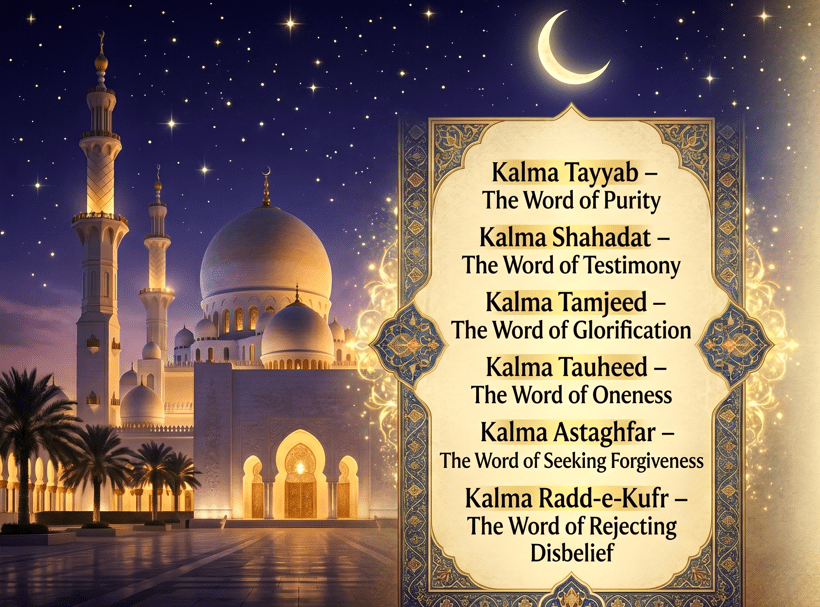
There are 6 Kalmas in Islam, each unique in its wording and purpose. They are:
- Kalma Tayyab – The Word of Purity
- Kalma Shahadat – The Word of Testimony
- Kalma Tamjeed – The Word of Glorification
- Kalma Tauheed – The Word of Oneness
- Kalma Astaghfar – The Word of Seeking Forgiveness
- Kalma Radd-e-Kufr – The Word of Rejecting Disbelief
It is worth noting that while all six are widely taught and memorized — especially in South Asian Islamic education — the first Kalma (Tayyab) and second Kalma (Shahadat) are the most universally recognized across all Muslim traditions worldwide.
1st Kalma Tayyab – Arabic, Transliteration, and Meaning
Arabic: لَا إِلٰهَ إِلَّا اللّٰهُ مُحَمَّدٌ رَّسُولُ اللّٰهِ
Transliteration: Laa ilaaha illal laahu Muhammadur Rasoolullaah
English Meaning: “There is no god but Allah, Muhammad is the Messenger of Allah.”
Explanation and Benefits of First Kalma Tayyab
The First Kalma Tayyab is the most well-known statement in all of Islam. It is the Shahada in its simplest form and the gateway into the Islamic faith. Anyone who sincerely recites this Kalma with belief in their heart enters the fold of Islam.
Spiritual Significance: The Kalma Tayyab consists of two parts:
- Laa ilaaha illallaah — Negating all false deities and affirming that Allah alone is worthy of worship.
- Muhammadur Rasoolullaah — Affirming that Muhammad ﷺ is the final Messenger of Allah.
Benefits of Reciting Kalma Tayyab:
- It is the key to paradise (Jannah). The Prophet ﷺ said: “Whoever says Laa ilaaha illallaah sincerely, with a truthful heart, will enter paradise.”
- Regular recitation purifies the soul and acts as a shield against evil.
- It carries immense weight on the Mizan (scales of deeds) on the Day of Judgment.
- Reciting it frequently is among the best forms of Dhikr.
This Kalma should be the first and last thing on a Muslim’s tongue — upon waking, before sleeping, and ideally as the final words of one’s life.
2nd Kalma Shahadat – Arabic, Transliteration, and Meaning
Arabic: أَشْهَدُ أَنْ لَّا إِلٰهَ إِلَّا اللّٰهُ وَحْدَهُ لَا شَرِيكَ لَهُ وَأَشْهَدُ أَنَّ مُحَمَّدًا عَبْدُهُ وَرَسُولُهُ
Transliteration: Ash-hadu al-laa ilaaha illal laahu wahdahoo laa shareeka lahoo wa ash-hadu anna Muhammadan ‘abduhoo wa rasooluh
English Meaning: “I bear witness that there is no god but Allah, alone, without any partner, and I bear witness that Muhammad is His servant and His Messenger.”
Explanation and Importance of Second Kalma Shahadat
The Second Kalma Shahadat (the Testimony) goes a step deeper than the first. It uses the personal voice — “I bear witness” — making it a conscious, individual declaration of faith.
Key Elements:
- Wahdahoo laa shareeka lah — Allah is alone, without any partner. This directly negates shirk.
- ‘Abduhoo wa rasooluh — Muhammad ﷺ is Allah’s servant AND messenger — affirming his humanity while honoring his prophethood.
Importance:
- The Kalma Shahadat is recited in the Adhan (call to prayer) and Iqamah five times a day, making it the most frequently heard Islamic declaration.
- It is part of the Tashahhud recited in every prayer (Salah).
- It reinforces the twin pillars of Islamic faith: Tawheed and Risalat.
- Reciting it after Wudu (ablution) opens the eight gates of paradise for that person, as mentioned in authentic hadith.
This Kalma is the verbal covenant between the believer and their Lord — a daily renewal of one’s commitment to Islam.
3rd Kalma Tamjeed – Arabic, Transliteration, and Meaning
Arabic: سُبْحَانَ اللّٰهِ وَالْحَمْدُ لِلّٰهِ وَلَا إِلٰهَ إِلَّا اللّٰهُ وَاللّٰهُ أَكْبَرُ وَلَا حَوْلَ وَلَا قُوَّةَ إِلَّا بِاللّٰهِ الْعَلِيِّ الْعَظِيمِ
Transliteration: Subhaanal laahi wal hamdu lillaahi wa laa ilaaha illal laahu wallaahu akbar. Wa laa hawla wa laa quwwata illaa billaahil ‘aliyyil ‘azeem
English Meaning: “Glory be to Allah, and praise be to Allah, and there is no god but Allah, and Allah is the Greatest. And there is no might and no power except with Allah, the Most High, the Most Great.”
Explanation and Benefits of Third Kalma Tamjeed
The Third Kalma Tamjeed (the Word of Glorification) is an exquisite collection of some of the most beloved phrases in Islamic devotion. It brings together four essential forms of remembrance:
- Subhanallah — Glory be to Allah (Tasbih)
- Alhamdulillah — All praise is for Allah (Tahmid)
- Laa ilaaha illallah — There is no god but Allah (Tahleel)
- Allahu Akbar — Allah is the Greatest (Takbeer)
These four phrases are collectively known as the Baaqiyaat-us-Saalihaat — the Enduring Good Deeds — and are described in hadith as the most beloved words to Allah.
Benefits:
- According to hadith, reciting Subhanallah, Alhamdulillah, Laa ilaaha illallah, Allahu Akbar is lighter on the tongue but heavier on the scales of deeds than anything else.
- The final phrase, Laa hawla wa laa quwwata illaa billaah, is a treasure from paradise and a cure for 99 ailments, with the least of them being grief and anxiety.
- Regular recitation cultivates gratitude, humility, and constant awareness of Allah’s greatness.
4th Kalma Tauheed – Arabic, Transliteration, and Meaning
Arabic: لَا إِلٰهَ إِلَّا اللّٰهُ وَحْدَهُ لَا شَرِيكَ لَهُ، لَهُ الْمُلْكُ وَلَهُ الْحَمْدُ يُحْيِيْ وَيُمِيتُ وَهُوَ حَيٌّ لَا يَمُوتُ أَبَدًا أَبَدًا، ذُو الْجَلَالِ وَالْإِكْرَامِ، بِيَدِهِ الْخَيْرُ وَهُوَ عَلَى كُلِّ شَيْءٍ قَدِيرٌ
Transliteration: Laa ilaaha illal laahu wahdahoo laa shareeka lah, lahul mulku wa lahul hamdu yuhyee wa yumeetu wa huwa hayyul laa yamootu abadan abada, dhul jalaali wal ikraam, biyadihil khayru wa huwa ‘alaa kulli shay’in qadeer
English Meaning: “There is no god but Allah, alone, without partner. His is the kingdom and His is the praise. He gives life and causes death, and He is Living and will never die, forever and ever. He is the Possessor of Majesty and Honor. In His hand is all goodness, and He is Powerful over all things.”
Explanation and Importance of Fourth Kalma Tauheed
The Fourth Kalma Tauheed (the Word of Oneness) is the most comprehensive of all the Kalmas. It is a profound theological declaration that covers the major divine attributes of Allah:
- His Absolute Sovereignty — Lahul mulku — all kingdoms belong to Him
- His Exclusive Praise — Lahul hamdu — all praise returns to Him alone
- His Power Over Life and Death — Yuhyee wa yumeetu
- His Eternal Living — Hayyul laa yamootu — He is the Ever-Living who does not die
- His Majesty and Honor — Dhul jalaali wal ikraam
- His Power Over All Things — ‘Alaa kulli shay’in qadeer
Benefits of Fourth Kalma:
- This Kalma powerfully reinforces the concept of Tawheed (Islamic monotheism) in the heart.
- Reciting it is among the best forms of Dhikr after obligatory prayers.
- It erases sins and earns tremendous reward.
- It reminds the believer that all power, control, and goodness belong only to Allah — a perspective that brings peace, contentment, and reliance (Tawakkul) upon Allah.
5th Kalma Astaghfar – Arabic, Transliteration, and Meaning
Arabic: أَسْتَغْفِرُ اللّٰهَ رَبِّيْ مِنْ كُلِّ ذَنْبٍ أَذْنَبْتُهُ عَمَدًا أَوْ خَطَأً سِرًّا أَوْ عَلَانِيَةً وَأَتُوبُ إِلَيْهِ مِنَ الذَّنْبِ الَّذِيْ أَعْلَمُ وَمِنَ الذَّنْبِ الَّذِيْ لَا أَعْلَمُ إِنَّكَ أَنْتَ عَلَّامُ الْغُيُوبِ وَسَتَّارُ الْعُيُوبِ وَغَفَّارُ الذُّنُوبِ وَلَا حَوْلَ وَلَا قُوَّةَ إِلَّا بِاللّٰهِ الْعَلِيِّ الْعَظِيمِ
Transliteration: Astaghfirul laaha rabbee min kulli zambin aznabtuhoo ‘amadan aw khata’an sirran aw ‘alaaniyatan wa atoobu ilayhi minadh dhambilladhee a’lamu wa minadh dhambilladhee laa a’lam, innaka anta ‘allaamul ghuyoobi wa sattaaral ‘uyoobi wa ghaffaarudh dhunoob, wa laa hawla wa laa quwwata illaa billaahil ‘aliyyil ‘azeem
English Meaning: “I seek forgiveness from Allah, my Lord, for every sin I have committed intentionally or by mistake, secretly or openly, and I repent to Him for the sin that I know and the sin that I do not know. Indeed, You are the Knower of all hidden things, the Concealer of faults, and the Forgiver of sins. And there is no might and no power except with Allah, the Most High, the Most Great.”
Explanation and Benefits of Fifth Kalima Astaghfar
The Fifth Kalma Astaghfar (the Word of Seeking Forgiveness) is unique among the Kalmas — it is the only one framed entirely as a personal prayer of repentance. It acknowledges human weakness and imperfection with stunning completeness.
Key Themes:
- Forgiveness for intentional and unintentional sins
- Forgiveness for secret and open sins
- Forgiveness for known and unknown sins
This comprehensive coverage reflects deep Islamic theology: a human being is not always aware of their wrongdoings, and this Kalma seeks Allah’s forgiveness for all of them.
Three Beautiful Divine Names are invoked:
- ‘Allaamul Ghuyoob — Knower of all hidden things (Allah knows even what we have forgotten)
- Sattaaral ‘Uyoob — Concealer of faults (Allah covers our shortcomings from others)
- Ghaffaarudh Dhunoob — Forgiver of sins (Allah erases our transgressions)
Benefits:
- Istighfar (seeking forgiveness) is one of the most beloved acts to Allah.
- The Prophet ﷺ himself sought forgiveness from Allah more than 70 times a day.
- Regular recitation cleanses the soul, lifts spiritual burdens, and opens doors of mercy and provision.
- It cultivates humility and a deep sense of reliance on Allah’s grace.
6th Kalima Radd-e-Kufr – Arabic, Transliteration, and Meaning
Arabic: اَللّٰهُمَّ إِنِّيْ أَعُوذُ بِكَ مِنْ أَنْ أُشْرِكَ بِكَ شَيْئًا وَأَنَا أَعْلَمُ بِهِ وَأَسْتَغْفِرُكَ لِمَا لَا أَعْلَمُ بِهِ تُبْتُ عَنْهُ وَتَبَرَّأْتُ مِنَ الْكُفْرِ وَالشِّرْكِ وَالْكِذْبِ وَالْغِيبَةِ وَالْبِدْعَةِ وَالنَّمِيمَةِ وَالْفَوَاحِشِ وَالْبُهْتَانِ وَالْمَعَاصِيْ كُلِّهَا وَأَسْلَمْتُ وَأَقُولُ لَا إِلٰهَ إِلَّا اللّٰهُ مُحَمَّدٌ رَّسُولُ اللّٰهِ
Transliteration: Allaahumma innee a’oodhu bika min an ushrika bika shay’an wa ana a’lamu bih, wa astaghfiruka limaa laa a’lamu bih, tubtu ‘anhu wa tabarraatu minal kufri wash shirki wal kidhbi wal gheebati wal bid’ati wan nameemati wal fawaahishi wal buhtaani wal ma’aasee kullihaa, wa aslamtu wa aqoolu laa ilaaha illal laahu muhammadur rasoolullaah
English Meaning: “O Allah! I seek refuge in You from knowingly associating any partner with You, and I seek Your forgiveness for what I do not know of. I repent from it and I free myself from disbelief, polytheism, lying, backbiting, innovation (in religion), tale-carrying, obscenity, false accusation, and all acts of disobedience. I submit to Islam and I declare: There is no god but Allah, Muhammad is the Messenger of Allah.”
Explanation and Importance of Sixth Kalima Radd-e-Kufr
The Sixth Kalma Radd-e-Kufr (the Word of Rejecting Disbelief) is the most comprehensive and morally rich of all the Kalmas. It is both a prayer for protection and a public declaration of what a Muslim renounces.
Structure:
- Seeking refuge from shirk — even unknowing shirk
- Seeking forgiveness for unknown sins
- Explicit rejection of specific moral and spiritual wrongs:
- Kufr — disbelief
- Shirk — associating partners with Allah
- Kidhb — lying
- Gheebah — backbiting
- Bid’ah — unlawful innovations in religion
- Nameemah — tale-carrying/slander
- Fawahish — indecency/obscenity
- Buhtan — false accusation
- Ma’asi — all acts of disobedience
- Affirmation of Islam and the first Kalma
Importance:
- This Kalma is a spiritual contract. By reciting it sincerely, a Muslim verbally commits to leaving not just disbelief, but a whole range of social and spiritual evils.
- It is deeply character-building — each named vice (backbiting, lying, slander) is one the believer pledges to abandon.
- The Kalma ends powerfully with the first Kalma Tayyab, completing the circle from declaration of faith to rejection of everything contrary to it.
6 Kalimas in English Translation
| # | Name | English Meaning (Summary) |
| 1 | Kalma Tayyab | There is no god but Allah, Muhammad is His Messenger |
| 2 | Kalma Shahadat | I personally testify to Allah’s oneness and Muhammad’s prophethood |
| 3 | Kalma Tamjeed | Glory, praise, and greatness belong to Allah alone |
| 4 | Kalma Tauheed | Allah alone has all sovereignty, life, death, and power |
| 5 | Kalma Astaghfar | I seek Allah’s forgiveness for all known and unknown sins |
| 6 | Kalma Radd-e-Kufr | I reject disbelief and all evil and submit to Islam |
6 Kalimas in Hindi and Urdu
For Muslim communities in South Asia — Pakistan, India, Bangladesh — reciting the Kalmas in one’s native language alongside Arabic greatly helps understanding and memorization.
Urdu transliterations use the same Arabic Kalma text but are often taught phonetically in Urdu script (اردو), making them accessible even for young children who have not yet mastered Arabic script.
Hindi-speaking Muslims likewise learn the Arabic Kalmas through Devanagari-based phonetic guides, which are widely available in Islamic educational centers (madrasas) and Islamic apps across India.
The six Kalmas carry the same spiritual power regardless of the phonetic guide used for learning — what matters is understanding the meaning and reciting the Arabic correctly.
How to Memorize the 6 Kalimas Easily (Step-by-Step Guide)
Memorizing the 6 Kalmas does not need to be overwhelming. Follow this structured approach:
Step 1: Start with the First Kalma The Kalma Tayyab is just one short line. Learn it first and practice it throughout the day — morning, evening, and before sleep.
Step 2: Learn the Meaning Alongside the Arabic Don’t just memorize sounds. Understand what each word means. This dramatically improves retention and makes the Kalma alive in your heart, not just your memory.
Step 3: Use Repetition in Short Sessions Practice each Kalma for 5–10 minutes, three times a day. Short, frequent sessions outperform long single sessions.
Step 4: Recite Aloud Say the Kalmas out loud — speaking activates more memory pathways than reading silently. Listen to audio recordings to perfect pronunciation.
Step 5: Learn One Kalma Per Week Progress gradually. Spend a full week on each Kalma before moving to the next. This gives time for deep embedding, not just surface recall.
Step 6: Write It Out Writing Arabic by hand (or using transliteration) reinforces memory through muscle memory. Even non-Arabic speakers benefit from writing practice.
Step 7: Use Flashcards or Islamic Apps Apps like Muslim Pro, Quran Companion, or simple flashcard apps let you test yourself anywhere, anytime.
Step 8: Teach Someone Else Teaching the Kalmas to a child, sibling, or friend is one of the most powerful ways to cement your own memorization.
6 Kalimas for Kids and Beginners
For children learning the Kalmas, the key principles are patience, play, and positive reinforcement.
Tips for Teaching Kids:
- Begin with the First Kalma Tayyab — it is the shortest and most musical, making it ideal for young learners.
- Use a sing-song rhythm or gentle repetition to make the words stick.
- Show them the meaning through simple storytelling: “This Kalma tells us that only Allah is our God and Prophet Muhammad ﷺ is His Messenger — like a special message from Allah.”
- Use colorful Islamic workbooks and Kalma charts displayed in the home.
- Reward and praise every milestone — creating a positive association with Islamic learning.
- Practice as a family during car rides, after prayers, or at bedtime.
For complete beginners of any age, start with the first two Kalmas and internalize their meaning before moving forward. Quality of understanding matters far more than speed of completion.
Benefits (Fazilat) of Reciting 6 Kalimas Daily
The spiritual rewards of reciting the Kalmas are immense, as indicated in authentic hadith and Islamic scholarship:
Kalma Tayyab: The Prophet ﷺ said it is the best of all speech. It is the most virtuous form of Dhikr and the key to paradise.
Kalma Shahadat: Reciting it after ablution opens the eight gates of paradise, as narrated in Sahih Muslim.
Kalma Tamjeed (Baaqiyaat-us-Saalihaat): The Prophet ﷺ described Subhanallah, Alhamdulillah, Laa ilaaha illallah, and Allahu Akbar as the phrases most beloved to Allah and heaviest on the scale of deeds.
Kalma Tauheed: It contains the most comprehensive affirmation of divine sovereignty and is deeply rewarded as a form of Dhikr after prayers.
Kalma Astaghfar: Istighfar opens the mercy and provision of Allah, relieves distress, and cleanses the record of sins. “If anyone constantly seeks pardon (from Allah), Allah will appoint for him a way out of every distress.” (Abu Dawud)
Kalma Radd-e-Kufr: It serves as a spiritual shield — a formal renunciation of every form of disbelief and moral corruption, and a renewal of one’s Islamic covenant.
Collectively, incorporating all six Kalmas into your daily routine enriches your spiritual life, purifies your character, and keeps you constantly anchored to the core truths of Islam.
When and How to Recite Kalimas in Daily Life
The beauty of the Kalmas is that they require no special occasion. Here are natural moments to incorporate them:
- Morning and evening: Recite Kalma Tayyab and Tauheed as part of morning and evening Adhkar (remembrance routines).
- After Salah: Recite Kalma Tamjeed and Tauheed following obligatory prayers as Dhikr.
- When seeking forgiveness: Recite Kalma Astaghfar throughout the day, especially after any moment of weakness or wrongdoing.
- Before sleep: The Prophet ﷺ emphasized remembering Allah before sleep. Kalma Tayyab is ideal.
- During hardship: Kalma Astaghfar and “Laa hawla wa laa quwwata illaa billaah” (part of Kalma Tamjeed) are particularly comforting during stress, anxiety, or difficulty.
- When entering and leaving home or mosque: Kalma Tayyab is appropriate as a brief Dhikr.
- Teaching children: Make Kalma practice part of the bedtime or pre-meal routine.
Difference Between Kalima and Shahada
Many people use the terms Kalma and Shahada interchangeably, but there is a subtle distinction:
Shahada refers specifically to the declaration of faith: “Laa ilaaha illallaah, Muhammadur Rasoolullaah” — the twin testimony that is the first pillar of Islam. Pronouncing the Shahada is what makes someone a Muslim.
Kalma is a broader term that encompasses all six declarations of faith. The First Kalma Tayyab and Second Kalma Shahadat are essentially elaborated forms of the Shahada, while Kalmas 3 through 6 address glorification, oneness, repentance, and rejection of disbelief.
In short: the Shahada is contained within the Kalmas — specifically the first and second — while the six Kalmas together form a more comprehensive spiritual system.
Are 6 Kalimas Mentioned in the Quran or Hadith?
This is a question many sincere Muslims ask. The answer deserves nuance:
The phrases within the Kalmas are absolutely from the Quran and authentic Hadith. For example:
- Laa ilaaha illallaah appears in multiple Quranic verses (e.g., Surah Muhammad 47:19)
- Subhanallah, Alhamdulillah, Allahu Akbar are richly attested in both Quran and Sunnah
- Laa hawla wa laa quwwata illaa billaah is confirmed as a Prophetic teaching
- Istighfar is strongly emphasized throughout both Quran and Hadith
The compilation of exactly these six Kalmas in this particular numbered sequence is a pedagogical tradition developed by Islamic scholars — especially prevalent in South Asian Islamic education. It serves as an organized framework for teaching the foundational beliefs and declarations of Islam to new Muslims and children.
This compilation is not a religious innovation (bid’ah) in the forbidden sense — it is a teaching method using fully authentic Quranic and prophetic content. Its widespread acceptance and use across centuries of Islamic scholarship testifies to its value and legitimacy.
Common Mistakes While Reading Kalimas
Even well-intentioned Muslims sometimes make errors when reciting the Kalmas. Being aware of these helps:
Mispronunciation of Arabic letters: Arabic contains sounds not found in Urdu, Hindi, or English — such as ‘ain (ع), ghain (غ), qaf (ق), and kha (خ). Mispronouncing these can alter the meaning.
Rushing through recitation: Reciting quickly without focus (khushu) reduces the spiritual benefit. Recite slowly and with presence of mind.
Memorizing without understanding: Many people memorize Kalmas phonetically without knowing what they mean. This disconnects the heart from the tongue.
Incorrect pronunciation of “Allah”: The name Allah (اللّٰه) has a specific pronunciation with a slightly heavy lam (ل) when preceded by a fatha or damma. This should be learned from a qualified teacher.
Omitting key phrases: In longer Kalmas (especially the 5th and 6th), it is common for learners to skip phrases through habit. Regular review against the full text prevents this.
Reciting as a ritual without sincerity: The Kalmas are most powerful when accompanied by genuine belief and understanding (yaqeen). The tongue and heart should work together.
Frequently Asked Questions About 6 Kalimas
Q: Are the 6 Kalmas compulsory (fard) in Islam?
A: Reciting the first Kalma (Tayyab/Shahada) is essential to enter Islam and is considered fard in that sense. The remaining Kalmas are highly recommended acts of worship (mustahabb) that carry immense reward but are not obligatory in the same way.
Q: Which Kalma should I recite if I am converting to Islam?
A: The First Kalma Tayyab (or Shahada) is what someone recites to embrace Islam. It must be said with sincere belief and conviction.
Q: Can I recite the Kalmas at any time?
A: Yes. The Kalmas can be recited at any time of day or night. There is no restriction, though reciting them during the morning, evening, and after prayers is particularly rewarding.
Q: What is the difference between Kalma Tayyab and Kalma Shahadat?
A: Kalma Tayyab is a third-person declaration (“There is no god but Allah”). Kalma Shahadat uses first-person (“I bear witness”), making it a more personal and formal testimony of faith.
Q: Is Kalma Astaghfar the same as regular Istighfar?
A: The phrase Astaghfirullah (I seek forgiveness from Allah) is the simplest form of Istighfar. The 5th Kalma Astaghfar is an extended, comprehensive version that covers all categories of sins.
Q: Can children memorize all 6 Kalmas?
A: Absolutely. With patience and the right approach, children as young as 4–5 years can begin learning the first Kalma, and by age 7–10, many children have memorized all six.
Q: Do I need a scholar to learn the Kalmas?
A: While personal learning is possible, having a qualified teacher (Ustadh) or at minimum a knowledgeable parent or elder check your pronunciation is strongly recommended, especially for Arabic letters.
namaz related post–
| Namaz Rakat Guide Table |
| fajr namaz rakat |
| zohar namaz rakat |
| asr namaz rakat |
| maghrib namaz rakat |
| isha namz rakat |
| practicaly method namaz |
| witr namaz |
| sunnat namaz |
| jumma namaz rakat |
| nafl namaz |
Conclusion – Importance of Learning All 6 Kalimas
The 6 Kalmas represent the heart of Islamic belief — distilled into six powerful declarations that any Muslim can carry with them always. From the fundamental testimony of faith in Kalma Tayyab to the comprehensive rejection of moral and spiritual corruption in Kalma Radd-e-Kufr, each Kalma adds a distinct layer to a Muslim’s understanding of their relationship with Allah and their responsibilities as a believer.
Learning the 6 Kalmas is not a destination — it is a beginning. When you move beyond mere memorization and begin to truly understand and internalize what you are saying, these words transform from syllables into living faith.
Make the Kalmas a part of your daily life. Teach them to your children. Recite them in your moments of gratitude and in your moments of struggle. Let them be among the last words on your tongue and the first thing your heart reaches for when the world feels uncertain.
Because ultimately, Laa ilaaha illallaah — there is no god but Allah — is not just a statement. It is the foundation upon which an entire life of peace, purpose, and devotion is built.
May Allah grant us all the tawfiq to recite, understand, and live by the 6 Kalmas. Ameen.