
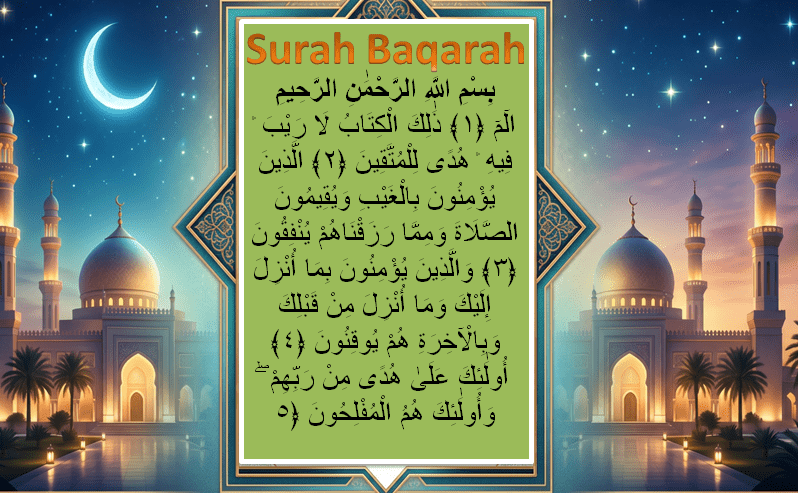
Surah Baqarah is the Quran’s longest chapter, providing a complete guide to faith, law, and morality. This article offers the full Arabic text, English translation, and MP3 audio, alongside the profound virtues of Ayat-ul-Kursi. Explore its historical context, key stories like Prophet Adam (AS) and Bani Israel, and practical lessons on Islamic law and spiritual protection to enrich your daily life.
Surah Al-Baqarah Reader & Audio
Select an Ayah number to read and listen
Please select an Ayah number to view text and listen to recitation.
Surah Baqarah Audio Recitation (MP3) and download
What Is Surah Baqarah?
Surah Baqarah is the second chapter (surah) of the Holy Quran and is the longest surah in the entire Book of Allah. It contains 286 verses (ayahs), making it a comprehensive and expansive chapter that addresses nearly every dimension of a Muslim’s life — from theology and worship to law, history, and personal conduct.
The word “Surah” means “chapter” in Arabic, and “Baqarah” translates to “the cow.” Despite this name, the surah is not primarily about cows; rather, it references a pivotal event involving Bani Israel (the Children of Israel) that serves as a powerful lesson in obedience and faith.
Meaning of “Al-Baqarah” (The Cow)
The name Al-Baqarah is derived from a well-known story mentioned in verses 67–73 of the surah, in which Allah commanded the Bani Israel to slaughter a specific cow as an act of obedience. The Bani Israel repeatedly questioned the command, asking for further specifications rather than immediately obeying. This story carries a profound lesson — over-questioning divine commands and seeking excuses reflects weak faith and causes unnecessary hardship.
Although the surah is named after this story, the cow narrative occupies only a small portion of the overall chapter. The title serves as a symbolic reminder of the importance of swift and complete submission to the will of Allah.
Position in the Qur’an
Surah Baqarah holds the second position in the Quran, appearing immediately after Surah Al-Fatiha (the Opening). It is classified as a Madani surah, meaning it was revealed in Madinah after the Hijra (the Prophet’s migration from Makkah to Madinah). Positioned right at the beginning of the Quran after the opening surah, it sets the foundational framework for Islamic belief, worship, and way of life.
Why This Surah Is Important
The importance of Surah Baqarah cannot be overstated. It is the longest surah in the Quran, packed with guidance on almost every aspect of a Muslim’s life. The Prophet Muhammad (peace be upon him) described it as a light and declared that its recitation drives away evil and grants blessings.
Among its many treasures is Ayat-ul-Kursi (verse 255), described in hadith as the greatest verse in the Quran. The surah also includes foundational Islamic laws on prayer, fasting, charity, marriage, business ethics, and much more. For a Muslim who truly wants to live by the Quran, Surah Baqarah is an essential starting point.
Revelation and Historical Background
Makki or Madani Surah?
Surah Baqarah is a Madani surah, meaning it was revealed in Madinah after the migration (Hijra) of Prophet Muhammad (peace be upon him) in 622 CE. The revelations of this surah did not come all at once; rather, they were revealed in stages over a number of years following the Hijra, making it one of the earliest and most foundational Madani surahs.
The Madani surahs are generally characterized by longer verses, more detailed legal rulings, and greater emphasis on community guidance — all of which are prominently featured in Surah Baqarah.
Historical Context of Revelation
When the Prophet Muhammad (peace be upon him) migrated to Madinah, he was entering a society that was vastly different from Makkah. Madinah had a significant Jewish population (Bani Israel), Arab tribes with varying loyalties, and a growing Muslim community. The early Muslims needed comprehensive guidance on how to live in this complex social environment, how to interact with non-Muslims, and how to establish an Islamic society.
Surah Baqarah was revealed progressively to address these realities. It provided rulings on personal, social, legal, and spiritual matters. It also specifically addressed the Bani Israel to remind them of the covenant they had made with Allah and the many blessings He had bestowed upon their ancestors.
Role in Early Islamic Society
Surah Baqarah played a central role in shaping early Islamic society. Its verses established the direction of prayer (Qiblah) from Jerusalem to the Kaaba in Makkah (verse 144). It laid down the laws of fasting during Ramadan (verses 183–187), commanded the prohibition of interest-based transactions (verses 275–281), and outlined rules for marriage, divorce, and financial dealings.
The surah also introduced the concept of the Muslim Ummah as a “middle community” (ummatan wasatan) — a balanced, just, and moderate people who would serve as witnesses over mankind (verse 143). These foundational teachings helped transform a diverse group of believers into a cohesive, law-abiding Islamic community.
Transliteration for Non-Arabic Readers
For Muslims who are still learning to read Arabic, transliterations of key parts of Surah Baqarah — especially Ayat-ul-Kursi and the last two verses (Al-Baqarah 285–286) — are widely available. For example, Bismillah-ir-Rahman-ir-Raheem begins the surah, meaning “In the name of Allah, the Most Gracious, the Most Merciful.”
Using transliteration as a stepping stone is perfectly acceptable for those still memorizing Arabic letters and pronunciation. However, scholars universally encourage learners to prioritize learning to read Arabic script, as recitation in the original language carries far greater reward and spiritual depth.
How to Understand While Reading
Understanding Surah Baqarah while reading it requires both translation and tafsir (exegesis). Reading a word-by-word translation helps basic comprehension, while consulting a reputable tafsir — such as Tafsir Ibn Kathir, Tafsir Al-Jalalayn, or Maariful Quran — provides the historical context, linguistic depth, and scholarly insight needed for a richer understanding.
Many apps and online platforms now offer side-by-side Arabic text with translation, making it easier than ever to read, understand, and reflect upon Surah Baqarah during recitation.
Structure and Composition
Total Ayahs, Rukus, and Length
Surah Baqarah consists of 286 ayahs (verses), divided into 40 rukus (sections used for structuring recitation, especially in tarawih prayers). It is the longest surah in the Quran, comprising approximately one-twelfth of the entire Quran in terms of length.
Reading the entire surah at a moderate pace typically takes between 2 to 2.5 hours. In terms of written text, it spans multiple juz (parts of the Quran) — beginning in Juz 1 and extending through Juz 2 and into the beginning of Juz 3.
How the Surah Is Organized
While Surah Baqarah may appear to be a collection of diverse topics, scholars of Quranic sciences identify a sophisticated internal structure and coherence. The surah can be broadly divided into the following segments:
- Opening (1–20): Description of believers, disbelievers, and hypocrites
- Address to Bani Israel (40–123): History, covenant, and failures of the Children of Israel
- Core Islamic Laws (124–242): Prayer, fasting, Hajj, charity, marriage, finance
- Stories of Prophets (243–253): Talut, Jalut, Dawud, Ibrahim
- Conclusion (254–286): Ayat-ul-Kursi, prohibition of Riba, and the final supplication
Key Sections and Flow
The surah opens with the famous Alif Lam Mim (verses 1–5), describing the character of the believers. It then distinguishes between the disbelievers (verses 6–7) and the hypocrites (verses 8–20). A significant portion of the middle section addresses the Bani Israel and their history (verses 40–123). The latter portion transitions into Islamic laws covering prayer, fasting, pilgrimage, charity, marriage, divorce, and business ethics. The surah concludes magnificently with Ayat-ul-Kursi (verse 255) and the last two ayahs (verses 285–286), which form a beautiful du’a (supplication) on behalf of all believers.
Core Themes of Surah Baqarah
Faith (Iman) and Guidance
The very opening of Surah Baqarah declares that it is a guide (huda) for the muttaqeen — those who are conscious of Allah and mindful of their duties to Him. Faith (Iman) in the unseen, in the Quran, in divine revelation, in the Hereafter, and in Allah’s complete authority is the cornerstone theme that runs throughout the entire surah.
The surah presents guidance not as a set of arbitrary rules, but as a comprehensive system designed by the Creator for the wellbeing of humanity — spiritually, socially, legally, and morally.
Believers, Disbelievers, and Hypocrites
One of the unique features of Surah Baqarah’s opening section is its classification of humanity into three categories: the believers (mumineen), who embrace faith wholeheartedly; the disbelievers (kafireen), whose hearts are sealed against guidance; and the hypocrites (munafiqeen), who outwardly claim faith while inwardly rejecting it.
The longest and most detailed description is reserved for the hypocrites (verses 8–20), reflecting the serious danger that hypocrisy poses to both the individual and the Muslim community. This classification remains highly relevant for Muslims today in examining the sincerity of their own faith.
Tests, Patience, and Obedience
Surah Baqarah repeatedly emphasizes that believers will face trials and tests. Verse 155 states that Allah will test His servants with fear, hunger, loss of wealth, lives, and fruits — and that those who remain patient will receive glad tidings. The stories of Prophet Adam, Bani Israel, and Prophet Ibrahim all illustrate this theme of being tested and the virtue of patient obedience.
The surah teaches that hardship is not a sign of divine abandonment but rather a divine examination that elevates the believer’s rank when faced with patience and gratitude.
Divine Laws and Lifestyle Guidance
A large portion of Surah Baqarah is dedicated to Islamic law (Shariah). It covers prayer, fasting, Hajj, charity, financial transactions, marriage, divorce, breastfeeding, waiting periods for divorced women, and the prohibition of interest. These laws were not merely theoretical — they were the practical framework for building an Islamic civilization in Madinah.
For contemporary Muslims, these laws remain as relevant and binding as they were 1,400 years ago, making Surah Baqarah an ongoing legal reference alongside its spiritual guidance.
Tajweed and Correct Pronunciation
Proper recitation of Surah Baqarah, as with all Quranic recitation, requires learning Tajweed — the set of rules governing correct pronunciation, elongation (madd), nasalization (ghunnah), stops (waqf), and other phonetic aspects of Quranic recitation. Surah Baqarah contains several challenging pronunciations and words that benefit greatly from Tajweed study.
Enrolling in a Tajweed class, using Quran learning apps with audio guides, or following a qualified teacher’s recitation are among the best ways to learn the proper pronunciation of Surah Baqarah.
Major Stories in Surah Baqarah
Story of Prophet Adam (AS)
The story of Prophet Adam (peace be upon him) is one of the first major narratives in Surah Baqarah (verses 30–39). Allah announces to the angels His intention to create a vicegerent (khalifah) on earth. The angels question this wisdom, but Allah teaches Adam the names of all things — demonstrating humanity’s unique capacity for knowledge and stewardship.
The story continues with Iblis (Shaytan) refusing to bow to Adam out of arrogance, and Adam and his wife eventually being misled into eating from the forbidden tree. The story concludes with Allah’s forgiveness upon Adam’s sincere repentance and his descent to earth, with the promise that divine guidance would be sent to humanity.
Story of Bani Israel
The account of Bani Israel occupies a substantial portion of Surah Baqarah (roughly verses 40–123). Allah reminds the Children of Israel of the countless blessings He bestowed upon them — how He saved them from Pharaoh, parted the sea for them, provided them with manna and quails in the desert, and sent them prophets.
Yet despite these blessings, Bani Israel repeatedly disobeyed, broke their covenant with Allah, worshipped the golden calf, and rejected and even killed their prophets. Their story serves as a powerful cautionary tale for all Muslims: blessings must be met with gratitude and obedience, not ingratitude and rebellion.
Story of the Cow
The story that gives the surah its name appears in verses 67–73. Allah commanded Bani Israel to slaughter a cow, but instead of obeying immediately, they asked question after question — What color should it be? What age? What work should it have done? — each question making the command harder to fulfill.
Eventually, when they reluctantly slaughtered the specific cow they had identified, they struck a dead man with a piece of it and he was miraculously revived. This story teaches that excessive questioning and over-complication of divine commands leads to hardship, while simple and sincere obedience is the path of the believer.
Story of Talut and Jalut
Another compelling narrative in Surah Baqarah (verses 246–252) is the story of Talut (Saul) and Jalut (Goliath). The Bani Israel requested a king to lead them in battle against their enemies. When Allah appointed Talut as king, many rejected him because he was not wealthy. However, Allah chose him for his physical strength and knowledge.
The story culminates with the young Prophet Dawud (David, peace be upon him) defeating the powerful Jalut against all odds — a timeless reminder that victory comes from Allah, not from material strength or numbers. The verse concludes: “How many small groups have overcome large groups by the permission of Allah.”
Important Ayahs and Their Significance
Ayat-ul-Kursi (Ayah 255)
Ayat-ul-Kursi is verse 255 of Surah Baqarah and is arguably the most famous and most virtuous single verse in the entire Quran. The Prophet Muhammad (peace be upon him) explicitly declared it the greatest verse of the Quran. The verse describes Allah’s infinite sovereignty, His eternal existence (Al-Hayy Al-Qayyum — the Ever-Living, the Self-Subsisting), and His complete dominion over all creation.
Reciting Ayat-ul-Kursi after every obligatory prayer is reported to guarantee entry into Paradise. Reciting it before sleeping is described as ensuring divine protection throughout the night. It is a short but extraordinarily powerful verse that every Muslim should memorize and recite daily.
Last Two Ayahs (285–286)
The final two verses of Surah Baqarah (285–286) are described in a hadith of the Prophet (peace be upon him) as a special gift given exclusively to this Ummah on the Night of Ascension (Isra wal Miraj). The Prophet stated that whoever recites these two verses at night will be sufficed (protected and taken care of) for that night.
Verse 285 affirms the believers’ faith in Allah, His angels, His books, and His messengers. Verse 286 contains one of the most beautiful supplications in the Quran: “Our Lord, do not burden us beyond what we can bear. Pardon us, forgive us, and have mercy on us.” This du’a remains a source of deep comfort for Muslims in times of difficulty.
Other Key Verses
Beyond Ayat-ul-Kursi and the last two verses, several other ayahs in Surah Baqarah carry immense significance:
- Verse 2:45 — Instructs believers to seek help through patience and prayer
- Verse 2:152 — Commands remembrance of Allah (dhikr): “Remember Me and I will remember you”
- Verse 2:177 — Defines true righteousness (birr) in a beautifully comprehensive manner
- Verse 2:286 — Affirms that “Allah does not burden a soul beyond that it can bear” — one of the most comforting affirmations in all of scripture
Islamic Laws in Surah Baqarah
Prayer (Salah) and Charity (Zakat)
Salah (prayer) and Zakat (obligatory charity) are repeatedly mentioned together in Surah Baqarah, emphasizing their joint importance in a Muslim’s life. Verse 2:43 commands believers to “establish prayer and give zakat and bow with those who bow.” The surah emphasizes that prayer must be consistent and on time, while Zakat is presented as a purifier of wealth and a means of social justice.
The surah also distinguishes between Zakat (obligatory) and Sadaqah (voluntary charity), encouraging Muslims to give generously without showing off or following their charity with harm or reminders of the gift.
Fasting (Ramadan Rules)
Verses 183–187 of Surah Baqarah contain the primary Quranic legislation on fasting during the month of Ramadan. Fasting is declared obligatory upon all believers (verse 183), with the purpose of achieving taqwa (God-consciousness). Exemptions are provided for the ill and the traveller, who must make up missed fasts later. Verse 185 also establishes that Ramadan is the month in which the Quran was revealed.
Verse 187 introduces the permissibility of eating, drinking, and intimacy during the nights of Ramadan until the Fajr (dawn) prayer, and introduces the concept of I’tikaf (spiritual retreat in the mosque) during the last ten nights of Ramadan.
Marriage, Divorce, and Family Laws
Surah Baqarah contains extensive legislation on family life. Verses 221–242 address prohibitions on marrying polytheists, the concept of divorce (talaq) and its conditions, the waiting period (iddah) for divorced women, rulings on breastfeeding, and the rights and responsibilities of divorced mothers and fathers.
These laws establish a framework of dignity, rights, and responsibility for all parties in a marriage — ensuring that both husband and wife are treated with fairness and justice even in the event of separation. The Quranic directive that divorce should be “retained in kindness or released with grace” (verse 229) remains a guiding principle of Islamic family law.
Business Ethics and Riba (Interest)
The prohibition of Riba (usury or interest) is one of the most emphatic rulings in Surah Baqarah. Verses 275–281 declare that those who deal in Riba are at war with Allah and His Messenger — extraordinarily severe language reserved for very few sins in the Quran. Riba refers to any unjust increase in a loan or financial transaction beyond its actual value.
The surah also commands the proper documentation of financial transactions (verse 282), the presence of witnesses, and the importance of honoring debts. These rulings form the foundation of Islamic finance, which today represents a global industry worth trillions of dollars.
Benefits and Virtues of Recitation
Protection from Shaytan
One of the most well-known virtues of Surah Baqarah is its power to repel Shaytan (the devil). The Prophet Muhammad (peace be upon him) said: “Do not make your homes like graves; verily Shaytan does not enter a house in which Surah Baqarah is recited.” (Sahih Muslim)
A home where Surah Baqarah is regularly recited becomes a spiritually fortified environment, protected from the whispers and influence of Shaytan. This is why many scholars and families make it a practice to complete the recitation of Surah Baqarah at least once every three days in their homes.
Spiritual and Mental Benefits
Beyond its protective benefits, regular recitation of Surah Baqarah brings profound spiritual elevation and peace of mind. Engaging with its meanings and reflecting on its verses strengthens Iman, clarifies one’s purpose, and provides answers to life’s deepest questions — Who am I? Why am I here? How should I live? What happens after death?
Many Muslims report that consistent engagement with Surah Baqarah — even listening to its recitation — provides a sense of calm, clarity, and reconnection with Allah during times of anxiety, grief, or confusion.
Blessings in Home and Life
The presence of Surah Baqarah’s recitation in a home is associated with barakah (divine blessings) in multiple dimensions of life — in sustenance (rizq), in family relationships, in health, and in overall wellbeing. The prophetic tradition strongly encourages making the home a place of Quran recitation, with Surah Baqarah holding special status.
Reciting Surah Baqarah at the beginning of a journey, before a significant endeavor, or during times of hardship is also a widely practiced sunnah-inspired tradition among Muslims globally.
Hadith About Surah Baqarah
Several authentic hadiths speak to the extraordinary virtues of Surah Baqarah:
- The Prophet (peace be upon him) said: “Learn Surah Baqarah, for taking recourse to it is a blessing and giving it up is a cause of grief, and the magicians cannot confront it.” (Sahih Muslim)
- The Prophet described Surah Baqarah and Surah Al-Imran as the “two bright lights” that will come on the Day of Judgement arguing for their companions — interceding on behalf of those who recited them regularly.
- Whoever recites Ayat-ul-Kursi after every obligatory prayer, nothing prevents him from entering Paradise except death. (Al-Nasa’i)
How to Recite Surah Baqarah
Best Time to Recite
There is no single specified time for the recitation of Surah Baqarah, but scholars recommend reciting it in the home regularly to benefit from its protective and spiritual properties. Reciting it during the night — particularly in the late night prayers (Tahajjud) or after Isha — is considered especially virtuous.
For those who recite the Quran daily, incorporating portions of Surah Baqarah into each session ensures regular engagement with it. During Ramadan, completing Surah Baqarah is a common goal during Tarawih prayers, as it is often the surah through which Imams lead the congregation.
Can It Be Read in Parts?
Yes, Surah Baqarah can absolutely be read in parts across multiple sessions. There is no Islamic ruling that requires it to be completed in a single sitting. Given its length — 286 verses — most people recite it over multiple sessions, dividing it by ruku (section), by juz (part), or by a set number of pages per day.
What matters most is consistent engagement and sincere reflection. Even reciting a few verses of Surah Baqarah daily — with understanding and presence of heart — is far more beneficial than rushing through the entire surah without comprehension.
Listening vs Reading
Both listening to and reading Surah Baqarah carry tremendous reward. Listening to its recitation by a qualified and melodious reciter — such as Sheikh Mishary Rashid Alafasy, Sheikh Abdurrahman As-Sudais, or Sheikh Mahmoud Khalil Al-Husary — is a deeply moving spiritual experience. The Prophet Muhammad (peace be upon him) is reported to have loved to hear the Quran recited by others.
However, actively reading and reciting the Quran yourself carries its own special reward. The Prophet (peace be upon him) said: “Whoever reads a letter from the Book of Allah, he will receive one hasanah (reward) and the hasanah is multiplied by ten.” This reward applies to every single letter of Surah Baqarah’s thousands of letters.
Namaz-related post
| Namaz Rakat Guide Table |
| fajr namaz rakat |
| zohar namaz rakat |
| asr namaz rakat |
| maghrib namaz rakat |
| isha namz rakat |
| practicaly method namaz |
| witr namaz |
| sunnat namaz |
| jumma namaz rakat |
| nafl namaz |
FAQs About Surah Baqarah
How Long Does It Take to Read?
The time required to read Surah Baqarah depends on one’s pace, proficiency in Arabic, and whether one reads silently or aloud. For an average reader reciting aloud at a moderate Tajweed-compliant pace, it typically takes between 2 to 2.5 hours to complete the entire surah. Fast readers may finish in under 2 hours, while slower or newer readers may take up to 3 hours.
For those listening to a recorded recitation, professional reciters typically complete Surah Baqarah in approximately 2 to 3 hours, depending on their style and speed.
Is Daily Recitation Necessary?
Daily recitation of the entire Surah Baqarah is not strictly obligatory in Islamic law. What is obligatory is the five daily prayers, which include recitation of Surah Fatiha and portions of other surahs. However, hadiths strongly encourage regular engagement with Surah Baqarah, particularly in the home.
Many scholars recommend completing Surah Baqarah at least once every three days to maximize its protective benefits. If reading it daily in full is not feasible, reciting Ayat-ul-Kursi daily (after every prayer and before sleeping) and the last two verses every night are highly encouraged practices.
What Are the Main Benefits?
The main benefits of Surah Baqarah include:
- Protection of the home from Shaytan and evil influences
- Intercession on the Day of Judgment for its regular reciters
- Spiritual elevation and strengthening of Iman
- Comprehensive guidance on how to live a complete Islamic life
- Protection from magic and the evil eye (according to numerous scholarly opinions)
- Peace of mind and contentment in times of difficulty
- Immense divine reward for every letter recited
Beyond these spiritual benefits, engaging with Surah Baqarah’s teachings on law, ethics, history, and theology provides Muslims with practical guidance for navigating every dimension of life in accordance with the will of Allah.
Conclusion
Key Lessons from Surah Baqarah
Surah Baqarah is nothing less than a comprehensive manual for Islamic life. Its key lessons include:
- The absolute oneness of Allah and the duty to submit to Him fully
- The dangers of hypocrisy, excessive questioning, and disobedience as illustrated through the Bani Israel narratives
- The importance of patience and gratitude in the face of trials
- The establishment of a just and God-fearing society through adherence to Islamic law
- The immense mercy of Allah who forgives those who repent sincerely
The surah reminds every Muslim that guidance (huda) is available — but it requires opening one’s heart, engaging sincerely with the Quran, and translating belief into consistent action.
Applying Teachings in Daily Life
The teachings of Surah Baqarah are not meant to remain on the pages of a book — they are meant to be lived:
- Establish the five daily prayers with presence and devotion
- Give Zakat and voluntary charity generously and sincerely
- Fast in Ramadan with sincere intention and reflection
- Conduct all business dealings with honesty and avoid interest-based transactions
- Maintain justice and kindness in all family and community relationships
Begin with what you can: memorize Ayat-ul-Kursi, recite the last two verses every night, strive to understand at least one new verse of Surah Baqarah each week, and let its guidance seep into your heart and transform your daily choices. In doing so, you bring the light of the longest surah of the Quran into every corner of your life — and earn blessings in this world and the next.
May Allah grant us all the tawfiq (ability) to recite, understand, memorize, and act upon Surah Baqarah. Ameen.