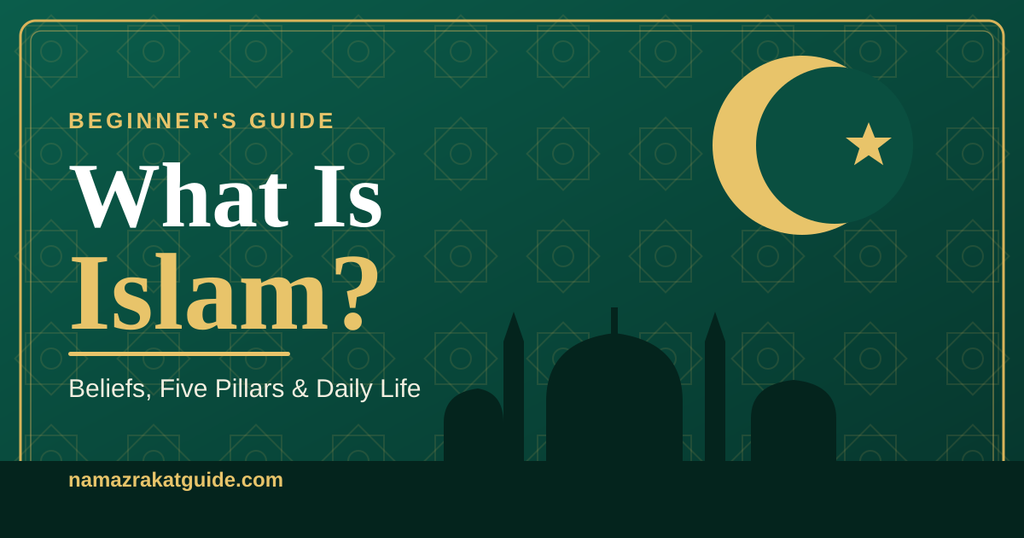
Islam is a religion of peace, faith, and trust in One God. The Arabic word for God is Allah (ٱللَّه). A person who follows Islam is called a Muslim (مُسْلِم).
Muslims believe Allah made everything. They believe He sent guidance to people through His prophets. The last prophet was Muhammad ﷺ. The final book of guidance is the Quran (ٱلْقُرْآن).
Islam is not only about prayer. It is a full way of life. It teaches how to worship, how to treat people, how to earn money, and how to live with a clean heart.
In this guide, you will learn what Islam means, what Muslims believe, and what they do each day. You will also find common questions and answers. Every word is written in simple English.
What Does the Word “Islam” Mean?
The word Islam (ٱلْإِسْلَام) comes from the Arabic root س ل م (s-l-m). This root is linked to peace and submission.
In Islam, “submission” means giving your life willingly to Allah. It means trusting Him and following His guidance. It is not about being forced.
The word salam (سَلَام) comes from the same root. It means “peace.” This is why Muslims greet each other with:
as-salamu alaykum (ٱلسَّلَامُ عَلَيْكُمْ), which means “Peace be upon you.”
The Quran calls this faith “Islam.” It says:
“Indeed, the religion with Allah is Islam.” (Quran 3:19)
What Is a Muslim?
A Muslim is a person who believes in Allah and follows the teachings of Islam. A Muslim can be of any colour, race, or country. Islam is for everyone.
Islam is the name of the religion. Muslim is the name of the person who follows it. Many people mix these two words up. That is a common mistake.
What Do Muslims Believe About God?
The most important idea in Islam is that Allah is One. This belief is called Tawhid (تَوْحِيد).
Muslims believe:
- Allah has no partners.
- Allah has no children.
- Allah was not born, and He did not give birth.
- Nothing is like Him.
The Quran sums this up in a short chapter. It is Surah Al-Ikhlas:
“Say: He is Allah, the One. Allah, the Eternal Refuge. He did not give birth, nor was He born. And there is nothing equal to Him.” (Quran 112:1–4)
Is Allah a Different God?
No. Allah is simply the Arabic word for God. Arabic-speaking Christians and Jews also use the word “Allah” when they speak of God in Arabic.
Muslims believe Allah is kind and fair. He is full of mercy. Most chapters of the Quran begin with these words:
Bismillah ir-Rahman ir-Rahim (بِسْمِ ٱللَّهِ ٱلرَّحْمَٰنِ ٱلرَّحِيم)
It means: “In the name of Allah, the Most Kind, the Most Merciful.”
Who Was the Prophet Muhammad ﷺ?
Muhammad ﷺ was born in the city of Makkah (مَكَّة) around the year 570 CE. Makkah is in what is now Saudi Arabia.
He grew up as an orphan. People knew him as honest and kind. They called him Al-Amin (ٱلْأَمِين), which means “the trustworthy.”
The First Revelation
When he was about 40 years old, the angel Jibril (جِبْرِيل), known in English as Gabriel, came to him. This was in a cave called Hira. The first words that came down were:
“Read! In the name of your Lord who created.” (Quran 96:1)
Over about 23 years, the Quran came down to him piece by piece.
The Journey to Madinah
Some people in Makkah did not like his message. They were unkind to him and his followers. In 622 CE, he moved to the city of Madinah (ٱلْمَدِينَة). This journey is called the Hijrah (هِجْرَة). The Islamic calendar starts from this year.
The Prophet ﷺ passed away in 632 CE. Muslims love him deeply. When they say or write his name, they add “peace be upon him” (ﷺ).
Is Muhammad ﷺ the Only Prophet?
No. Muslims believe Allah sent many prophets. Some of them are:
- Adam (آدَم)
- Nuh (نُوح), or Noah
- Ibrahim (إِبْرَاهِيم), or Abraham
- Musa (مُوسَىٰ), or Moses
- Isa (عِيسَىٰ), or Jesus
- Muhammad ﷺ
Muslims respect all of them. They believe all prophets taught the same main message: worship Allah alone. Muslims love Isa (Jesus) and honour his mother, Maryam (Mary). There is a whole chapter in the Quran named after her.
What Are the Six Articles of Faith?
Islam has six main beliefs. They are called Iman (إِيمَان), which means “faith.” A famous hadith tells of the angel Jibril asking the Prophet ﷺ about faith. The Prophet ﷺ answered with these six things (Sahih Muslim 8).
- Belief in Allah. He is One.
- Belief in the angels (مَلَائِكَة). They are made of light. They obey Allah.
- Belief in the holy books. These include the Quran, the Torah (Tawrat), the Gospel (Injil), and the Psalms (Zabur), as they were sent by Allah.
- Belief in the prophets (أَنْبِيَاء). Allah chose them to guide people.
- Belief in the Day of Judgement. Every person will answer for what they did.
- Belief in Qadr (قَدَر). This means Allah knows and plans all things. Good and bad happen by His knowledge.
The Quran also speaks about these beliefs, for example in Surah Al-Baqarah 2:285 and Surah An-Nisa 4:136.
What Are the Five Pillars of Islam?
The Five Pillars are the main acts of worship in Islam. The Prophet ﷺ said:
“Islam is built on five: to testify that there is no god but Allah and that Muhammad is the Messenger of Allah, to establish prayer, to give zakat, to perform Hajj, and to fast in Ramadan.” (Sahih al-Bukhari 8, Sahih Muslim 16)
Let us look at each one.
1. Shahada (شَهَادَة) – The Declaration of Faith
This is the first step to becoming a Muslim. A person says:
Ashhadu an la ilaha illa Allah, wa ashhadu anna Muhammadan rasul Allah.
أَشْهَدُ أَنْ لَا إِلٰهَ إِلَّا ٱللَّٰه وَأَشْهَدُ أَنَّ مُحَمَّدًا رَسُولُ ٱللَّٰه
It means: “I bear witness that there is no god but Allah, and I bear witness that Muhammad is the Messenger of Allah.”
2. Salah (صَلَاة) – The Five Daily Prayers
Muslims pray five times a day. Each prayer is a time to stop, think of Allah, and say thank you. The prayers are:
| Prayer | Arabic | When |
|---|---|---|
| Fajr | ٱلْفَجْر | Before sunrise |
| Dhuhr | ٱلظُّهْر | Just after midday |
| Asr | ٱلْعَصْر | Afternoon |
| Maghrib | ٱلْمَغْرِب | Just after sunset |
| Isha | ٱلْعِشَاء | Night |
Before praying, a Muslim does wudu (وُضُوء). This means washing the hands, mouth, nose, face, arms, head, ears, and feet in a set way.
Muslims face the Kaaba (ٱلْكَعْبَة) in Makkah when they pray. The direction is called the Qibla (قِبْلَة).
Prayer times change during the year, because they depend on the sun. In places like Britain, the days are very long in summer and very short in winter. So the times move a lot. Most Muslims use a prayer timetable from their local mosque or a trusted app.
3. Zakat (زَكَاة) – Giving to the Poor
Zakat means giving a fixed part of your savings each year to people in need. It cleans your wealth and helps others. The usual rate is 2.5% of savings that stay above a set limit for a full year.
The Quran often puts prayer and zakat together:
“Establish prayer and give zakat.” (Quran 2:43)
Muslims in the UK usually pay zakat in pounds (£). Many give through mosques or trusted charities. The limit, called the nisab (نِصَاب), changes with the price of gold and silver. So check a trusted scholar or charity for this year’s figure.
There is also sadaqah (صَدَقَة). This is extra giving that is not fixed. Even a kind smile can be sadaqah.
4. Sawm (صَوْم) – Fasting in Ramadan
Ramadan (رَمَضَان) is the ninth month of the Islamic calendar. During this month, healthy adult Muslims do not eat or drink from dawn until sunset.
The Quran says:
“O you who believe, fasting is made compulsory for you, as it was for those before you, so that you may become mindful of Allah.” (Quran 2:183)
Fasting teaches patience, thankfulness, and care for those who are hungry. People also read more Quran and pray more.
Some people do not need to fast. This includes young children, the very sick, travellers, and women who are pregnant or on their period. They may make up the fast later or give food to a poor person if they cannot fast.
Ramadan ends with the happy festival of Eid al-Fitr (عِيد ٱلْفِطْر). People pray together, wear nice clothes, share food, and give gifts.
Because the Islamic calendar follows the moon, Ramadan moves about 10 to 11 days earlier each year.
5. Hajj (حَجّ) – The Pilgrimage to Makkah
Hajj is a journey to Makkah. Every Muslim who is able to go, in health and in money, should go once in their life.
“Pilgrimage to the House is a duty owed to Allah by those who are able to make the journey.” (Quran 3:97)
Millions of Muslims from around the world gather in the same simple clothes. Rich and poor stand side by side. It shows that all people are equal before Allah.
What Is the Quran?
The Quran is the holy book of Islam. Muslims believe it is the word of Allah. It was sent to the Prophet Muhammad ﷺ through the angel Jibril.
Here are some simple facts:
- It has 114 chapters. Each chapter is called a surah (سُورَة).
- The verses are called ayat (آيَات).
- It is split into 30 parts. Each part is called a juz (جُزْء).
- It was written in Arabic.
Many Muslims learn to read the Quran as children. Some people memorise the whole book. They are called Hafiz (حَافِظ).
Muslims read translations in English too, to understand the meaning. But they believe the Arabic words are the true words of Allah.
Quran and Respect
Muslims treat the Quran with great respect. They wash before touching it. They keep it in a clean, high place.
What Is the Sunnah and Hadith?
After the Quran, the second source of guidance is the Sunnah (سُنَّة). This is the way of the Prophet Muhammad ﷺ. It covers what he said, did, and approved.
The reports of his words and actions are called Hadith (حَدِيث). Scholars checked them very carefully. The most trusted collections are Sahih al-Bukhari and Sahih Muslim.
Here are a few well-known hadith:
- On intentions: “Actions are judged by intentions.” (Sahih al-Bukhari 1, Sahih Muslim 1907)
- On love for others: “None of you truly believes until he loves for his brother what he loves for himself.” (Sahih al-Bukhari 13, Sahih Muslim 45)
- On mercy: “Whoever does not show mercy will not be shown mercy.” (Sahih al-Bukhari 5997)
- On good words: “Whoever believes in Allah and the Last Day should speak good or stay silent.” (Sahih al-Bukhari 6018, Sahih Muslim 47)
What Does Islam Teach About Good Character?
Islam is not only about worship. It is also about how you treat people. The Prophet ﷺ said that the best people are those with the best character (Sahih al-Bukhari 3559).
Muslims are taught to:
- Tell the truth
- Keep promises
- Be kind to parents
- Be fair and just
- Help neighbours
- Be kind to animals
- Avoid lying, cheating, and stealing
The Quran says:
“Indeed, Allah commands justice, kindness, and giving to relatives.” (Quran 16:90)
And about parents:
“Your Lord has decreed that you worship none but Him, and be kind to your parents.” (Quran 17:23)
What Is Halal and Haram?
You may hear these two Arabic words often.
- Halal (حَلَال) means allowed.
- Haram (حَرَام) means not allowed.
Halal Food
Muslims eat halal food. They do not eat pork. They do not drink alcohol. Meat must come from an animal slaughtered in the way Islam teaches, with Allah’s name said over it.
In British shops, you can now find halal meat, halal-labelled snacks, and many halal restaurants. Always check the label, as ingredients vary.
Other Haram Things
Islam also forbids things like lying, stealing, cheating, gambling, and charging or paying interest (riba, رِبَا). Many British Muslims choose banking or mortgage options that follow Islamic rules, such as Islamic finance products.
Is There Force in Islam?
No. The Quran is clear on this:
“There is no compulsion in religion.” (Quran 2:256)
Faith must come from the heart. No one can be forced to believe.
What Does Islam Say About Peace and Life?
Islam teaches respect for human life. The Quran says that taking one life wrongly is like harming all people, and saving one life is like saving all people (Quran 5:32).
The Quran also says Allah sent the Prophet ﷺ as a mercy:
“And We did not send you except as a mercy to all the worlds.” (Quran 21:107)
Sadly, some people use the name of Islam for hate and harm. Most Muslims reject this. Their faith teaches kindness, fairness, and care for others.
What Does Islam Say About Women?
Islam teaches that men and women are both responsible before Allah. Both have rights. The Quran speaks to believing men and believing women together many times. For example, in Quran 33:35, both are promised forgiveness and a great reward for good deeds.
Women in Islam have the right to own money, to get an education, and to agree to their own marriage. Many Muslim women in Britain work as doctors, teachers, business owners, and more.
Some Muslim women wear the hijab (حِجَاب), a headscarf. They do it as an act of faith. Practices can differ between families and cultures, but the core teaching is modesty and respect for all.
Different Groups in Islam
Like many big faiths, Islam has groups. The two main ones are Sunni and Shia.
- Sunni Muslims are the biggest group worldwide.
- Shia Muslims are the second biggest.
Both believe in one Allah, the Prophet Muhammad ﷺ, and the Quran. Both follow the Five Pillars in some form. Their main differences are about who should have led the Muslims after the Prophet ﷺ, and some religious practices.
Islam in Everyday Life
Here is what a normal day may look like for a Muslim:
- Wake up before sunrise and pray Fajr.
- Say “Bismillah” before eating.
- Go to school or work. Pray Dhuhr and Asr when time allows.
- Pray Maghrib at sunset.
- Spend time with family and pray Isha at night.
- Say a short prayer before sleep.
Many British workplaces and schools now give space for prayer or allow flexible breaks. If you want to know more, you can ask your Muslim friend or colleague. Most are happy to explain.
Muslim Festivals
There are two main festivals:
- Eid al-Fitr (عِيد ٱلْفِطْر): after Ramadan ends. It is a day of joy, prayer, and sharing food.
- Eid al-Adha (عِيد ٱلْأَضْحَىٰ): during the time of Hajj. It remembers the Prophet Ibrahim’s willingness to obey Allah. Families share meat with relatives, neighbours, and the poor.
Where Do Muslims Pray?
A place of prayer is called a mosque (مَسْجِد, masjid). A mosque is open to Muslims for the daily prayers and the special Jumu’ah (جُمُعَة), or Friday, prayer.
A mosque often has:
- A prayer hall
- A place to wash for wudu
- A school for children to learn the Quran
- A space for community events
In the UK, there are hundreds of mosques. Many hold open days where visitors can come and see inside. This is a good way to learn more.
How Many Muslims Are There?
There are nearly two billion Muslims around the world. Islam is one of the biggest religions on Earth.
In the 2021 Census, about 3.9 million people in England and Wales said they were Muslim. This was around 6.5% of the population (source: Office for National Statistics). It is the second largest religion in England and Wales after Christianity.
How Does a Person Become a Muslim?
Becoming a Muslim is simple. Here are the steps:
- Learn. Read about Islam. Ask questions. Take your time.
- Believe. Believe in one God and in Muhammad ﷺ as His final messenger.
- Say the Shahada. Say it with a sincere heart, and with understanding.
- Start to practise. Learn how to pray and begin the basics. You do not have to learn everything in one day.
- Find support. Many mosques and Muslim groups welcome new Muslims. They offer classes and friendly company.
No big ceremony is needed. Many people say the Shahada in front of a few Muslims for support, but this is not a rule.
Tips for New Muslims
- Go step by step. Do not feel you must be perfect.
- Learn the basics first: the Shahada, wudu, and prayer.
- Find a kind mentor or a local group.
- Be gentle with family. Share your journey in time.
Common Mistakes People Make About Islam
Many people have the wrong idea about Islam. Here are some of the most common:
- Mistake 1: “All Muslims are Arabs.” Not true. Most Muslims in the world are not Arab. Many live in Indonesia, Pakistan, India, and Bangladesh. Many are British, too.
- Mistake 2: “Muslims worship Muhammad.” No. Muslims worship Allah alone. Muhammad ﷺ is a prophet and a role model, not a god.
- Mistake 3: “Muslims worship a different God.” Muslims believe in the one God who also sent Ibrahim, Musa, and Isa.
- Mistake 4: “Islam is a new religion.” Muslims believe Islam is the same message that all prophets brought, finished through Muhammad ﷺ.
- Mistake 5: “One person’s bad act shows what Islam is.” Judge a faith by its own teachings, not by the worst behaviour of a few people.
Frequently Asked Questions (FAQs)
1. What is Islam in simple words?
Islam is a religion that teaches belief in one God, Allah. Its followers are called Muslims. They follow the Quran and the example of the Prophet Muhammad ﷺ.
2. What does Islam mean?
Islam means peaceful submission to Allah. It comes from the Arabic root س ل م, linked to peace.
3. What do Muslims believe?
Muslims believe in one God, angels, holy books, prophets, the Day of Judgement, and Allah’s plan (Qadr).
4. What are the five pillars of Islam?
They are the Shahada (faith), Salah (prayer), Zakat (charity), Sawm (fasting in Ramadan), and Hajj (pilgrimage to Makkah).
5. Who is Allah?
Allah is the Arabic name for God. Muslims believe He is One, Merciful, and the Creator of all things.
6. Who is Prophet Muhammad ﷺ?
He is the last prophet in Islam. He was born in Makkah around 570 CE. He received the Quran from Allah through the angel Jibril.
7. What is the holy book of Islam?
The Quran. It has 114 chapters and was sent in Arabic.
8. Is Islam the same as Christianity?
No, but they share some beliefs. Both honour Ibrahim, Musa, and Isa. Muslims believe Isa was a great prophet, but not God or the son of God. Muslims also believe in one God without a Trinity.
9. Can anyone become a Muslim?
Yes. Anyone who believes and says the Shahada can become a Muslim. No one is forced.
10. What is the difference between Muslim and Islam?
Islam is the religion. A Muslim is a follower of the religion.
Conclusion
Islam is a faith built on one simple idea: there is one God, Allah. It teaches belief, prayer, charity, fasting, and kindness. Its guide is the Quran, and its example is the Prophet Muhammad ﷺ.
Muslims all over the world, and across Britain, live by these teachings. Their goal is to be good people, to help others, and to please their Lord.
If you want to know more, read a good translation of the Quran. Visit a local mosque on an open day. Or simply ask a Muslim neighbour. Learning with an open mind is always a good step.