
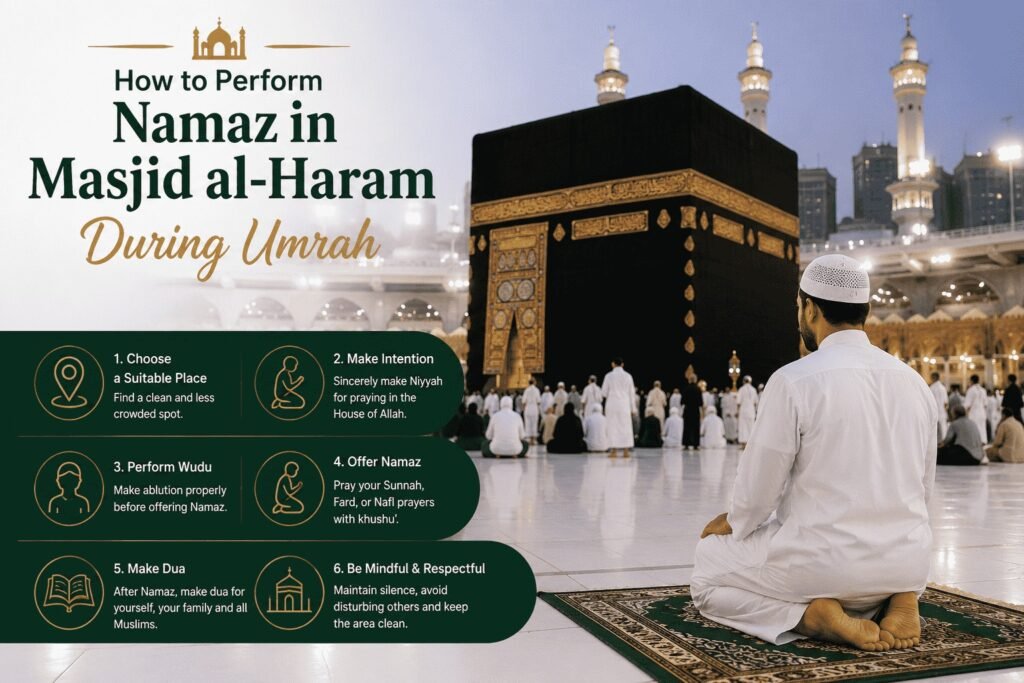
Performing Namaz in Masjid al-Haram is one of the most spiritually rewarding experiences for Muslims visiting Makkah for Umrah. Surrounded by the Kaaba and thousands of worshippers from around the world, praying here can make your Umrah journey deeply meaningful. However, first-time pilgrims may have questions about prayer times, rakats, joining the congregation, and proper mosque etiquette.
If you are planning your pilgrimage from the UK, it is helpful to arrange your travel and accommodation well in advance. Many pilgrims compare Umrah packages for 2027 to find suitable options that fit their budget, preferred travel dates, accommodation needs, and proximity to Masjid al-Haram.
What Is Masjid al-Haram?
Masjid al-Haram is the sacred mosque in Makkah and surrounds the Kaaba, the direction Muslims face during their daily prayers. It is the most sacred mosque in Islam and a central destination for Muslims performing Umrah and Hajj.
For an Umrah pilgrim, the mosque is not only the place where Tawaf is performed but also where you can offer the five daily prayers, Jumu’ah, Taraweeh during Ramadan, Tahajjud, and other voluntary prayers.
Can You Perform Regular Namaz in Masjid al-Haram During Umrah?
Yes. An Umrah pilgrim can perform the obligatory daily prayers in Masjid al-Haram just as they would in any other mosque, while following the congregation and the prayer leader (Imam).
You do not need to perform a special type of Namaz simply because you are performing Umrah. The normal rules of Salah apply.
Your daily prayers include:
- Fajr Namaz – 2 obligatory rakats
- Dhuhr Namaz – 4 obligatory rakats
- Asr Namaz – 4 obligatory rakats
- Maghrib Namaz – 3 obligatory rakats
- Isha Namaz – 4 obligatory rakats
If you are travelling, the rules concerning Qasr Namaz (shortening prayers) may also apply depending on your circumstances and the Islamic ruling you follow.
How to Perform Namaz in Masjid al-Haram
The basic method of performing Salah remains the same. The main difference is that you will usually pray as part of a large congregation.
1. Make Your Intention
Before beginning Salah, make the intention in your heart for the prayer you are about to perform.
For example, if it is Dhuhr, intend to offer the four obligatory rakats of Dhuhr for the sake of Allah.
There is no requirement to say the intention aloud.
2. Make Wudu
Make sure you have Wudu before entering the prayer area for Salah. If you lose your Wudu while waiting for the prayer, you should renew it before joining the prayer.
Because Masjid al-Haram can become extremely busy, allow yourself enough time to find a suitable place and complete your preparations.
3. Face the Qiblah
Face the Kaaba/Qiblah when preparing for Salah.
Inside Masjid al-Haram, prayer rows are arranged around the Kaaba, so the direction can look different depending on where you are standing.
Follow the existing prayer rows and the positioning of other worshippers.
4. Join the Congregation
When the Imam begins the prayer, follow his movements.
Do not move ahead of the Imam. Perform the standing, bowing (Ruku), prostration (Sujood), and other movements after the Imam begins them.
If you arrive late, quietly join the prayer in whatever position the congregation is currently in.
5. Complete the Prayer
Continue following the Imam until the prayer is completed.
Once the Imam finishes with the final Salam, your congregational prayer is complete if you joined correctly.
If you missed some rakats because you arrived late, you should complete the missed portion according to the rules of Salah.
Should You Pray Near the Kaaba?
Many pilgrims naturally want to pray as close to the Kaaba as possible. However, you should never push, rush, or inconvenience other worshippers simply to find a particular spot.
Masjid al-Haram can become exceptionally crowded around prayer times. A safe and respectful place further away from the Kaaba is better than forcing your way through a crowded area.
Remember that maintaining khushu (humility and concentration) and respecting fellow Muslims are important parts of worship.
Two Rakats After Tawaf
After completing Tawaf, pilgrims traditionally perform two rakats of prayer. These are commonly associated with the prayer after Tawaf and may be offered in a suitable place within the mosque when possible.
Because the area around Maqam Ibrahim can become crowded, do not obstruct people or put yourself or others at risk while trying to pray in a particular location.
Follow the guidance of mosque authorities and choose a safe place when the area is busy.
What If Prayer Time Begins During Tawaf?
This is an important situation for Umrah pilgrims.
If the congregational prayer begins while you are performing Tawaf, you should stop and join the congregational Salah. After the prayer, you can resume Tawaf according to the applicable Islamic guidance.
Since crowd management and mosque arrangements can change, follow instructions from the mosque authorities and security staff.
Namaz During Umrah in Ihram
Men and women may perform Salah while in the state of Ihram. Being in Ihram does not prevent you from offering the obligatory prayers.
You should continue observing the rules of Ihram while praying and throughout your Umrah.
For men, this includes maintaining the prescribed Ihram clothing and avoiding prohibited actions. Women should follow the relevant requirements for modest Islamic dress.
Qasr Namaz During Umrah
Travellers may be eligible to perform Qasr, meaning shortening certain four-rakat obligatory prayers to two rakats, depending on their travel status and the scholarly opinion they follow.
The four-rakat prayers affected by Qasr are:
- Dhuhr: 4 → 2 rakats
- Asr: 4 → 2 rakats
- Isha: 4 → 2 rakats
Fajr remains 2 rakats, while Maghrib remains 3 rakats.
However, rules surrounding Qasr and whether a traveller should shorten prayers behind an Imam can depend on circumstances and the school of Islamic jurisprudence. If you are unsure, ask a qualified scholar or your group’s religious guide before travelling.
Tips for Praying in Masjid al-Haram
Your experience can be much easier if you prepare before reaching the mosque.
Arrive Early
Masjid al-Haram becomes particularly busy around the five daily prayers and Jumu’ah. Arriving early gives you more time to find a suitable place.
Keep Your Belongings Secure
Carry only essential items and keep your valuables secure. Large crowds require extra awareness.
Stay With Your Group
If you are travelling with family members or a group from the UK, establish a meeting point outside the immediate prayer area in case someone becomes separated.
Keep Your Phone on Silent
Avoid unnecessary phone calls, notifications, photographs, or conversations during prayer.
Follow Mosque Instructions
Security and mosque staff may direct pilgrims toward particular entrances, exits, prayer areas, or routes. Follow their instructions for everyone’s safety.
Be Patient
You may encounter worshippers from many countries and cultures. Avoid pushing or arguing and give elderly people, children, and those with mobility difficulties extra space.
Namaz Etiquette in Masjid al-Haram
When praying in the sacred mosque, remember basic mosque etiquette:
- Maintain cleanliness.
- Keep your voice low.
- Avoid unnecessary conversations.
- Do not block walkways.
- Do not push other pilgrims.
- Keep prayer rows orderly.
- Follow the Imam.
- Avoid taking excessive space.
- Respect elderly and vulnerable worshippers.
- Follow official instructions during crowded periods.
These simple actions can help create a peaceful environment for everyone.
What Should You Do After Namaz?
After completing Salah, you can make personal Dua and engage in Dhikr. Many pilgrims use their time in Masjid al-Haram to ask Allah for forgiveness, guidance, protection, good health, and blessings for themselves and their families.
You can make Dua in your own language as well. What matters is sincerity and turning your heart toward Allah.
Avoid rushing immediately after prayer if the area is crowded. Allow other worshippers to move safely and follow the designated routes.
Planning Your Umrah From the UK
For British Muslims preparing for Umrah, planning ahead can make the journey considerably smoother. Consider your flights, accommodation, transport between Makkah and Madinah, travel dates, and required documentation.
You should also check the latest Saudi entry and pilgrimage requirements before travelling, as rules can change. Make sure your passport and relevant travel documents are valid and that you have arranged the appropriate Umrah visa or travel authorization applicable to your circumstances.
Final Thoughts
Performing Namaz in Masjid al-Haram during Umrah is a beautiful opportunity to worship Allah in one of Islam’s most sacred places. The prayer itself follows the normal method of Salah, but the experience can feel especially meaningful when you are surrounded by pilgrims from across the world.
Prepare your Wudu, arrive early, follow the Imam, respect other worshippers, and remain patient in crowded conditions. Most importantly, focus on your worship rather than worrying about finding the perfect location.
With good preparation and proper knowledge of Salah, you can make your time in Masjid al-Haram more peaceful, organised, and spiritually rewarding.
Frequently Asked Questions About Namaz in Masjid al-Haram
Can you pray Namaz in Masjid al-Haram during Umrah?
Yes, you can perform all five daily prayers in Masjid al-Haram during Umrah. The obligatory prayers are performed according to the normal rules of Salah, and you can join the congregation led by the Imam.
How many rakats are there in Namaz in Masjid al-Haram?
The obligatory rakats are the same as in other mosques: Fajr has 2, Dhuhr has 4, Asr has 4, Maghrib has 3, and Isha has 4 obligatory rakats. Travellers may be eligible for Qasr in certain circumstances.
Do I need to pray differently in Masjid al-Haram?
No. You do not need to perform a special method of Salah simply because you are praying in Masjid al-Haram. Follow the normal method of Salah and follow the Imam when praying in congregation.
Can I pray Namaz while wearing Ihram?
Yes. Being in the state of Ihram does not prevent a pilgrim from performing Salah. Both men and women can offer their obligatory and voluntary prayers while observing the rules of Ihram.
Can I perform Qasr Namaz in Makkah during Umrah?
A traveller may be eligible to perform Qasr, in which certain four-rakat obligatory prayers are shortened to two rakats. Whether Qasr applies depends on your travel circumstances and the Islamic ruling you follow, so ask a qualified scholar if you are unsure.
What are the rakats for Qasr Namaz during Umrah?
When Qasr applies, Dhuhr, Asr, and Isha are shortened from 4 obligatory rakats to 2. Fajr remains 2 rakats and Maghrib remains 3 rakats.
Should I pray close to the Kaaba in Masjid al-Haram?
You may pray wherever a suitable prayer space is available. There is no need to push or inconvenience other worshippers to get close to the Kaaba. During busy prayer times, choosing a safe and less crowded area is often better.
What should I do if the congregational prayer starts during Tawaf?
If the congregational prayer begins while you are performing Tawaf, stop Tawaf and join the congregational Salah. After the prayer, you can resume your Tawaf according to the applicable Islamic guidance and current mosque arrangements.
Can I pray two rakats after Tawaf in Masjid al-Haram?
Yes, pilgrims traditionally perform two rakats after completing Tawaf. You should choose a suitable and safe place to pray and avoid blocking pathways or causing difficulty for other worshippers, especially when Masjid al-Haram is crowded.
What should I do if I arrive late for congregational Namaz?
If you arrive after the Imam has started Salah, quietly join the congregation in whatever position the Imam is in. After the Imam completes the prayer, complete any rakats you missed according to the rules of Salah.
Do I have to pray all five daily prayers in Masjid al-Haram during Umrah?
No. You are not required to perform every daily prayer inside Masjid al-Haram. However, many pilgrims choose to pray there because of its great spiritual significance and the opportunity to join the congregation.
Can women perform Namaz in Masjid al-Haram?
Yes. Women can perform Salah in Masjid al-Haram. They should follow the designated prayer areas and the instructions of mosque staff while maintaining the required Islamic dress and etiquette.
What should I do after Namaz in Masjid al-Haram?
After Salah, you can make Dua, perform Dhikr, and ask Allah for forgiveness and blessings. You may make personal Dua in your own language as well. When the mosque is crowded, remain considerate and avoid blocking other worshippers.
Is Wudu required for Namaz in Masjid al-Haram?
Yes, Wudu is required for Salah when a person is in a state that requires purification. Make sure you have valid Wudu before joining the congregational prayer.
What should I take care of when praying in Masjid al-Haram?
Keep your phone silent, maintain cleanliness, avoid unnecessary conversation, follow prayer rows, do not block walkways, and follow the instructions of mosque and security staff. Patience and consideration are especially important during crowded periods.
Can I pray Jumu’ah in Masjid al-Haram during Umrah?
Yes. Pilgrims can attend the Jumu’ah prayer in Masjid al-Haram when it is held. Because Friday prayers can attract very large crowds, it is advisable to arrive early and follow the mosque’s current crowd-management instructions.
Can I perform Tahajjud or other voluntary prayers in Masjid al-Haram?
Yes. Pilgrims may perform voluntary prayers such as Tahajjud and other Nafl prayers in Masjid al-Haram, subject to the relevant prayer times and mosque arrangements.
Is Namaz in Masjid al-Haram more rewarding?
Masjid al-Haram has a special status in Islam, and prayer there is associated with a greatly multiplied reward compared with prayer elsewhere. The exact wording and interpretation of narrations about the multiplication of reward are matters that should be understood through reliable Islamic scholarship.
What is the best way to prepare for Namaz in Masjid al-Haram?
Plan to arrive before the prayer begins, keep Wudu, allow extra time because of crowds, know where your group will meet afterward, keep essential belongings secure, and follow the instructions of mosque authorities.