
Witr prayer is an important act of worship performed after the Isha prayer. According to Dawat-e-Islami and based on the Hanafi school of thought, Witr consists of three Wajib (necessary) raka‘at. It is not merely Sunnah in the Hanafi madhhab; rather, it is considered Wajib, meaning it is obligatory to perform and sinful to deliberately leave.
Witr is prayed in a manner similar to Maghrib, but with a key difference in the third raka‘ah. After completing the first two raka‘at and sitting for Qa‘dah (Tashahhud), one stands for the third raka‘ah. In this raka‘ah, Surah Al-Fatiha and another Surah are recited. Before going into Ruku‘, the hands are raised for Takbeer, then folded again, and Dua-e-Qunoot is recited. After that, the prayer continues as normal with Ruku‘ and Sujood until completion.
Key Aspects of Witr Prayer (According to Dawat-e-Islami)
1. Wajib Act:
In the Hanafi school, Witr is Wajib, not just Sunnah. Deliberately abandoning it is sinful.
2. Method (3 Raka‘at with Two Sittings):
Witr consists of three raka‘at with two sittings (Qa‘dah). In the third raka‘ah, after reciting a Surah and before Ruku‘, one raises the hands for Takbeer, folds them, and recites Dua-e-Qunoot.
3. Time:
Witr is performed after the Isha prayer and before Fajr. If Isha turns out to be invalid, Witr must also be repeated.
4. Dua-e-Qunoot:
Reciting Dua-e-Qunoot in the third raka‘ah is necessary. If someone has not memorized it, they may recite an alternative supplication such as “Rabbana Aatina” or “Allahummaghfirli” until they learn it.
5. Issue of Qada (Missed Prayer):
According to some rulings referenced by Dawateislami India, if someone forgets Isha but performs Witr, they may later perform Isha without necessarily repeating Witr. However, taking the cautious approach is better.
For detailed step-by-step guidance, Dawat-e-Islami publishes pamphlets and books, including instructions from the Ameer-e-Ahle Sunnat, explaining the complete method with evidences.
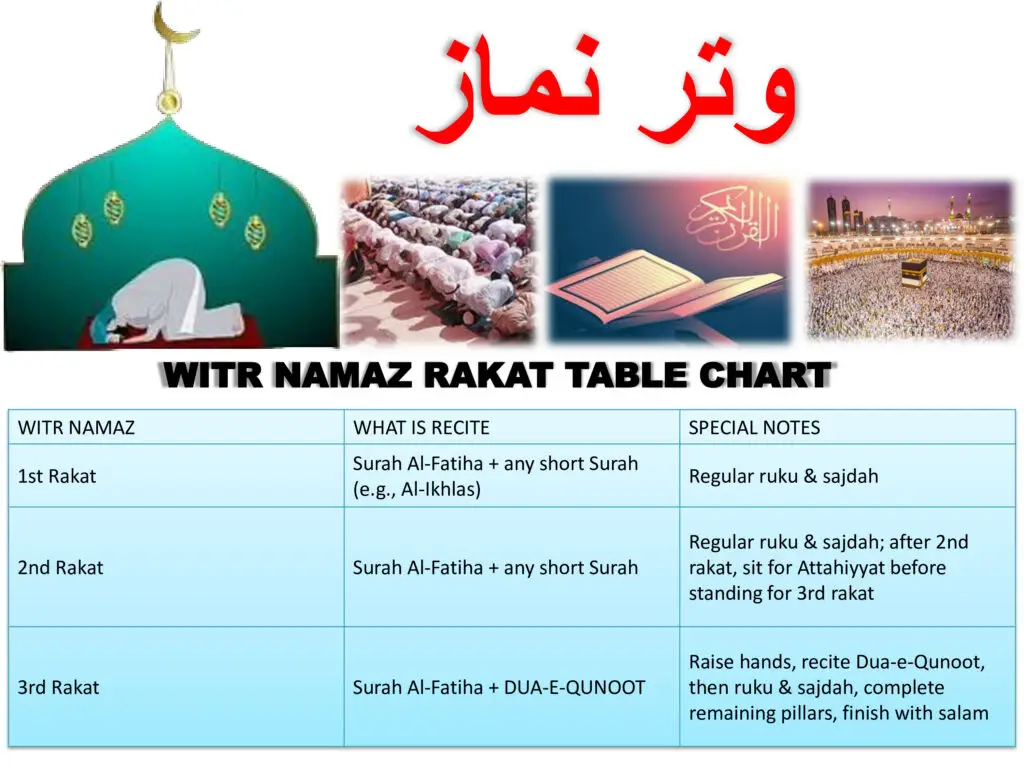
How Many Rakats Are in Witr namaz and table?
| Rakat | What to Recite | Special Notes |
|---|---|---|
| 1st Rakat | Surah Al-Fatiha + any short Surah (e.g., Al-Ikhlas) | Regular ruku & sajdah |
| 2nd Rakat | Surah Al-Fatiha + any short Surah | Regular ruku & sajdah; after 2nd rakat, sit for Attahiyyat before standing for 3rd rakat |
| 3rd Rakat | Surah Al-Fatiha + dua-e-qunoot | Raise hands, recite Dua-e-Qunoot, then ruku & sajdah, complete remaining pillars, finish with salam |
Witr namaz is always prayed in an odd number of rakats, as established by the Sunnah of Prophet Muhammad ﷺ. According to authentic Hadith, the Prophet ﷺ prayed Witr with 1, 3, 5, 7, or 9 rakats. Even if a person prays just 1 rakat, it counts as Witr, while praying more rakats brings additional reward and virtue.
According to the Hanafi method, Witr is prayed in 3 rakats and completed with a single salam. This method is similar to Maghrib prayer, but in the third rakat, it is necessary to recite Dua-e-Qunoot before going into ruku. In Hanafi fiqh, these 3 rakats of Witr are Wajib (obligatory), and following this method is considered the most preferred way to perform Witr Salah.
How to Pray Witr Namaz (Step-by-Step Method)
Witr namaz is performed in the same way as other prayers, with the same basic steps. However, in the third rakat of Witr, after reciting Al-Fatiha and another Surah, raise both hands up to the ears (like during Takbeer), then say Allahu Akbar and bring your hands down to your sides.
Next, recite the Dua-e-Qunoot. After that, continue the prayer as usual with ruku and sajdah, completing all the required pillars (Arkaan) of Salah. Finally, conclude the prayer by giving salam.
This method ensures Witr Salah is performed according to the Sunnah while maintaining all its special features, like Dua-e-Qunoot in the final rakat.
🔹 Intention (Niyyah)-Witr namaz
Make the intention in your heart:
‘’I intend to perform the wajib three rak’ahs of the witr prayer for the sake of Allah Almighty, with my face towards the Kaaba, following this Imam. Allahu Akbar.’’
(Saying it out loud is not necessary.)
Note: Pay close attention to the correct pronunciation of the letters, otherwise, if the letters are not pronounced correctly, the prayer may become invalid.
🟢 1. First Rakat
- Say Takbeer-e-Tahreema – Allahu Akbar
اللّٰهُ أَكْبَرُ
- Recite Thana (Subhanaka Allahumma…)
سُبْحَانَكَ اللّٰهُمَّ وَبِحَمْدِكَ
وَتَبَارَكَ اسْمُكَ
وَتَعَالٰى جَدُّكَ
وَلَا إِلٰهَ غَيْرُكَ
- Recite Ta’awwudh and Tasmiyah
أَعُوذُ بِاللّٰهِ مِنَ الشَّيْطَانِ الرَّجِيمِ | بِسْمِ اللّٰهِ الرَّحْمٰنِ الرَّحِيمِ
- Recite Surah Al-Fatiha
الْحَمْدُ لِلّٰهِ رَبِّ الْعَالَمِينَ
الرَّحْمٰنِ الرَّحِيمِ
مَالِكِ يَوْمِ الدِّينِ
إِيَّاكَ نَعْبُدُ وَإِيَّاكَ نَسْتَعِينُ
اهْدِنَا الصِّرَاطَ الْمُسْتَقِيمَ
صِرَاطَ الَّذِينَ أَنْعَمْتَ عَلَيْهِمْ
غَيْرِ الْمَغْضُوبِ عَلَيْهِمْ وَلَا الضَّالِّينَ
- Recite any Surah –
أَلَمْ تَرَ كَيْفَ فَعَلَ رَبُّكَ بِأَصْحَابِ الْفِيلِ
أَلَمْ يَجْعَلْ كَيْدَهُمْ فِي تَضْلِيلٍ
وَأَرْسَلَ عَلَيْهِمْ طَيْرًا أَبَابِيلَ
تَرْمِيهِمْ بِحِجَارَةٍ مِنْ سِجِّيلٍ
فَجَعَلَهُمْ كَعَصْفٍ مَأْكُولٍ
- Go into Ruku
سُبْحَانَ رَبِّيَ الْعَظِيمِ
- Perform two Sujood
سُبْحَانَ رَبِّيَ الْأَعْلَى
🟢 2. Second Rakat
For the second rak’ah, recite this while standing:
- Recite Surah Al-Fatiha
الْحَمْدُ لِلّٰهِ رَبِّ الْعَالَمِينَ-عَلَيْهِمْ وَلَا الضَّالِّينَ
- Recite any Surah
قُلْ هُوَ اللّٰهُ أَحَدٌ-كُفُوًا أَحَدٌ
- Go into Ruku
سُبْحَانَ رَبِّيَ الْعَظِيمِ
- Perform two Sujood
سُبْحَانَ رَبِّيَ الْأَعْلَى
- Sit for Qa’dah Ula and recite Tashahhud (At-Tahiyyat) only
التَّحِيَّاتُ لِلّٰهِ وَالصَّلَوَاتُ وَالطَّيِّبَاتُ
السَّلَامُ عَلَيْكَ أَيُّهَا النَّبِيُّ وَرَحْمَةُ اللّٰهِ وَبَرَكَاتُهُ
السَّلَامُ عَلَيْنَا وَعَلَىٰ عِبَادِ اللّٰهِ الصَّالِحِينَ
أَشْهَدُ أَنْ لَا إِلٰهَ إِلَّا اللّٰهُ
وَأَشْهَدُ أَنَّ مُحَمَّدًا عَبْدُهُ وَرَسُولُهُ
🟡 3. Third Witr namaz –For the third rak’ah, recite this while standing:
- Stand up for the third rakat
- Recite Surah Al-Fatiha only (no additional Surah) + After Al-Fatiha, recite a short surah.
+الْحَمْدُ لِلّٰهِ رَبِّ الْعَالَمِينَ—عَلَيْهِمْ وَلَا الضَّالِّينَ
قُلْ هُوَ اللّٰهُ أَحَدٌ—كُفُوًا أَحَدٌ
- Duaye qunoot in witr- After reciting Surah Al-Fatiha and Surah Al-Ikhlas, raise both hands to your ears, say “Allahu Akbar,” then lower your hands and clasp them below your navel. Then recite Dua-e-Qunoot.
اللَّهُمَّ إِنَّا نَسْتَعِينُكَ وَنَسْتَغْفِرُكَ
وَنُؤْمِنُ بِكَ وَنَتَوَكَّلُ عَلَيْكَ
وَنُثْنِي عَلَيْكَ الْخَيْرَ
وَنَشْكُرُكَ وَلَا نَكْفُرُكَ
وَنَخْلَعُ وَنَتْرُكُ مَنْ يَفْجُرُكَ
اللَّهُمَّ إِيَّاكَ نَعْبُدُ
وَلَكَ نُصَلِّي وَنَسْجُدُ
وَإِلَيْكَ نَسْعَى وَنَحْفِدُ
نَرْجُو رَحْمَتَكَ وَنَخْشَى عَذَابَكَ
إِنَّ عَذَابَكَ بِالْكُفَّارِ مُلْحِقٌ
- Go into Ruku
سُبْحَانَ رَبِّيَ الْعَظِيمِ
- Perform two Sujood
سُبْحَانَ رَبِّيَ الْأَعْلَى
- Tashahhud
التَّحِيَّاتُ لِلّٰهِ وَالصَّلَوَاتُ وَالطَّيِّبَاتُ
السَّلَامُ عَلَيْكَ أَيُّهَا النَّبِيُّ وَرَحْمَةُ اللّٰهِ وَبَرَكَاتُهُ
السَّلَامُ عَلَيْنَا وَعَلَىٰ عِبَادِ اللّٰهِ الصَّالِحِينَ
أَشْهَدُ أَنْ لَا إِلٰهَ إِلَّا اللّٰهُ
وَأَشْهَدُ أَنَّ مُحَمَّدًا عَبْدُهُ وَرَسُولُهُ
- Durood-e-Ibrahim
اللَّهُمَّ صَلِّ عَلَىٰ مُحَمَّدٍ وَعَلَىٰ آلِ مُحَمَّدٍ
كَمَا صَلَّيْتَ عَلَىٰ إِبْرَاهِيمَ وَعَلَىٰ آلِ إِبْرَاهِيمَ
إِنَّكَ حَمِيدٌ مَجِيدٌ
اللَّهُمَّ بَارِكْ عَلَىٰ مُحَمَّدٍ وَعَلَىٰ آلِ مُحَمَّدٍ
كَمَا بَارَكْتَ عَلَىٰ إِبْرَاهِيمَ وَعَلَىٰ آلِ إِبْرَاهِيمَ
إِنَّكَ حَمِيدٌ مَجِيدٌ
- Any Masnoon Dua
رَبَّنَا آتِنَا فِي الدُّنْيَا حَسَنَةً
وَفِي الْآخِرَةِ حَسَنَةً
وَقِنَا عَذَابَ النَّارِ
- End the prayer by turning the head right and left, saying Salam soldier twin side
السَّلَامُ عَلَيْكُمْ وَرَحْمَةُ اللّٰهِ
Hadiths About Witr namaz
1. Importance of Witr namaz
The Prophet Muhammad ﷺ emphasized the significance of Witr prayer. He said:
“Witr is a right; whoever does not pray Witr is not from us.”
(Abu Dawood)
This hadith highlights the strong emphasis and importance of performing Witr.
2. Time of Witr namaz
The time for Witr is after Isha prayer until the beginning of Fajr. The Prophet ﷺ said:
“Allah has added a prayer for you that is prayed after Isha and before Fajr, and that is Witr.”
(Ahmad)
This shows the correct timing for performing Witr.
3. Virtue of Witr namaz
The Prophet ﷺ said:
“Allah is One and loves the odd-numbered prayer, so pray Witr.”
(Tirmizi)
This hadith demonstrates that performing Witr is a means of drawing closer to Allah and earning great reward.
How Witr namaz Is Performed in Mecca and Medina
In Mecca and Medina, Witr Salah is performed following the Sunnah with simplicity and devotion, often reflecting the Hanafi or local practices:
- Rakats: Most people pray 3 rakats as Witr, though praying 1, 3, 5, 7, or 9 rakats is valid.
- Dua-e-Qunoot: In the 3rd rakat, Dua-e-Qunoot is recited before ruku.
- Qira’at: After Surah Al-Fatiha, a short Surah like Al-Ikhlas, Al-Falaq, or Al-Nas is recited in each rakat.
- Ruku & Sajdah: Performed as in any other Salah with proper humility and focus.
- Salam: Witr is concluded with a single salam to the right side.
In the Haramain, Witr is often prayed congregationally at the mosque after Isha, especially during Ramadan, though it can also be prayed individually at home. This method ensures consistency with the Sunnah while maintaining ease for the worshippers.
How to Pray Tahajjud and Witr namaz Together
1. Witr namaz After Tahajjud
Tahajjud is prayed in the last part of the night, and it is highly recommended (Sunnah Mu’akkadah) to pray Witr afterward.
- Pray any number of rakats for Tahajjud (2, 4, 6, etc.).
- After Tahajjud, Witr can be prayed with 1, 3, 5, 7, or 9 rakats.
- Hanafi method: 3 rakats, reciting Dua-e-Qunoot in the third rakat before ruku.
- Perform ruku and sajdah with full concentration, and conclude the prayer with salam.
2. Best Time for Witr namaz
- Witr can be prayed after Isha until the beginning of Fajr.
- The preferred time is during the last part of the night, just before Fajr, especially after Tahajjud.
- It is also valid to pray Witr immediately after Isha if needed.
Praying Witr after Tahajjud is considered the best way to complete night worship and draw closer to Allah.
Witr namaz While Travelling
1. Do You Witr namaz When Travelling?
Yes, Witr namaz should still be performed while travelling, as it is a Sunnah Mu’akkadah (highly emphasized Sunnah) in most schools of thought and Wajib according to Hanafi fiqh. It is highly recommended to maintain the practice even on a journey.
2. Shortening Rules
- While travelling, Muslims are allowed to shorten (Qasr) the prayers:
- Witr is always prayed in odd rakats, usually 1 or 3 rakats, depending on ease.
- This flexibility makes it easier to maintain Witr even during travel.
3. Hadith Evidence
The Prophet ﷺ said:
“Pray the Witr before you sleep, even while travelling.”
This shows the importance of not neglecting Witr, regardless of being on a journey, and emphasizes its regular performance.
Ruling on Neglecting Witr namaz
1. Deliberately Leaving Witr namaz
According to Hanafi fiqh, Witr is Wajib (obligatory). Intentionally leaving it without a valid excuse is considered sinful, as it neglects a duty emphasized by the Prophet ﷺ.
2. When Is It Considered a Sin?
- If a person misses Witr without a valid reason (such as sleep, forgetfulness, or genuine inability), it is sinful, and they should make it up as soon as possible.
- In the Shafi‘i, Maliki, and Hanbali schools, Witr is Sunnah Mu’akkadah. Regularly neglecting it is blameworthy but not sinful like abandoning a fard prayer.
- Scholars recommend that Witr should not be habitually skipped. Even while travelling or on busy nights, one should try to pray it, preferably in the last part of the night.
Maintaining Witr prayer consistently is highly encouraged, as it strengthens night worship and brings spiritual reward.
Common Mistakes in Witr Salah
1. Forgetting Dua-e-Qunoot
One common mistake is forgetting to recite Dua-e-Qunoot in the third rakat (Hanafi method). While the prayer is still valid without it, consistently skipping this dua reduces the Sunnah’s full reward. It is recommended to recite it carefully before going into ruku in the final rakat.
2. Missing the Time for Witr
Another frequent mistake is delaying Witr until Fajr or missing its time entirely. Witr should be prayed after Isha until the start of Fajr, ideally in the last third of the night. Praying it at the correct time ensures adherence to Sunnah and maximizes spiritual benefits.
Avoiding these mistakes helps maintain the proper form of Witr Salah and ensures the prayer is performed according to the Prophet ﷺ’s guidance.
Summary: How to Pray Witr namaz Correctly
Witr namaz is a highly emphasized night prayer, ideally performed after Isha and before Fajr, preferably in the last third of the night. It is prayed in odd rakats—3, 5, 7, or 9—depending on ease and school of thought, with 3 rakats being the Hanafi standard. Begin with niyyah (intention), say Takbeer-e-Tahreema, recite Surah Al-Fatiha and another Surah in each rakat, perform ruku and sajdah, and conclude with salam. In the final rakat, recite Dua-e-Qunoot before ruku.
Witr can be prayed individually or in congregation, and it is recommended to maintain it even while travelling. Avoid common mistakes such as forgetting Dua-e-Qunoot or missing the correct time. Following this method ensures Witr Salah is performed according to the Sunnah, bringing spiritual reward and closeness to Allah.
Activity for namaz
Start incorporating namaz into your nightly routine today to earn Allah’s blessings and spiritual reward. Whether at home or while travelling, make it a habit to pray Witr consistently. Share this guide with family and friends so they too can learn the correct method of performing Witr Salah. Don’t miss the opportunity to complete your night prayers and strengthen your connection with Allah—pray Witr tonight!
faqs-witr namaz in isha
How do Hanafis pray Witr?
Hanafis pray 3 rakats Witr after Isha, with Dua-e-Qunoot in the third rakat before ruku. They recite Al-Fatiha + a short Surah in each rakat, do ruku and sajdah, and finish with salam.
Can Hanafis pray 1 rakat Witr?
No, in Hanafi fiqh, Witr must be 3 rakats. Praying only 1 rakat does not fulfill the Wajib requirement.
Is Qunoot compulsory in Witr Hanafi?
Yes, Dua-e-Qunoot is Wajib in the 3rd rakat for Hanafis. Skipping it without excuse makes the prayer incomplete.
Can you make up Witr Hanafi?
Yes, if you miss Witr, you should make it up as soon as possible, ideally before Fajr.
How is Witr prayer performed?
Witr is prayed like other Salah, in odd rakats (1, 3, 5, etc.), with Dua-e-Qunoot recited in the last rakat before ruku.
How do you pray 3 Witr step by step?
- Niyyah (intention)
- Takbeer
- Surah Al-Fatiha + another Surah in each rakat
- Ruku & Sajdah
- In the 3rd rakat, recite Dua-e-Qunoot
- Finish with salam
Is Witr only 1 rakat?
No, Witr can be 1, 3, 5, 7, or 9 rakats, but 1 rakat is the minimum.
Is Witr namaz mandatory?
Hanafi: Wajib. Other schools: Sunnah Mu’akkadah.
How to pray 4 Rakat of Witr?
Witr should always be odd rakats, so 4 rakats is not correct.
Can I miss Witr prayer?
It’s recommended not to miss it. In Hanafi fiqh, skipping without reason is sinful; in other schools, it’s blameworthy.
How to pray 3 Witr without Dua-e-Qunoot?
You can pray 3 rakats without Qunoot; the prayer is valid but less rewarded.
What are common mistakes in Witr?
- Forgetting Dua-e-Qunoot
- Missing the Witr time
- Not maintaining proper ruku/sajdah
How to perform Witr Namaz at home?
Pray after Isha, follow the normal Salah steps, recite Qunoot in the last rakat, then finish with salam.
How to read 1 Witr?
Pray 1 rakat like normal Salah with Al-Fatiha + any Surah, perform ruku and sajdah, recite Qunoot optional, then salam.
Is Witr three rakat?
Yes, 3 rakats is the common Hanafi method.
Can you read 2 rakat Witr?
No, Witr must be an odd number of rakats.
How to perform 3 Witr?
Follow the step-by-step guide in Q2.
Is Witr valid without dua?
Yes, Witr is still valid without Dua-e-Qunoot, but it’s sunnah to recite it.
Is 3 rakat Witr compulsory in Isha?
Hanafi: Yes (Wajib). Other schools: not compulsory.
What to recite instead of Qunoot?
If Qunoot is skipped, you can continue normal ruku & sajdah; no replacement is needed.
Can I pray Witr silently or aloud?
- Silent in all rakats except Fajr and Maghrib if praying aloud in congregation.
- Dua-e-Qunoot is recited silently.
What to recite in third rakat?
Al-Fatiha + a short Surah, then Dua-e-Qunoot before ruku.
Can I skip Witr in Isha?
It’s better not to; in Hanafi fiqh it’s Wajib, skipping is sinful.
Is Witr 3 rakats or just one Rakat?
Minimum 1 rakat; commonly 3 rakats in Hanafi practice.
How to finish Witr prayer?
After the last rakat, perform ruku, sajdah, and conclude with salam.
Does Allah love Witr?
Yes, Prophet ﷺ said: “Allah is One and loves the odd-numbered prayer, so pray Witr” (Tirmizi).
What to say right after Witr?
After salam, you may make any personal supplication (dua).
Can I pray Witr immediately after Isha?
Yes, Witr can be prayed immediately after Isha or later during the night before Fajr.