
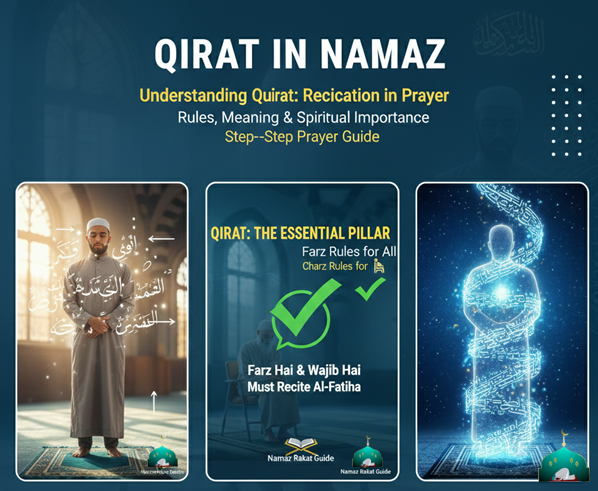
Qirat in Namaz, or reciting verses from the Holy Quran, is one of the essential Fara’iz-e-Namaz (obligatory acts). To fulfill this duty, recitation must be audible to yourself—moving your lips and tongue—even in silent prayers.
What Is Qirat in Namaz? Meaning and Definition
Qirat in Namaz literally means “recitation.” In the context of Namaz, it refers to the act of reciting portions of the Holy Qur’an while standing (Qiyam). It is not merely a silent reading in the heart; in Islamic Jurisprudence (Fiqh), Qirat requires moving the lips and tongue so that a slight sound is produced (audible at least to oneself).
Qirat Meaning in English, Arabic, and Urdu/Hindi
- Arabic: قراءة (Recitation/Reading).
- English: The rhythmic and melodious recitation of the Qur’an.
- Urdu/Hindi: تلاوت (Tilawat) or قرآن پڑھنا (Qur’an Padhna).
Farz of Qirat in Namaz – Is Recitation Compulsory?
Yes, Qirat is one of the Arkan (pillars) or Fara’id (obligatory acts) of Namaz. Without reciting the Qur’an, the prayer is considered invalid. According to most schools of thought, Qirat is Farz in at least two Rak’ahs of the Fard prayer and in every Rak’ah of Sunnah and Nafl prayers.
Importance of Qirat in Namaz
Qirat is the direct communication between the slave and Allah. It is the moment where the worshiper speaks the words of the Creator back to Him. It brings Khushu (concentration) and transforms a physical routine into a spiritual experience.
Is Surah Al-Fatiha Mandatory in Every Rak‘ah?
There is a famous Hadith stating: “There is no prayer for the one who does not recite the Opening of the Book (Al-Fatiha).”
- In the Hanafi school, reciting any verse is Farz, but reciting Surah Al-Fatiha specifically is Wajib (necessary).
- In the Shafi’i school, Al-Fatiha is a pillar (Rukn) and must be recited in every single Rak’ah.
namaz related post:
How to Perform Qirat in Namaz (Step-by-Step Guide)
- Start with Ta’awwudh: Say A’udhu billahi minash-shaitanir-rajim.
- Basmalah: Say Bismillahir-Rahmanir-Rahim.
- Recite Al-Fatiha: Recite clearly and slowly.
- Say “Ameen”: Silently (Hanafi) or Aloud (Shafi’i).
- Recite a Surah: In the first two Rak’ahs of Fard (and all Rak’ahs of Sunnah/Nafl), join another Surah or at least three short verses.
Qirat in Farz, Sunnah, and Nafl Prayers
- Farz: Recitation is required in the first two Rak’ahs. In the 3rd and 4th, only Al-Fatiha is usually recited.
- Sunnah & Nafl: You must recite Al-Fatiha and an additional Surah in every Rak’ah.
Loud vs Silent Qirat – When to Recite Aloud?
- Jahri (Loud): Fajr, Maghrib, Isha, Jumu’ah, and Eid prayers.
- Sirri (Silent): Dhuhr and Asr prayers.
Qirat in Congregational and Jumu‘ah Prayer
When praying behind an Imam (Muqtadi):
- In the Hanafi school, the follower remains silent and listens to the Imam’s recitation.
- In the Shafi’i school, the follower recites Al-Fatiha silently even if the Imam is reciting aloud.
Qirat in the Qur’an – Divine Command for Recitation
Allah says in the Qur’an: “So, recite as much of the Qur’an as may be easy [for you].” (Surah Al-Muzzammil, 73:20). This establishes that recitation is a divine order.
Hadith About Qirat in Salah
The Prophet (PBUH) said: “When you stand for prayer, say Takbeer and then recite what is easy for you from the Qur’an.” (Sahih Bukhari).
Rules of Qirat According to Islamic Fiqh (Hanafi & Shafi‘i)
- Hanafi: Focuses on the minimum requirement of one long verse or three short verses after Al-Fatiha.
- Shafi‘i: Emphasizes that Al-Fatiha is indispensable for every person in the congregation.
What Happens If Qirat Is Missed in Namaz?
If a person forgets to recite a Surah in the first two Rak’ahs of a Fard prayer, they must perform Sajdah Sahw (Prostration of Forgetfulness) at the end. If Qirat is missed entirely, the prayer is void.
Types of Qirat in Salah
There are different Qira’at (styles of recitation) such as Qirat Hafs (most common) or Qirat Warsh. However, in daily Namaz, this refers to the length of recitation (Tiwāl, Awsāt, or Qisār Mufassal).
Qirat vs Zikr – What Is the Difference?
Qirat is specifically the recitation of the Qur’an. Zikr refers to general remembrance like SubhanAllah or Alhamdulillah. While all Qirat is Zikr, not all Zikr is Qirat.
Common Mistakes in Qirat During Namaz
- Reciting too fast: Not observing Tajweed rules.
- No lip movement: Praying entirely in the mind.
- Mixing Surah order: Reciting Surahs in an order that goes against the sequence of the Qur’an (Makruh).
Understanding Qirat – A Beginner’s Guide
For beginners, the goal is accuracy over quantity. Start by perfecting Surah Al-Fatiha and small Surahs like Al-Ikhlas and Al-Kauthar. As your Tajweed improves, your connection in Salah will grow stronger.
Author Note: My goal in creating the Namaz Rakat Guide is to provide clear, authentic, and easy-to-follow resources for the Ummah. Qirat is a fundamental pillar of Salah, and even small mistakes in recitation or understanding its “Farz” (obligatory) status can affect the validity of your worship.
Conclusion: Perfecting Your qirat in namaz (Recitation)
In summary, Qirat is much more than a set of rules; it is the soul of your Namaz. As one of the fundamental Fara’id (obligatory acts) of prayer, ensuring that your recitation is performed with correct lip movement and focus is essential for a valid Salah. Whether you are reciting silently in the afternoon or aloud during the night prayers, the goal is to connect deeply with the words of Allah. By understanding the differences between Farz and Sunnah recitation, you can move from simply performing a routine to experiencing a profound spiritual conversation.
Frequently Asked Questions: Qirat in Namaz
Q1. Is Qirat mandatory (Farz) in every Rak’ah of Namaz?
Answer: In the Hanafi school, Qirat is Farz in all Rak’ahs of Sunnah and Nafl prayers, and in the first two Rak’ahs of Farz prayers. In the Shafi’i school, reciting Surah Al-Fatiha is a mandatory pillar (Rukn) in every single Rak’ah of any prayer.
Q2. Can I recite the Qur’an silently in my mind without moving my lips?
Answer: No. For Qirat to be valid in Islamic Fiqh, you must move your lips and tongue. The recitation should be at least audible to yourself. Purely mental recitation without lip movement is not considered “reading” and may invalidate the prayer.
Q3. What is the minimum length of Qirat required in Namaz?
Answer: The minimum requirement is to recite either one long verse (Ayah) or three short verses of the Qur’an after Surah Al-Fatiha in the Rak’ahs where Qirat is mandatory.
Q4. Should I recite Surah Al-Fatiha while praying behind an Imam?
Answer: This depends on your Maslak:
- Hanafi: The follower (Muqtadi) remains silent and listens to the Imam’s recitation.
- Shafi’i: The follower must recite Surah Al-Fatiha silently, even during loud (Jahri) prayers.
Q5. What should I do if I forget to recite a Surah after Al-Fatiha?
Answer: If you forget the additional Surah in the first two Rak’ahs of a Fard prayer, you must perform Sajdah Sahw (Prostration of Forgetfulness) at the end of the prayer to make it valid.
Q6. Which Surahs are best to recite for beginners?
Answer: Beginners usually start with shorter Surahs from the 30th Para (Juz Amma), such as Surah Al-Ikhlas, Surah Al-Kawthar, and Surah An-Nas, as they are easy to memorize and perfect in Tajweed.
Q7. Is it allowed to change the order of Surahs in Namaz?
Answer: It is Sunnah to recite Surahs in the order they appear in the Qur’an. Reciting them in reverse order (e.g., reciting Surah Al-Ikhlas in the first Rak’ah and Surah Al-Fil in the second) is considered Makruh (disliked) but the prayer remains valid.