
Salatul Tasbeeh is a four-rak‘ah voluntary (nafl) prayer performed with the intention of seeking forgiveness and drawing closer to Allah. It includes the recitation of a special tasbeeh phrase 300 times throughout the prayer. Some scholars, particularly within the Hanafi and Shafi‘i schools, consider it recommended (mustahabb) based on certain narrations, while others regard the related hadith as weak or even fabricated and therefore do not emphasize it.
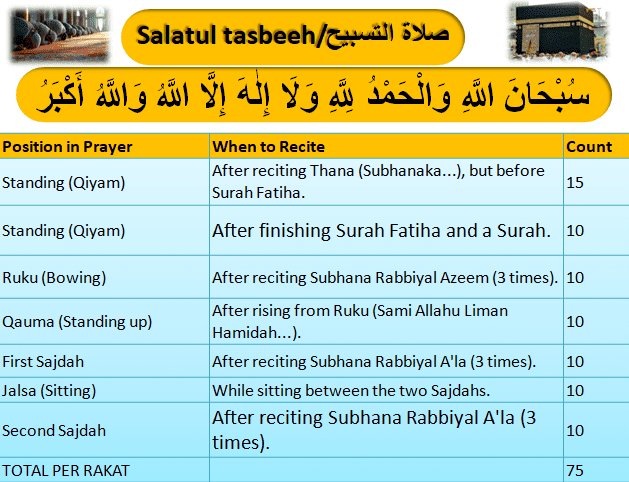
The specific tasbeeh recited is: “Subhaan Allahi wal hamdulillahi wa laa ilaha illal laahu wallahu akbar.” This phrase is repeated 75 times in each rak‘ah, making a total of 300 times in four rak‘ahs. In every rak‘ah, it is recited 15 times after the opening supplication (Thana), 10 times after Surah al-Fatiha and another surah, 10 times in ruku after “Subhaana Rabbiyal Azeem,” 10 times after rising from ruku, 10 times in the first sajdah, 10 times while sitting between the two sajdahs, and 10 times in the second sajdah. This method is repeated in all four rak‘ahs.
Salatul Tasbeeh may be prayed at any permissible time except during the prohibited periods, such as at sunrise, sunset, and when the sun is at its zenith. It can be offered as one set of four rak‘ahs with one salam, or according to some opinions, as two sets of two rak‘ahs. It is widely known as a prayer for comprehensive forgiveness of sins, though scholars differ regarding the strength and authenticity of its supporting narrations.
What Is Salatul Tasbeeh?
Salatul Tasbih is a voluntary (nafl) prayer in which specific words of glorification (tasbih) are repeated many times during different postures of the salah. It is named “Tasbih” because its main purpose is to glorify Allah abundantly while praying. This prayer may be performed as two rak‘ahs or four rak‘ahs, with a fixed number of tasbih recitations.
Is Salatul Tasbeeh Sunnah or Nafl?
According to the majority of scholars, Salatul Tasbih is not an obligatory Sunnat, but a recommended Nafl namaz. It is reported through narrations attributed to Ibn ‘Abbas (رضي الله عنه), and although some scholars discussed their strength, many accepted them for virtuous actions. In Hanafi fiqh, it is treated as permissible Nafl worship, not a binding Sunnah.
Is Salatul Tasbeeh Permissible or Bid‘ah?
Scholars have differed regarding this prayer:
- Permissible view: Many Hanafi, Shafi‘i, and some Hanbali scholars allow Salatul Tasbih, considering the narrations acceptable when combined. Renowned scholars such as Ibn Hajar and Imam Suyuti regarded the hadith as strengthened through multiple chains.
- Opposing view: Some scholars, including Ibn Taymiyyah, regarded it as an innovation due to lack of continuous practice by the Companions.
Balanced conclusion: It is not compulsory, so leaving it carries no sin, and performing it with sincere intention is rewarded according to scholars who permit it.
Rewards and Virtues of Salatul Tasbeeh
Salatul Tasbih is associated with great forgiveness and mercy. The Prophet ﷺ is reported to have explained that through this prayer, a believer’s past and future sins, minor and major, open and hidden may be forgiven. Because of this, scholars encourage performing it occasionally, not necessarily daily, as an act of extra devotion.
When Can You Perform Salatul Tasbeeh?
Salatul Tasbih may be offered at any time of the day or night, except during the makruh (disliked) times, such as sunrise, sunset, and zawal. According to Hanafi scholars, it is preferable to perform it before Zuhr, but it remains valid at other permissible times as well.
How To Pray Salatul Tasbeeh
The tasbih recited throughout the prayer is:
Subḥānallāhi wal-ḥamdu lillāhi wa lā ilāha illallāhu wallāhu akbar

The total tasbih count is 300 in four rak‘ahs or 150 in two rak‘ahs.
Step-by-Step Method
- Make intention for Salatul Tasbih.
- Begin with Takbir and recite Thana, then read the tasbih 15 times.
- Recite Surah Al-Fatihah and another surah, then recite the tasbih 10 times.
- In Ruku, after normal dhikr, recite tasbih 10 times.
- After standing from ruku, recite tasbih 10 times.
- In the first sajdah, recite tasbih 10 times.
- While sitting between the two sajdahs, recite tasbih 10 times.
- In the second sajdah, recite tasbih 10 times.
This completes 75 tasbih in one rak‘ah. Repeat for remaining rak‘ahs.
Recitation Pattern
- 75 tasbih per rak‘ah
- 150 tasbih in 2 rak‘ahs
- 300 tasbih in 4 rak‘ahs
Each posture has a fixed share to maintain balance and focus during worship.
Overview Table Chart
| Aspect | Details |
| Type of Prayer | Nafl (Voluntary) Salah |
| Name | Salatul Tasbeeh |
| Reason for Name | Includes repeated Tasbih recitation in every posture |
| Total Rak‘ahs | 4 Rak‘ahs (can also be prayed as 2 + 2) |
| Total Tasbih Count | 300 Tasbih in 4 Rak‘ahs / 150 in 2 Rak‘ahs |
| Tasbih Words | سُبْحَانَ اللَّهِ وَالْحَمْدُ لِلَّهِ وَلَا إِلٰهَ إِلَّا اللَّهُ وَاللَّهُ أَكْبَرُ |
| Purpose | Seeking forgiveness and closeness to Allah |
| Obligation Status | Not compulsory |
| Fiqh Ruling | Permissible and recommended by many scholars |
| Best Practice | Performed occasionally with sincerity |
Special Notes
- Tasbih should not be counted aloud.
- Using fingers or beads openly is makruh, but subtle finger pressure is allowed.
- If a tasbih count is missed, it may be compensated in the next posture, following Hanafi guidelines.
- Sajdah Sahw does not require additional tasbih unless a count was previously missed.
How Do I Perform Salatul Tasbeeh?
In simple terms, Salatul Tasbih is prayed like a normal Nafl salah, with the addition of frequent tasbih recitations at fixed positions. A person may pray two or four rak‘ahs, focusing on humility, patience, and remembrance of Allah.
Summary of Salatul Tasbeeh
Salatul Tasbih is a recommended Nafl prayer that emphasizes glorifying Allah and seeking forgiveness. Though scholars differ regarding its regular practice, it remains a valid act of worship according to many classical scholars, especially when performed occasionally and sincerely.
Conclusion
Salatul Tasbih offers a powerful opportunity to increase remembrance of Allah and seek forgiveness beyond obligatory prayers. While it is not mandatory, performing it with sincerity can bring immense spiritual benefit. Learn its method properly, follow scholarly guidance, and include it occasionally in your worship routine to strengthen your connection with Allah.
nanaz related post
| Namaz Rakat Guide Table |
| fajr namaz rakat |
| zohar namaz rakat |
| asr namaz rakat |
| maghrib namaz rakat |
| isha namz rakat |
| practicaly method namaz |
| witr namaz |
| sunnat namaz |
| jumma namaz rakat |
Faqs Salatul Tasbeeh Namaz
How do you recite Salatul Tasbeeh?
Salatul Tasbeeh is prayed like a normal nafl prayer, but a special tasbih is recited 300 times in 4 rak‘ahs at fixed positions such as standing, bowing, prostration, and sitting.
What is the benefit of Salatul Tasbih?
It helps in forgiveness of sins, increases remembrance of Allah, and strengthens spiritual connection.
Can I pray Salatul Tasbeeh after Zuhr?
Yes, Salatul Tasbeeh may be prayed after Zuhr as long as it is not a makruh (disliked) time.
What is Solat Sunat Tasbih?
Solat Sunat Tasbih is another name for Salatul Tasbeeh, meaning a voluntary prayer focused on tasbih.
Which tasbih is most powerful?
The tasbih used in Salatul Tasbeeh is very virtuous:
SubhanAllahi walhamdu lillahi wa la ilaha illallahu wallahu akbar.
Can we pray Salatul Tasbih anytime?
Yes, it can be prayed day or night, except during forbidden times like sunrise, sunset, and zawal.
How to get a dua accepted quickly?
Make dua sincerely, with halal income, patience, repentance, and by sending salawat upon the Prophet ﷺ.
Why is tasbih recited 33 times?
Reciting tasbih 33 times follows the Sunnah and completes remembrance with praise, gratitude, and glorification.
Can I pray Salatul Tasbih daily?
It is allowed, but scholars recommend praying it occasionally, not treating it as compulsory.
Is tasbih 99 or 100?
Both are correct. Usually 33 + 33 + 33 = 99, and one extra Allahu Akbar makes it 100.
Is it important to say Alhamdulillah?
Yes, saying Alhamdulillah expresses gratitude and brings Allah’s blessings.
What do you recite 99 times after prayer?
SubhanAllah 33 times, Alhamdulillah 33 times, and Allahu Akbar 33 times.
What if I miss a tasbih in Salatul Tasbeeh?
Missed tasbih can be made up in the next position according to the rules.
How should tasbih be recited correctly?
Tasbih should be recited calmly, silently, and with concentration.
Is it allowed to read from a phone in Salatul Tasbeeh?
It is better to avoid, but allowed for learning if necessary.
What are the benefits of saying Astaghfirullah 1000 times?
It brings forgiveness, peace of heart, relief from worries, and increased blessings.
What are the benefits of salawat?
Salawat brings mercy, forgiveness, acceptance of dua, and closeness to the Prophet ﷺ.
What are the rules of Salatul Tasbeeh?
Correct intention, proper tasbih count, avoiding makruh times, and praying with calmness.
What are common mistakes in Salatul Tasbih?
Counting aloud, rushing, missing tasbih without correction, and praying at forbidden times.
What is recited during Salatul Tasbeeh?
The main tasbih is:
SubhanAllahi walhamdu lillahi wa la ilaha illallahu wallahu akbar.
How to pray namaz step by step?
Make intention, say takbir, recite Qur’an, perform ruku, sajdah, sitting, and end with salam calmly.