
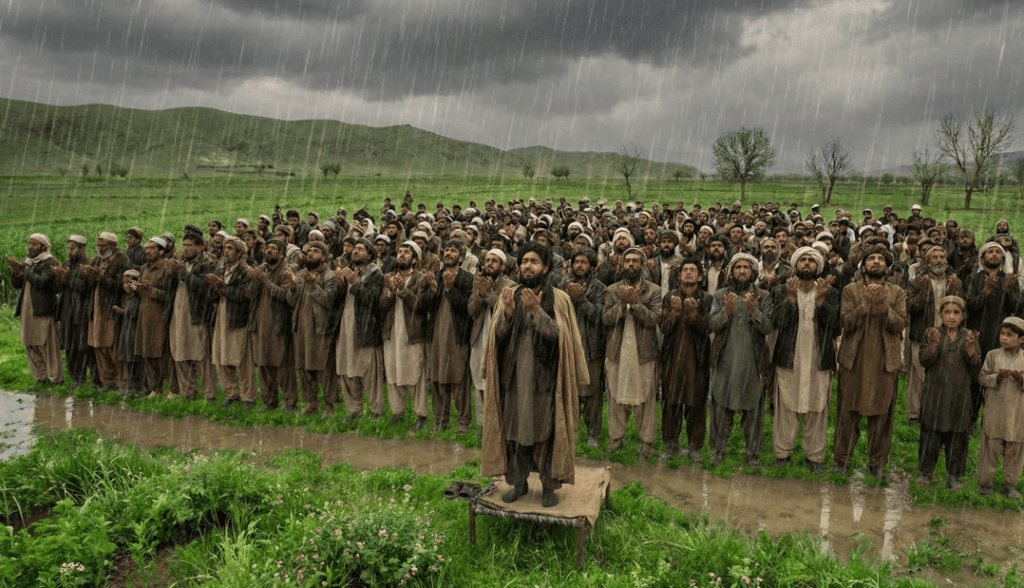
Salatul Istisqa is a special prayer taught by Islam to seek Allah’s mercy in the form of rain during times of drought, water shortage, or prolonged dryness. It reflects a believer’s humility, repentance, and complete reliance on Allah alone.
Jurisprudential Definition and Background
In Islamic jurisprudence, Istisqa means asking Allah for rain. It is a Sunnah act of worship performed collectively when rain is withheld and hardship spreads among people, animals, and crops.
From the earliest times, humanity has recognized that rain is beyond human control. Islam directs people to turn to Allah in such moments with sincerity, repentance, and supplication. Istisqa is not merely asking for rain—it is a return to Allah with humility and obedience.
Hadiths about Asking for Rain
Numerous authentic hadiths confirm that the Prophet ﷺ regularly supplicated for rain and taught the Ummah how to do so. He emphasized humility, raising hands in du‘a, and seeking forgiveness, showing that rain is closely linked with Allah’s mercy.
These narrations establish that asking Allah for rain is an act of worship and a Sunnah practice followed by the Companions and later generations.
Well-Known Cases of Salatul Istisqa
The life of the Prophet ﷺ contains many famous instances of Istisqa. At times, he prayed from the pulpit; at other times, he went to an open field with the people. In every case, Allah responded—sometimes immediately, sometimes abundantly.
These incidents prove that Istisqa can be performed in different ways, all rooted in Sunnah and sincerity.
Salatul Istisqa and the Manner of Istisqa’
Salatul Istisqa is a practical expression of faith. The Prophet ﷺ performed it with humility, simple clothing, and deep reliance on Allah, teaching Muslims that relief comes only from the Creator.
How to Pray Salatul Istisqa for Rain?
Salatul Istisqa is prayed as two rak‘ahs, similar to the Eid prayer:
- No adhan or iqamah
- Recitation is done aloud
- Extra takbeers are said in each rak‘ah
- After prayer, a sermon and heartfelt du‘a are made
When to Offer Salatul Istisqa?
There is no fixed or compulsory time for Salat Al-Istisqa.
- It is recommended after sunrise, like Eid prayer time
- It can be offered whenever rain is needed
- It should not be prayed during disliked prayer times
This flexibility reflects Allah’s mercy and openness to supplication.
Where to Offer the Prayer of Rain?
The Sunnah is to offer Salat Al-Istisqa in an open area (musalla) rather than inside a mosque. This public gathering strengthens unity and collective humility.
However, praying inside the mosque is allowed if circumstances require it.
related post :
| awwabin namaz |
| salatul tasbeeh |
| taraweeh namaz |
| Tahiyyatul Wudhu |
| tahiyatul masjid |
| qasar namaz |
| qaza namaz |
| salat ul hajat |
| salatul tauba |
| istikhara namaz |
| salatul kusuf |
How to Offer Salatul Istisqa?
The correct Sunnah method includes:
- Wearing simple, modest clothing
- Walking calmly and humbly
- Raising hands excessively during du‘a
- Turning the cloak inside out as a sign of hope for change
- Facing the Qiblah during supplication
The imam leads the people in repentance, remembrance, and prayer.
Rulings concerning Salatul Istisqa
Salat Al-Istisqa is a confirmed Sunnah, not obligatory. Scholars recommend that it be preceded by:
- Repentance from sins
- Returning people’s rights
- Giving charity
- Encouraging taqwa and obedience
Sins are among the causes of rain being withheld, while repentance invites mercy.
Other Rulings
- Beautifying oneself excessively is discouraged
- Perfume should be avoided
- Children, elders, and the needy may attend
- Humility is more important than outward appearance
Salatul Istisqa Intention (Niyyah)
There is no verbal intention required.
Make the intention in your heart:
“I intend to pray two rak‘ahs of Salat Al-Istisqa seeking rain from Allah.”
Best Time for Salatul Istisqa
- There is no fixed or compulsory time
- The recommended time is after sunrise, similar to the Eid prayer (about 15–20 minutes after sunrise)
- It may be performed any time when voluntary prayers are allowed
- It should not be performed during prohibited prayer times
Place of Prayer
- The Sunnah is to perform Salat Al-Istisqa in an open area (musalla)
- It may be prayed inside the mosque if necessary
Dress Code and Attitude
- Wear simple and modest clothing
- Do not beautify or wear perfume
- Walk calmly, humbly, and with sincerity
- Show humility, need, and repentance before Allah
Method of Salatul Istisqa (Step-by-Step)
1. No Adhan or Iqamah
There is no call to prayer (adhan) and no iqamah for Salat Al-Istisqa.
2. Two Rak‘ahs Like Eid Prayer
Salat Al-Istisqa consists of two rak‘ahs, performed in the same manner as the Eid prayer.
First Rak‘ah
- The imam begins with Takbiratul Ihram (Allahu Akbar)
- He then says seven additional takbeers
- Between the takbeers, the imam praises Allah, sends blessings upon the Prophet ﷺ, and makes brief supplications
- Surah Al-Fatihah is recited aloud
- Another surah is recited aloud (such as Surah Al-A‘la)
- The rak‘ah is completed normally
Second Rak‘ah
- Upon standing, the imam says five additional takbeers
- Between each takbeer, remembrance of Allah is made
- Surah Al-Fatihah is recited aloud
- Another surah is recited aloud (such as Surah Al-Ghashiyah)
- The rak‘ah is completed normally
3. Khutbah (Sermon) After the Prayer
- After completing the prayer, the imam delivers one sermon
- The sermon includes:
- Seeking forgiveness (Istighfar)
- Encouraging repentance from sins
- Advising charity and obedience to Allah
- Reciting Qur’anic verses
- Seeking forgiveness (Istighfar)
- The imam then makes lengthy and sincere du‘a
4. Raising Hands and Turning the Cloak
- During the du‘a, the imam raises his hands high
- He turns his cloak inside out, placing the right side on the left and the left on the right
- The congregation also faces the Qiblah and raises their hands
- This symbolizes hope for a change in circumstances—from drought to rain
Salatul Istisqa 9 Dua in Arabic and translation
1. Short & Powerful Istisqa Duʿa
Arabic
اللَّهُمَّ أَغِثْنَا، اللَّهُمَّ أَغِثْنَا، اللَّهُمَّ أَغِثْنَا
Transliteration
Allahumma aghithnā,
Allahumma aghithnā,
Allahumma aghithnā
Translation
O Allah, grant us rain.
O Allah, grant us rain.
O Allah, grant us rain.
2. Most Famous & Complete Rain Duʿa
Arabic
اللَّهُمَّ أَسْقِنَا غَيْثًا مُغِيثًا، مَرِيئًا، مَرِيعًا، نَافِعًا غَيْرَ ضَارٍّ، عَاجِلًا غَيْرَ آجِلٍ
Transliteration
Allahumma asqinā ghaythan mughīthan,
marī’an, marī‘an, nāfi‘an ghayra dārr,
‘ājilan ghayra ājil
Translation
O Allah, send down upon us rain that brings relief, is wholesome, abundant, beneficial and not harmful—immediate and not delayed.
3. Duʿa for People, Animals & Land
Arabic
اللَّهُمَّ اسْقِ عِبَادَكَ وَبَهَائِمَكَ، وَانْشُرْ رَحْمَتَكَ، وَأَحْيِ بَلَدَكَ الْمَيِّتَ
Transliteration
Allahumma’sqi ‘ibādaka wa bahā’imaka,
wanshur raḥmataka,
wa aḥyi baladakal-mayyit
Translation
O Allah, give water to Your servants and animals, spread Your mercy, and revive Your dead land.
4. Duʿa of Absolute Humility (Prophetic Sermon Duʿa)
Arabic
اللَّهُمَّ أَنْتَ اللَّهُ لَا إِلٰهَ إِلَّا أَنْتَ، أَنْتَ الْغَنِيُّ وَنَحْنُ الْفُقَرَاءُ، أَنْزِلْ عَلَيْنَا الْغَيْثَ، وَاجْعَلْ مَا أَنْزَلْتَ لَنَا قُوَّةً وَبَلَاغًا إِلَى حِينٍ
Transliteration
Allahumma anta-Allāh,
lā ilāha illā anta,
anta-l-ghaniyyu wa naḥnu-l-fuqarā’,
anzil ‘alaynā-l-ghayth,
waj‘al mā anzalta lanā quwwatan wa balāghan ilā ḥīn
Translation
O Allah, You are Allah, none has the right to be worshipped but You. You are Self-Sufficient and we are needy. Send down rain upon us and make it a source of strength and provision for a time.
5. Duʿa When Rain Becomes Excessive
Arabic
اللَّهُمَّ حَوَالَيْنَا وَلَا عَلَيْنَا، اللَّهُمَّ عَلَى الْآكَامِ وَالظِّرَابِ وَبُطُونِ الْأَوْدِيَةِ وَمَنَابِتِ الشَّجَرِ
Transliteration
Allahumma ḥawālaynā wa lā ‘alaynā,
Allahumma ‘alā-l-ākāmi wa-ẓ-ẓirābi
wa buṭūni-l-awdiyah
wa manābiti-sh-shajar
Translation
O Allah, let it fall around us and not upon us; upon hills, mountains, valleys, and places of vegetation.
6. Duʿa at the Start of Rainfall
Arabic
اللَّهُمَّ صَيِّبًا نَافِعًا
Transliteration
Allahumma ṣayyiban nāfi‘ā
Translation
O Allah, make it beneficial rain.
7. Duʿa for Mercy & Protection from Harm
Arabic
اللَّهُمَّ اجْعَلْهُ رَحْمَةً وَلَا تَجْعَلْهُ عَذَابًا، وَلَا هَدْمًا، وَلَا غَرَقًا
Transliteration
Allahumma’j‘alhu raḥmah,
wa lā taj‘alhu ‘adhāban,
wa lā hadman,
wa lā gharaqā
Translation
O Allah, make it a mercy and not a punishment, destruction, or flooding.
8. Duʿa When Hearing Thunder
Arabic
سُبْحَانَ اللَّهِ الَّذِي يُسَبِّحُ الرَّعْدُ بِحَمْدِهِ وَالْمَلَائِكَةُ مِنْ خِيفَتِهِ
Transliteration
Subḥānallāhi-lladhī yusabbiḥu-r-ra‘du biḥamdihī
wa-l-malā’ikatu min khīfatih
Translation
Glory be to Allah, Whom the thunder glorifies with praise, and so do the angels out of fear of Him.
9. Short Collective Duʿa (For Jama‘at)
Arabic
اللَّهُمَّ ارْحَمْنَا بِالْغَيْثِ، وَلَا تَجْعَلْنَا مِنَ الْقَانِطِينَ
Transliteration
Allahumma’rḥamnā bil-ghayth,
wa lā taj‘alnā mina-l-qāniṭīn
Translation
O Allah, have mercy on us with rain and do not make us among those who despair.
Author request : We pray to Allah that times of famine and hardship never reach us. However, if such trials come due to the consequences of our sins, we should sincerely turn to Allah and participate in Salat Al-Istisqa, offering it collectively with humility and repentance. We ask Allah Almighty to protect all Muslims from sins and safeguard us from every calamity. If there is any mistake or oversight in this post, please feel free to correct it.
Conclusion
Salatul Istisqa is a beautiful Sunnah that reminds Muslims that rain, sustenance, and relief come only from Allah. In times of drought and hardship, Islam teaches us not to despair, but to return to Allah with humility, repentance, and sincere supplication. This prayer is not merely a request for rain; it is a spiritual awakening that calls hearts back to obedience, gratitude, and complete reliance on the Creator. By following the method taught by the Prophet ﷺ, seeking forgiveness, and correcting our actions, we open the doors of Allah’s mercy for ourselves, our communities, and future generations.
Call to Action
Whenever drought, water shortage, or hardship strikes, revive the Sunnah of Salatul Istisqa in your community. Encourage repentance, give charity, restore people’s rights, and turn to Allah with united hearts. Make sincere du‘a—individually and collectively—believing with certainty that Allah hears and responds. Let us not wait for trials to deepen; rather, let us act now by strengthening our connection with Allah and seeking His mercy through prayer, obedience, and trust in Him alone
FAQs Salatul Istisqa (Prayer for Rain)
You pray 2 Rakats in congregation (Jama’at) behind an Imam. It is similar to Eid prayer: the first Rakat has extra Takbeers, and there is a sermon (Khutbah) after the prayer. You then make intense Dua for rain.
What is the meaning of Namaz e Istisqa?
It means “Prayer for Seeking Rain.” It is a special prayer to ask Allah for water during a drought.
What is the time for Istisqa Namaz? It can be prayed at any time except the prohibited times (sunrise, sunset, and when the sun is directly overhead). The best time is in the morning (Chasht time), about 20 minutes after sunrise.
How to pray Istikhara step by step?
- Make Wudu.
- Pray 2 Rakats of voluntary prayer (Nafl).
- After the Salam (finishing prayer), recite the specific Dua of Istikhara.
- When reciting, mention your need/decision where indicated.
What is Salat e Istasqa offered for?
It is offered specifically to ask Allah to send rain when there is a lack of water or a drought.
What are the conditions for Solat Istisqa?
There should be a genuine need (drought). People should repent (Tawbah) for their sins beforehand. It is best performed in an open field (outside the mosque) in congregation.
How many Rakats do you pray for Istikhara?
You pray 2 Rakats.
What are the benefits of Salatul Kusuf?
Salatul Kusuf (Solar Eclipse Prayer) reminds Muslims of Allah’s power and that the sun and moon follow His command. It is a time for forgiveness, charity, and connecting with Allah during a fearful event.
How do I know Istikhara is working?
It is not about seeing a dream. You will know it is working if:
- You feel a sense of peace or inclination toward one choice.
- Or, circumstances change to make the right path easier and the wrong path harder/blocked.
Can I read Istikhara Dua from my phone? Yes.
If you haven’t memorized it, reading it from a phone or paper is perfectly fine.
What is the right time to do Istikhara?
You can do it at any time of the day or night, except during the prohibited prayer times (sunrise, sunset, zenith). The last third of the night is often recommended for Dua, but it is not mandatory.
Can I pray Istikhara right now? Yes,
as long as the sun is not currently rising, setting, or directly overhead.
How to perform Salatul Ishraq?
Pray your Fajr prayer, then remain seated in your place remembering Allah (Dhikr) until the sun has fully risen (about 15-20 minutes after sunrise). Then, stand up and pray 2 Rakats.
Who leads the Solat-Istisqa prayer?
An Imam leads the prayer for the congregation.
What if I feel confused after Istikhara?
You can repeat the Istikhara prayer (scholars suggest up to 7 times). If you are still confused, consult wise and pious people (Istishara) and make the most logical decision while trusting Allah.
How do I perform Dua e Istikhara?
Raise your hands after the 2 Rakats and recite the Dua reported by Prophet Muhammad (SAW). You can find the text in any prayer book or online.
What are common mistakes people make during Istikhara?
- Thinking they must see a dream (this is a myth).
- Praying it for things that are already obligatory (like “Should I pray today?”).
- Having already made up their mind before praying (you should be neutral and open to Allah’s guidance).
Can I touch my wife’s breast during fasting? Yes, it is permissible.
Touching, hugging, or kissing one’s spouse is allowed while fasting, provided one is confident they can control themselves. If there is a risk it will lead to sexual intercourse or ejaculation (which breaks the fast), it must be avoided.
Is it important to sleep after Istikhara? No.
Sleeping is not a requirement for Istikhara. You can continue with your day after the prayer.
Does Allah forgive mistakes in Salah? Yes.
Allah is Most Merciful. If the mistake was unintentional, it is forgiven. For minor errors (like forgetting to sit), there is Sujud Sahw (Prostration of Forgetfulness) to correct the prayer. If a major part is missed, you simply repeat the prayer.