
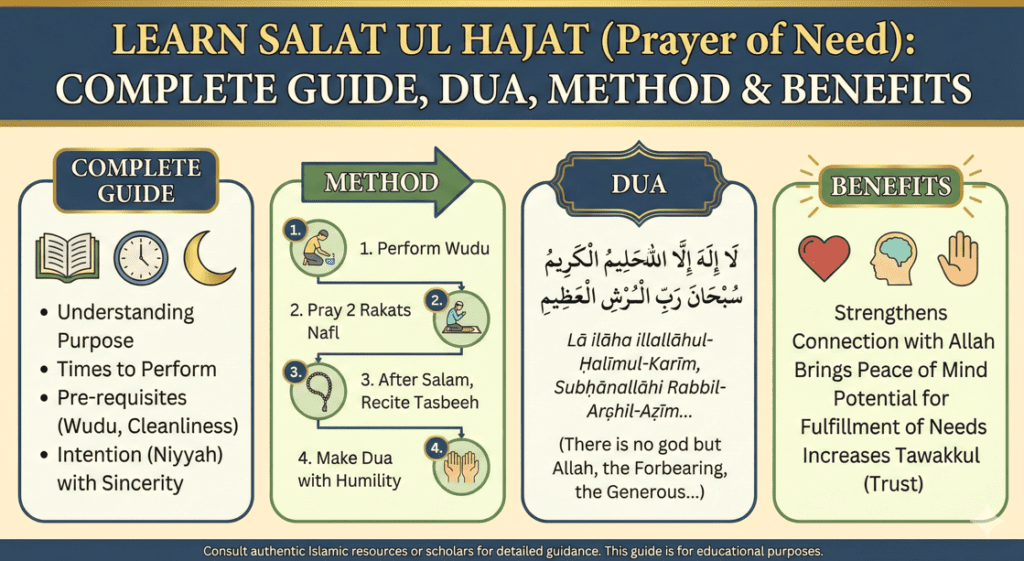
There are moments in a person’s life when every door seems closed and the heart turns only toward Allah. Salat ul Hajat (Prayer of Need) is a voluntary prayer offered when someone is facing difficulties, worries, or urgent needs and seeks help from Allah. This prayer teaches patience, trust, and firm belief that every problem has a solution only with Allah.
In this complete guide, we will explain the meaning of Salat ul Hajat, its purpose and significance, evidence from the Quran and Hadith, the best time to pray, a step-by-step method, the recommended dua with translation, Salat ul Hajat for marriage, its benefits, and common FAQs in a simple and authentic way. In the end, you will learn how Salat ul Hajat brings peace to a believer’s heart and draws their supplications closer to Allah.
Author’s Practice:
The author actively follows the Sunnah, regularly performs Salatul Hajat and other voluntary prayers, and applies authentic Islamic teachings in daily life, ensuring guidance is based on personal practice as well as scholarly knowledge.
What is Salat ul Hajat?
Salat ul Hajat is a voluntary (nafl) prayer performed when a person is facing a specific need, hardship, or important matter and seeks help directly from Allah. It is a form of worship that allows a believer to express weakness before Allah and ask for His mercy, guidance, and assistance.
Meaning of Salat ul Hajat
The word “Hajat” means a need, request, or necessity. Salatul Hajat literally means “the prayer performed for a need”, where a servant turns to Allah with sincerity and hope.
Definition of Salat ul Hajat in Islam
In Islam, Salat ul Hajat refers to a nafl salah offered outside the obligatory prayers, followed by sincere dua, with the intention of seeking Allah’s help in worldly or spiritual matters while fully trusting His wisdom and decree.
Purpose & Significance of Salat ul Hajat
Purpose of the Prayer of Need
The primary purpose of Salat ul Hajat is to seek Allah’s help when facing hardship, uncertainty, or an important need. It is a sincere way for a believer to place their concerns before Allah with humility and hope.
Importance of Salat ul Hajat in Islam
Salat ul Hajat holds great importance as it strengthens faith and reminds Muslims that true help comes only from Allah. It builds patience, reliance, and inner peace during challenging times.
Worship Allah According to the Sunnah
Offering Salatul Hajat reflects the Sunnah-based approach of turning to salah and dua for guidance and relief. It teaches believers to combine trust in Allah with proper Islamic worship and sincere supplication.
Evidence from Quran & Hadith
Quranic Verses Related to Hajat
The Quran repeatedly encourages believers to turn to Allah in times of need and distress. Allah says that He responds to the call of the one who calls upon Him with sincerity (Surah Al-Baqarah 2:186). Another verse highlights that relief comes after hardship, teaching believers to place hope only in Allah (Surah Ash-Sharh 94:5–6). These verses form the foundation of seeking help through prayer and dua.
Hadith on Salatul Hajat
Several narrations mention offering voluntary prayer and making dua when a need arises. A hadith reported in Tirmidhi states that whoever has a need should perform salah and then supplicate to Allah. Scholars explain that this reflects the prophetic method of connecting salah with dua, showing humility before Allah during times of need.
Authenticity & Degree of Salat ul Hajat Hadith
Scholars of hadith have differed regarding the strength of specific narrations about Salat al-Hajah. While some chains are considered weak, many scholars allow its practice because it falls under general voluntary prayer and supplication. Renowned scholars and Awliya (rahimahumullah) have emphasized that praying nafl salah and making sincere dua is firmly supported by Quranic principles and established Sunnah practices.
Best Time to Pray Salat ul Hajat
Best and Permissible Times
Salat ul Hajat may be offered at any time when voluntary prayers are allowed, especially during moments of calm and focus. The last third of the night is considered highly virtuous, as the Prophet ﷺ mentioned that Allah’s mercy is closest to those who supplicate at this time (Bukhari, Muslim). This period encourages sincerity and deep concentration in dua.
Can Salat ul Hajat Be Prayed Daily?
Yes, Salatul Hajat can be performed whenever a genuine need arises, even on a regular basis. Scholars and pious elders (Awliya Allah rahimahumullah) have emphasized consistency in turning to Allah through prayer, as it strengthens reliance on Him and keeps the heart connected to divine help.
Times When Prayer Is Disliked
Islam teaches that voluntary prayers should be avoided at certain times, such as immediately after Fajr until sunrise and after Asr until sunset, as mentioned in authentic hadith. Observing these guidelines shows respect for the Sunnah and ensures that Salatul Hajat is performed in a manner pleasing to Allah.
How to Perform Salat ul Hajat (Step-by-Step)
Preparation & Niyyah
Salat ul Hajat begins with proper preparation, just like any other salah. One should perform wudu, ensure clean clothing and a clean place, and face the Qiblah with a calm and focused heart. The niyyah is made in the heart to pray Salatul Hajat for seeking help from Allah; it does not need to be spoken aloud. Sincerity and humility are essential, as the purpose of this prayer is to rely completely on Allah.
Number of Rakats
Salat ul Hajat is generally prayed as two rakats of nafl salah, although some scholars also mention four rakats. There is flexibility in this matter, as it falls under voluntary prayers. What matters most is devotion, correct performance, and sincerity rather than a fixed number of rakats.
Complete Method of Salat ul Hajat
The prayer is performed like a normal nafl salah. Begin with Takbir al-Ihram, recite Surah Al-Fatiha followed by any other surah in each rakat, perform ruku and sujood properly, and complete the prayer with tashahhud, durood, and salam. One should pray calmly, avoiding haste, and focus fully on standing before Allah. After completing the rakats, remain seated for supplication.
How to Make Dua After Salat ul Hajat
Now, after completing your prayer, praise Allah, send blessings upon the Prophet Muhammad ﷺ(peace and blessings be upon him), and then make the supplication you need most. Perform your prayer with humility, conviction, and trust in Allah’s wisdom. Scholars and righteous people (may Allah have mercy on them) have emphasized that the acceptance of prayers depends on sincerity, pure intentions, and patience, for Allah answers in the best way and at the most opportune time..
Salat ul Hajat Dua (Arabic)
1
اللَّهُمَّ إِنِّي أَسْأَلُكَ وَأَتَوَجَّهُ إِلَيْكَ بِنَبِيِّكَ مُحَمَّدٍ ﷺ نَبِيِّ الرَّحْمَةِ،
يَا مُحَمَّدُ إِنِّي تَوَجَّهْتُ بِكَ إِلَى رَبِّي فِي حَاجَتِي هَذِهِ لِتُقْضَى،
اللَّهُمَّ فَشَفِّعْهُ فِيَّ.
Salatul Hajat Dua Arabic to English Translation
O Allah, I ask You and turn to You through Your Prophet Muhammad ﷺ, the Prophet of mercy.
O Muhammad, I turn through you to my Lord regarding this need of mine, so that it may be fulfilled.
O Allah, accept his intercession on my behalf.
(Another well-known supplication recited for Hajat):
2
لَا إِلَهَ إِلَّا اللَّهُ الْحَلِيمُ الْكَرِيمُ
سُبْحَانَ اللَّهِ رَبِّ الْعَرْشِ الْعَظِيمِ،
الْحَمْدُ لِلَّهِ رَبِّ الْعَالَمِينَ،
أَسْأَلُكَ مُوجِبَاتِ رَحْمَتِكَ،
وَعَزَائِمَ مَغْفِرَتِكَ،
وَالْغَنِيمَةَ مِنْ كُلِّ بِرٍّ،
وَالسَّلَامَةَ مِنْ كُلِّ إِثْمٍ،
لَا تَدَعْ لِي ذَنْبًا إِلَّا غَفَرْتَهُ،
وَلَا هَمًّا إِلَّا فَرَّجْتَهُ،
وَلَا حَاجَةً هِيَ لَكَ رِضًا إِلَّا قَضَيْتَهَا،
يَا أَرْحَمَ الرَّاحِمِينَ.
Another well-known supplication for needs: Arabic to English translation
There is no god but Allah, the Most Forbearing, the Most Generous.
Glory be to Allah, Lord of the Mighty Throne.
All praise is for Allah, Lord of the worlds.
I ask You for the means of Your mercy and the certainty of Your forgiveness,
for gain in every good deed and safety from every sin.
Do not leave any sin of mine except that You forgive it,
nor any worry except that You remove it,
nor any need that pleases You except that You fulfill it,
O Most Merciful of those who show mercy.
Adhkar After Salat ul Hajat
After completing Salatul Hajat, it is highly recommended to engage in adhkar (remembrance of Allah) and send blessings upon the Prophet ﷺ. This practice enhances sincerity, spiritual focus, and increases the chances of acceptance of your dua, as emphasized by the Quran, hadith, and sayings of Awliya Allah (rahimahumullah).
Recommended Dhikr (Arabic, Transliteration & English)
Some recommended dhikr after Salatul Hajat include:
- سُبْحَانَ اللهِ – SubhanAllah – “Glory be to Allah”
- الْحَمْدُ لِلَّهِ – Alhamdulillah – “All praise is due to Allah”
- اللَّهُ أَكْبَرُ – Allahu Akbar – “Allah is the Greatest”
The Quran mentions:
“ألا بذكر الله تطمئن القلوب” – “Indeed, in the remembrance of Allah do hearts find rest” (Surah Ar-Ra‘d 13:28).
Engaging in this dhikr after prayer brings calmness to the heart and strengthens the connection with Allah.
Sending Durood Before & After Dua (Arabic, Transliteration & English)
Sending blessings upon the Prophet ﷺ is a must before and after making dua, as mentioned in hadith: “A dua is suspended until durood is sent upon me” (Tirmidhi). The Durood-e-Ibrahimi is the most authentic and commonly recited:
Arabic:
اللَّهُمَّ صَلِّ عَلَى مُحَمَّدٍ وَعَلَى آلِ مُحَمَّدٍ
كَمَا صَلَّيْتَ عَلَى إِبْرَاهِيمَ وَعَلَى آلِ إِبْرَاهِيمَ
إِنَّكَ حَمِيدٌ مَجِيدٌ
اللَّهُمَّ بَارِكْ عَلَى مُحَمَّدٍ وَعَلَى آلِ مُحَمَّدٍ
كَمَا بَارَكْتَ عَلَى إِبْرَاهِيمَ وَعَلَى آلِ إِبْرَاهِيمَ
إِنَّكَ حَمِيدٌ مَجِيدٌ
Transliteration:
Allahumma salli ‘ala Muhammad wa ‘ala aali Muhammad,
kama sallayta ‘ala Ibrahim wa ‘ala aali Ibrahim,
innaka Hamidun Majid.
Allahumma barik ‘ala Muhammad wa ‘ala aali Muhammad,
kama barakta ‘ala Ibrahim wa ‘ala aali Ibrahim,
innaka Hamidun Majid.
English Meaning:
O Allah! Send Your blessings on Muhammad and the family of Muhammad,
as You sent Your blessings on Ibrahim and the family of Ibrahim.
Indeed, You are Praiseworthy, Glorious.
O Allah! Bless Muhammad and the family of Muhammad,
as You blessed Ibrahim and the family of Ibrahim.
Indeed, You are Praiseworthy, Glorious.
Reciting this Durood before and after your dua not only shows respect for the Sunnah but also increases the likelihood of acceptance of your prayer, as taught by the Prophet ﷺ and practiced by Awliya Allah (rahimahumullah).
Salat ul Hajat for Marriage (Nikah) – Complete Process
Salatul Hajat can be offered for any lawful need, including marriage. When someone wishes to seek Allah’s guidance and blessings in finding a righteous spouse or for a successful nikah, this prayer provides spiritual support, humility, and reliance on Allah.
1. Preparation
- Perform wudu (ablution) properly.
- Ensure a clean and quiet place to pray.
- Dress modestly and face the Qiblah.
- Make a sincere intention (niyyah) in your heart: “I am offering this Salatul Hajat seeking Allah’s help for my marriage.”
- Focus on complete humility and trust in Allah’s wisdom.
2. Number of Rakats
- Two rakats are sufficient, though some scholars mention four rakats.
- Offer it calmly, with full concentration, as this is a voluntary (nafl) prayer.
3. Performing the Prayer
- Begin with Takbir al-Ihram.
- Recite Surah Al-Fatiha in each rakat, followed by any other surah (commonly Surah Al-Ikhlas, Al-Falaq, or An-Nas).
- Perform ruku and sujood properly.
- Complete the prayer with tashahhud, durood, and salam.
Tip: Keep your heart and mind focused on your need while praying. Avoid distractions.
4. Dua for Nikah / Marriage
Arabic:
اللَّهُمَّ رَبَّنَا هَبْ لِي زَوْجًا صَالِحًا يَرْضَاكَ وَيُقَرِّبُنِي إِلَيْكَ
وَاجْمَعْ بَيْنِي وَبَيْنَهُ فِي الْخَيْرِ وَالْمَغْفِرَةِ
Transliteration:
Allahumma Rabbana hab li zawjan salihan yardhaka wa yuqarribuni ilayka,
wajma’ bayni wa baynahu fil khairi wal maghfirah.
English Meaning:
O Allah, our Lord, grant me a righteous spouse who pleases You and brings me closer to You,
and unite us in goodness and forgiveness.
Optional Additional Supplication
You can also say:
Arabic:
رَبَّنَا هَبْ لَنَا مِنْ أَزْوَاجِنَا وَذُرِّيَّاتِنَا قُرَّةَ أَعْيُنٍ وَاجْعَلْنَا لِلْمُتَّقِينَ إِمَامًا
Transliteration:
Rabbana hab lana min azwajina wa dhurriyyatina qurrata a’yunin waj’alna lilmuttaqeena imama.
English Meaning:
Our Lord, grant us from our spouses and offspring the comfort of our eyes, and make us leaders for the righteous.
5. Common Duas for Salatul Hajat / Nikah (English)
- Righteous Spouse
- “O Allah, grant me a spouse who pleases You and brings me closer to You.”
- “O Allah, grant me a spouse who pleases You and brings me closer to You.”
- Blessed Marriage
- “O Allah, bless our marriage with goodness and barakah.”
- “O Allah, bless our marriage with goodness and barakah.”
- Good Offspring
- “O Allah, make our children a source of joy and guide them on the righteous path.”
- “O Allah, make our children a source of joy and guide them on the righteous path.”
- Harmony & Understanding
- “O Allah, keep love, understanding, and cooperation between us.”
- “O Allah, keep love, understanding, and cooperation between us.”
- Relief from Delays & Hardship
- “O Allah, remove any obstacles in my marriage and grant it at the right time according to Your wisdom.”
- “O Allah, remove any obstacles in my marriage and grant it at the right time according to Your wisdom.”
- Acceptance of Prayers
- “O Allah, accept this dua of mine and grant me the right spouse.”
Benefits of Salat ul Hajat
Acceptance of Dua
One of the main benefits of Salatul Hajat is that it increases the likelihood of Allah accepting your supplications. When prayed sincerely, with humility and full reliance on Allah, this nafl prayer opens the door for Allah’s guidance and help in fulfilling legitimate needs, as emphasized in Quran 2:186 and various hadith.
Relief from Difficulties
Salatul Hajat provides spiritual support during times of hardship, anxiety, or confusion. Turning to Allah with a sincere heart brings ease, reduces stress, and helps the believer remain patient, trusting that every problem has a solution with Allah’s will.
Peace of Heart & Strong Iman
Regular performance of this prayer strengthens faith (iman) and brings inner peace. The remembrance of Allah through salah and adhkar restores mental clarity, instills confidence, and fosters a deep sense of reliance on Allah alone, as highlighted by the sayings of Awliya Allah (rahimahumullah).
Note:
To the best of my knowledge, this guide has been written with full care and attention. If you notice any errors or inaccuracies, please feel free to correct them.
Conclusion:
Salat ul Hajat is a profound voluntary prayer that allows a believer to turn to Allah with sincerity, humility, and complete trust during times of need, whether for personal difficulties, marriage, or any lawful request. Through this prayer, one learns patience, reliance on Allah, and the importance of combining effort with supplication.
The practice of Salatul Hajat encompasses preparation, correct performance of rakats, recitation of masnoon duas, and engaging in recommended adhkar and Durood-e-Ibrahimi. It is supported by the Quran, Hadith, and the teachings of Awliya Allah (rahimahumullah), emphasizing that Allah listens to the sincere supplications of His servants.
Performing this prayer regularly not only increases the acceptance of dua but also brings relief from difficulties, strengthens faith (iman), and instills inner peace. When offered for marriage or Nikah, it provides spiritual guidance, clarity, and divine blessings for a righteous and harmonious relationship.
Ultimately, Salatul Hajat is more than just a prayer for needs; it is a means of spiritual connection, trust, and closeness to Allah. By following the step-by-step method, making heartfelt dua, and reciting adhkar consistently, every believer can experience the tranquility, support, and mercy that this prayer offers.
Take the first step today: dedicate time to perform Salatul Hajat with sincerity, combine it with lawful efforts for your needs, and witness the spiritual and practical benefits it brings to your life.
FAQs: Salat ul Hajat Zamaz Guide
1. What is Salat-ul-Hajat and when should it be performed?
It is a voluntary (Nafl) prayer performed when a Muslim has a specific need or worry. You can perform it whenever you have a pressing need, day or night, except during forbidden times.
2. Is Salat-ul-Hajat mentioned in the Hadith?
Yes, it is mentioned in several traditions, notably in Jami` at-Tirmidhi and Sunan Ibn Majah, where the Prophet (PBUH) taught a specific dua for those in need.
3. What are the main benefits of praying Salat-ul-Hajat?
It strengthens your reliance on Allah, brings peace of mind, and is a direct spiritual method to ask Allah to fulfill your lawful needs or remove difficulties.
4. What is the difference between Salat-ul-Hajat and Salat-ul-Istikhara?
Salat-ul-Hajat is prayed when you know what you want and ask Allah to give it to you. Salat-ul-Istikhara is prayed when you are confused and ask Allah to guide you to the right decision.
5. How to perform Salat-ul-Hajat step-by-step?
Perform Wudu, pray 2 Rakats of Nafl prayer, praise Allah (Tahmeed), send blessings on the Prophet (Salawat), recite the specific Dua of Hajat, and then ask for your need.
6. How many Rakats are in Salat-ul-Hajat?
The most common view involves praying 2 Rakats. Some scholars also mention 4 Rakats, but 2 is the standard practice.
7. What is the specific Dua for Salat-ul-Hajat?
The specific supplication starts with “La ilaha illallahul Halimul Karim…” (There is no god but Allah, the Forbearing, the Generous). It is best to read the full Arabic text or its translation.
8. Which Surahs should be recited in Salat-ul-Hajat?
You can recite any Surah after Al-Fatiha. Commonly, people recite Ayat-ul-Kursi in the first Rakat and Surah Ikhlas in the second, but this is not mandatory.
9. What is the best time to perform Salat-ul-Hajat?
The last third of the night (before Fajr namaz) is considered the most powerful time for acceptance, but it is valid at any time that is not forbidden.
10. Can I perform Salat-ul-Hajat after Isha or Tahajjud?
Yes, performing it after the Isha prayer or combining it with Tahajjud is an excellent practice.
11. For how many days should I perform Salat-ul-Hajat?
There is no fixed limit. You can perform it once, or repeat it for 3 to 7 days (or longer) until your heart feels satisfied or the need is met.
12. Can Salat-ul-Hajat be performed during prohibited (Makruh) times?
No. You should avoid praying during Sunrise, Sunset, and Zawal (when the sun is at its highest point).
13. Can I pray Salat-ul-Hajat for marriage or love marriage?
Yes, it is permissible to pray Salat-ul-Hajat to ask Allah for a righteous spouse or to remove obstacles in marriage.
14. Can I perform Salat-ul-Hajat for exams or job success?
Yes, you can perform this prayer for any lawful worldly need, including passing exams, finding a job, or business success.
15. Can women perform Salat-ul-Hajat during menstruation (periods)?
No, women cannot offer the Salah (prayer) during menstruation. However, they can perform Wudu (for cleanliness), sit on the prayer mat, and recite the Dua of Hajat to ask for their needs.