
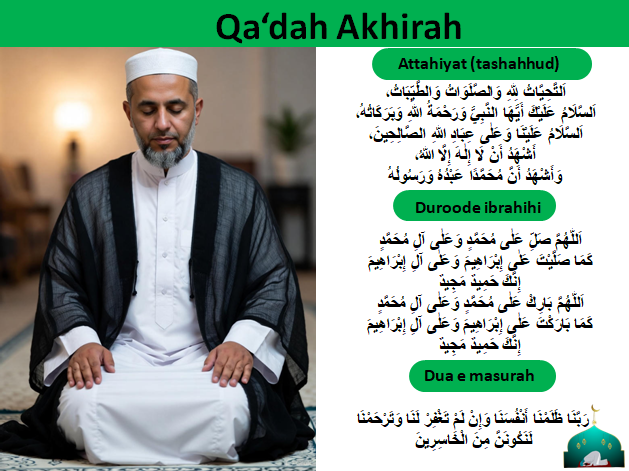
In this post, we will learn that the sixth obligatory act (Farz) of Qadah Akhirah in Namaz. In this obligation, we sit in the final rak‘ah of every prayer and recite the Tashahhud. If, for any reason, this Farz is not performed correctly, the prayer becomes invalid. Therefore, in the following sections, we will explain this obligation in detail.
1. Introduction to Qadah Akhirah in Namaz
Meaning in English and Arabic
The Arabic word “Qa‘dah” (قعدة) means “to sit”, and “Akhirah” (أخيرة) means “the last”. In English, it is called “the Final Sitting.”
Definition and Purpose
Qa‘dah Akhirah in Namaz refers to sitting for a duration long enough to complete the Tashahhud (Attahiyat) in the final rak‘ah of prayer after performing the two prostrations. Its purpose is to conclude the prayer properly by praising Allah, sending blessings upon the Prophet ﷺ, and making supplication for success in the Hereafter.
In the Light of the Qur’an and Authentic Hadith
The Messenger of Allah ﷺ said:
“When you sit in the final rak‘ah of prayer, recite the Tashahhud…” (Sahih Bukhari)
Various narrations in Bukhari and Muslim confirm that the Prophet ﷺ always remained seated at the end of prayer long enough to recite the Tashahhud.
2. Obligatory Rulings: Is Qadah Akhirah in Namaz?
Why It Is Essential
According to Hanafi Fiqh, Qa‘dah Akhirah is the sixth Farz (obligatory pillar) of Salah. Without it, the prayer is incomplete and invalid.
Farz, Wajib, and Sunnah Acts
- Farz: Sitting in the final rak‘ah for the time required to complete “Attahiyatu lillahi…” (Tashahhud).
- Wajib: Reciting the words of Tashahhud verbally.
- Sunnah: After Tashahhud, reciting Durood-e-Ibrahim and then any Masnoon (authentic) supplication is Sunnah Mu’akkadah (emphasized Sunnah).
Conditions (Shart) for Validity
For this sitting to be valid, it must be performed after completing the rak‘ah and before giving Salam.
3. Correct Method: How to Sit in Qadah Akhirah in Namaz
Correct Posture (Legs, Hands, Fingers)
For Men:
Keep the right foot upright with the toes facing the Qiblah, and sit on the left foot. Place both hands on the thighs with fingers naturally extended.
For Women:
For women, Tawarruk is Sunnah—sitting with both legs extended toward the right side while resting on the ground.
How Long to Remain
At minimum, it is Farz to sit long enough to complete the Tashahhud. It is preferable (Afzal) to remain seated until the Durood and supplications are completed.
For Beginners and Children
When teaching children, explain in simple words that this is “the final moment of speaking to Allah” in prayer. Encourage them to sit calmly and learn the Tashahhud with focus and respect.
4. Recitations Qadah Akhirah in Namaz: attahiyat(Tashahhud), Durood ibrahimi, and Masnoon Duas
Importance of Recitation
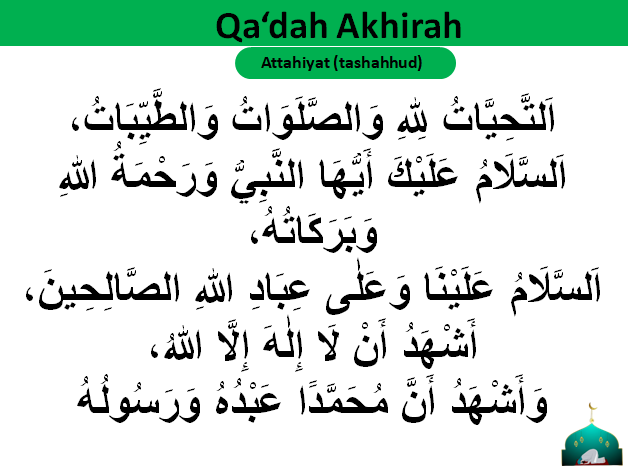
attahiyat(Tashahhud): In it, we bear witness to the Oneness of Allah and the Prophethood of Muhammad ﷺ.
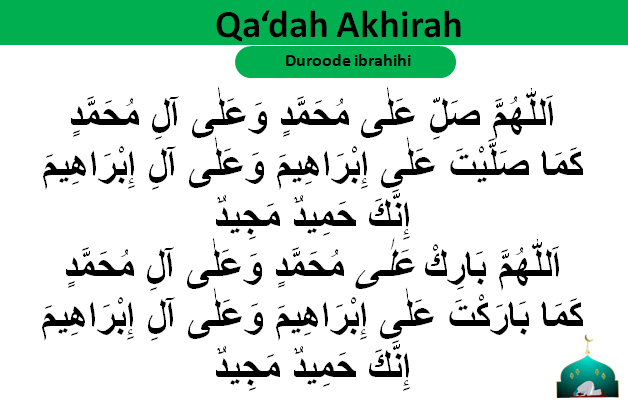
Durood-e-Ibrahim: A means of expressing love and sending blessings upon the Prophet ﷺ.
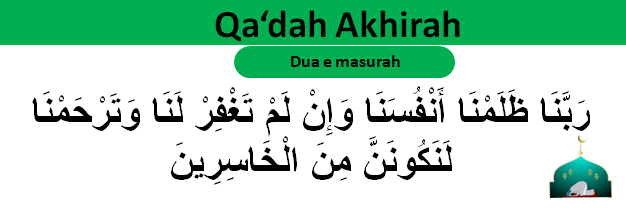
Supplications (Duas): Duas made before Salam are highly accepted, such as
Spiritual Benefits
This sitting is a silent conversation between the servant and Allah. It refreshes faith, brings peace to the heart, and strengthens spiritual awareness.
Namaz-related post:
| Namaz Rakat Guide Table |
| fajr namaz rakat |
| zohar namaz rakat |
| asr namaz rakat |
| maghrib namaz rakat |
| isha namz rakat |
| practicaly method namaz |
| witr namaz |
| sunnat namaz |
| jumma namaz rakat |
5. Troubleshooting: Common Mistakes and Solutions
Common Mistakes
Many people rush and do not complete the Tashahhud properly, or they fail to position their feet correctly. If a person forgets to recite the Tashahhud, Sajdah Sahw becomes necessary.
Missing the Sitting
- If someone forgetfully stands up, but has not yet performed the next sajdah, they should return to the sitting position and perform Sajdah Sahw at the end.
- If the final sitting (which is Farz) is deliberately omitted, the prayer becomes invalid (Batil) and must be repeated.
Difference Between Jalsah and Qa‘dah Akhirah
- Jalsah: Sitting between the two prostrations (a Wajib or Sunnah act).
- Qa‘dah Akhirah: Sitting at the very end of the prayer (a Farz act).
Author Note: This article has been prepared with the intention of providing authentic, clear, and easy-to-understand guidance on Qa‘dah Akhirah, one of the essential components of Salah. The content is based on the Qur’an, authentic Hadith, and established principles of Islamic jurisprudence, particularly according to the Hanafi school, while maintaining respect for scholarly differences. Our aim is to help readers perform their prayers correctly, with understanding, sincerity, and devotion. Any benefit in this work is from Allah alone, and any shortcomings are due to human limitation. May Allah accept this effort and make it a source of guidance for all.
Conclusion Qadah Akhirah in Namaz
Qa‘dah Akhirah is a fundamental part of Salah that completes the prayer. By sitting correctly, reciting Tashahhud, and making du‘a with sincerity, a believer fulfills this obligation and strengthens their connection with Allah.
Review your own prayer and ensure you observe Qa‘dah Akhirah properly. Practice it with focus, teach it to others, and share this guide so more Muslims can improve the quality of their Salah. May Allah accept our worship. Ameen.
FAQs Qadah Akhirah in Namaz
1. What is Qa‘dah Akhirah in Salah?
Qa‘dah Akhirah is the final sitting in prayer, performed in the last rak‘ah after the two prostrations, where Tashahhud is recited.
2. Is Qa‘dah Akhirah Farz in Namaz?
Yes. According to Hanafi Fiqh, Qa‘dah Akhirah is a Farz (obligatory pillar). If it is missed, the prayer becomes invalid.
3. How long should one sit in Qa‘dah Akhirah?
At minimum, one must sit long enough to complete the Tashahhud (Attahiyat). It is recommended to remain seated for Durood and du‘a as well.
4. What is recited in Qa‘dah Akhirah?
First, Tashahhud (Attahiyat) is recited, followed by Durood-e-Ibrahim, and then any masnoon (authentic) supplication before Salam.
5. What happens if Qa‘dah Akhirah is missed?
If it is intentionally omitted, the prayer is invalid and must be repeated. If missed unintentionally, the ruling depends on when it is remembered and may require Sajdah Sahw.
6. Is Salah valid without Qa‘dah Akhirah?
No. In Hanafi jurisprudence, Salah is not valid without performing Qa‘dah Akhirah.
7. What is the correct posture in Qa‘dah Akhirah?
Men sit on the left foot with the right foot upright and toes toward the Qiblah. Women sit in Tawarruk, with both legs extended to the right side.
8. What is the difference between Jalsah and Qa‘dah Akhirah?
Jalsah is the sitting between two prostrations. Qa‘dah Akhirah is the final sitting at the end of the prayer and is Farz.
9. Do women sit differently in Qa‘dah Akhirah?
Yes. It is Sunnah for women to sit in Tawarruk, placing both legs to the right side while seated.
10. Does missing Tashahhud in Qa‘dah Akhirah require Sajdah Sahw?
If the Wajib recitation of Tashahhud is forgotten, Sajdah Sahw is required. However, if the Farz sitting itself is omitted, the prayer must be repeated.