
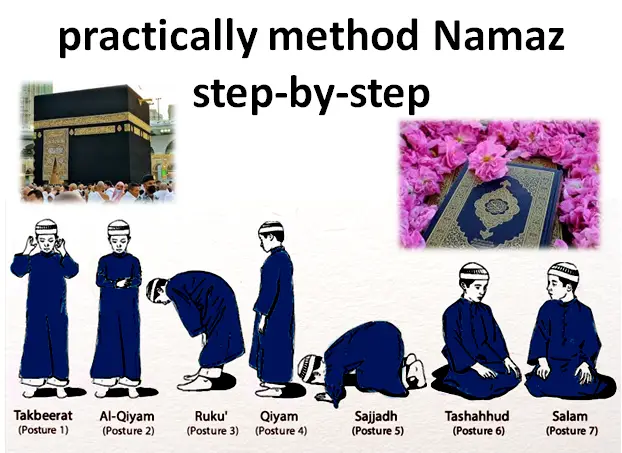
full namaz steps and practicaly method Namaz is one of the fundamental pillars of Islam and is obligatory upon every Muslim. Allah says in the Qur’an: “Establish prayer; indeed, prayer restrains from immorality and wrongdoing.” (Surah Al-Ankabut 29:45). The Prophet Muhammad ﷺ said: “Islam is built upon five pillars, and establishing prayer is one of them.” (Sahih Bukhari, Sahih Muslim). Namaz connects a believer with Allah and brings discipline, peace, and spiritual strength into daily life.
Namaz (Salah) is offered while facing the Qiblah in a state of cleanliness after completing Wudu. The prayer begins with a sincere intention in the heart, followed by raising the hands and saying Allahu Akbar to enter the prayer. The worshipper then stands and recites Surah Al-Fatihah along with additional verses from the Qur’an. After standing, one bows in Ruku, praising Allah, then returns to an upright position before going into Sujud, where the forehead touches the ground in humility. Each unit includes two prostrations with a brief sitting between them.
This sequence forms one Rakat, and prayers are made up of 2, 3, or 4 Rakats depending on the specific Salah. In longer prayers, a sitting (Tashahhud) is performed after two Rakats, and in the final sitting, Tashahhud and Durood are recited before ending the prayer by turning the head to both sides with Salaam. The daily obligatory prayers consist of Fajr (2 Rakats), Dhuhr (4 Rakats), Asr (4 Rakats), Maghrib (3 Rakats), and Isha (4 Rakats).
Every Muslim is obligated to perform five daily prayers—
Before offering Salah, it is essential to attain purity (Taharah). After that, one should perform wudu properly and wear clean and modest clothing. Facing the Qiblah, the prayer should then be offered with sincerity and devotion.
Full Steps Namaz
Takbeer-e-Tahreema – Allahu Akbar

Perform ablution, face the Qibla, stand with your feet apart by a distance of four fingers, and raise both hands to your ears, so that your thumbs touch the earlobes, with your palms facing the Qibla. Then make your intention and say “Allahu Akbar,” and fold your hands. Your gaze should be directed towards the place of prostration.
Sana

After namaz Allahu Akbar, recite the Sana.
Ta’awwuz / Tasmiyah


Then recite Ta’awwuz and Tasmiyah.
Surah Al-Fatiha
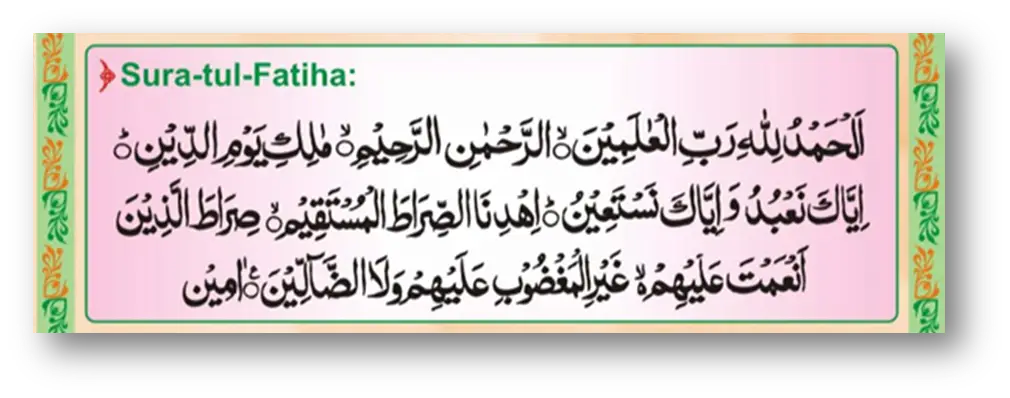
And recite Surah Fatiha and say Ameen softly.
Surah ikhlas
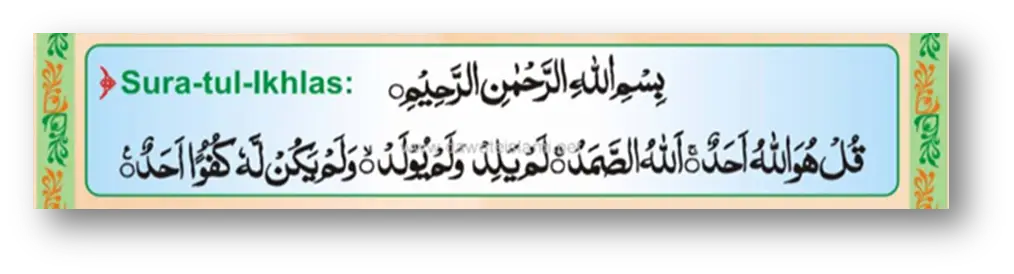
After this, recite a surah or three verses, or one verse that is equivalent to three short verses.
If you are performing four rakats, then in the first rakat, recite a long surah followed by a short surah.
For example,
Long surah: Surah Al-Fil, etc.
Short surah: Surah Al-Ikhlas, etc.
Ruku

Then, saying “Allahu Akbar,” go into the bowing position (ruku’), holding your knees with your hands in such a way that your palms are on your knees, your fingers are spread wide, your back is straight, and your head is level with your back, neither too high nor too low. Then recite the glorification “Subhana Rabbial Azeem” three to seven times, keeping your gaze fixed on your toes.
Tasmee“

After that, he should recite “Sami’allahu liman hamidah” and stand up straight. If he is praying alone, he should also say “Rabbana wa lakal hamd.”
Tahmeed

If you are praying behind the Imam, then only recite “Rabbana wa lakal hamd”.
Sajdah
Then, saying “Allahu Akbar,” go into prostration in such a way that you first place your knees on the ground, then your hands, then your nose between your hands, and then your forehead, so that your forehead and the bridge of your nose are firmly on the ground. Keep your arms away from your sides and your stomach away from your thighs and calves, and ensure that the tips of all the toes of both feet are facing the Qibla.
And your palms should be spread out, and your fingers should be pointing towards the Qibla. Then say “Subhana Rabbial A’la” 3-7 times. Then raise your head, then straighten your hands and your right foot so that its toes are facing the Qibla, and spread out your left foot and sit firmly on it. Place your palms on your thighs near your knees. Then, saying “Allahu Akbar,” go into prostration again and perform the prostration as before. Then raise your head, then place your hands on your knees and stand up on the balls of your feet. Now, recite only “Bismillahir Rahmanir Rahim” and begin the recitation. Then perform the bowing and prostration as before, and then sit down with your left foot spread out and recite the Tashahhud, keeping your gaze on your nose.
Tashahhud
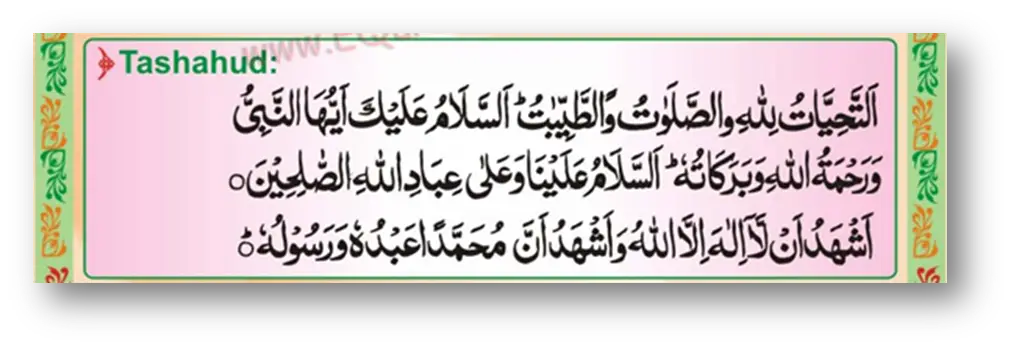
Now recite the Tashahhud. While reciting the Tashahhud, when you reach the word “La,لا” in the Kalimah, form a circle with the middle finger and thumb of your right hand, and keep the little finger and the one next to it joined to the palm. Raise the index finger (finger of testimony) at the word “La,لا “ but do not move it.
Then lower it at the word “Illa, الا” and immediately straighten all your fingers. Now, if you have to pray more than two rak’ahs, stand up and pray in the same way, but in the rak’ahs of the obligatory prayers (the third and fourth rak’ahs), it is not necessary to recite a surah after Al-Fatiha. Now, in the last sitting (which is called the fourth rak’ah’s sitting or the final sitting), after reciting the Tashahhud, recite Durood-e-Ibrahimi. Your gaze should be towards your lap.
Duroode ibraheemi
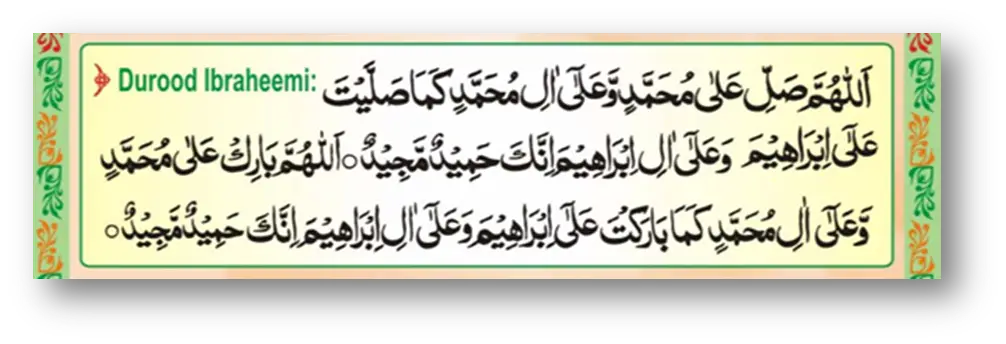
After this, recite Durood Ibraheemi.
Dua-e-masoorah
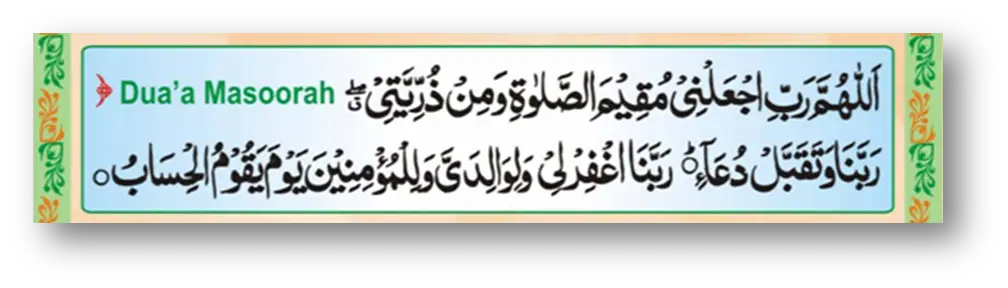
After this, recite any Masura prayer (a prayer found in the Quran).
Salaam

Finally, complete the prayer by turning your head to the right and then to the left (saying “peace be upon you” each time). Your gaze should be directed towards your shoulders on both sides.
activity practically method Namaz
Now is the time to strengthen your connection with Allah. Make prayer a daily habit, pray on time, and perform each prayer with complete sincerity and humility. Start today by learning the correct way to pray, understanding its meaning, and incorporating it into your daily life. Remember, prayer is not only an obligation but also a source of peace, guidance, and success in this world and the hereafter. Establish your prayers today, and let the light of prayer illuminate your life.
Faqs-Practically Method Namaz Steps
1. What is read in Namaz?
In Namaz, we read Surah Al-Fatiha, another Surah from the Quran, Tasbih in Ruku and Sujood, Tashahhud, Durood, and Dua.
2. How many rakats to read in Namaz?
There are 5 daily prayers with different rakats:
- Fajr: 2 Farz
- Zuhr: 4 Farz
- Asr: 4 Farz
- Maghrib: 3 Farz
- Isha: 4 Farz + 3 Witr
3. What to read in Namaz step by step?
- Niyyah (intention)
- Takbeer (Allahu Akbar)
- Sana
- Surah Al-Fatiha
- Another Surah
- Ruku (Subhana Rabbiyal Azeem)
- Sujood (Subhana Rabbiyal A‘la)
- Tashahhud, Durood, Dua
- Salam
4. How to read 5 times Namaz?
Pray Fajr, Zuhr, Asr, Maghrib, and Isha at their fixed times every day.
5. How to say 4 rakat farz Namaz?
Make intention in your heart:
“I intend to pray 4 rakat Farz for Allah, facing the Kaaba.”
6. How to get a dua 100% accepted?
Pray with sincerity, ask after Namaz, avoid haram, and trust Allah’s wisdom.
7. How to pray namaz for beginners?
Start with Farz prayers, learn Surah Fatiha, short Surahs, and pray slowly.
8. Can I pray all 5 prayers at once?
No. Each Namaz must be prayed at its own time, except in special cases.
9. What are the 7 points in salah?
- Face (forehead & nose)
- Two hands
- Two knees
- Toes of both feet
10. How to pray full Namaz?
Perform Wudu, make intention, pray rakats correctly, and end with Salam.
11. What are the 7 steps of wudu?
- Wash hands
- Rinse mouth
- Clean nose
- Wash face
- Wash arms
- Masah of head
- Wash feet
12. How to pray as a beginner?
Learn step by step, pray regularly, and don’t rush.
13. Can kissing break wudu?
No, kissing does not break wudu unless something invalidating happens.
14. What are the 4 Farz of wudu?
- Wash face
- Wash arms
- Masah of head
- Wash feet
15. Is wudu valid without Bismillah?
Yes, wudu is valid, but saying Bismillah is Sunnah.
16. Why is 3AM God’s hour?
It is a time when Allah accepts duas, especially in the last part of the night.
17. What is the 5 finger prayer?
A reminder to pray 5 daily prayers, not an Islamic obligation.
18. What is a simple prayer?
“Ya Allah, forgive me, guide me, and bless me. Ameen.”