
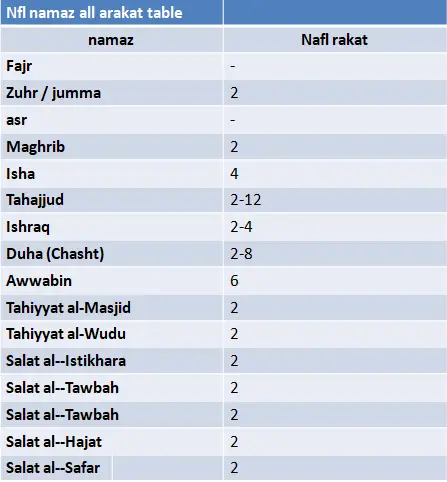
Nafl namaz are voluntary prayers in Islam that are not obligatory but bring great reward and help a believer grow closer to Allah. They are usually prayed in units of two rakats and may be offered at most times of the day, except during prohibited periods such as sunrise, sunset, and midday. Common examples include Tahajjud, Duha (Chasht), Awwabin, Tahiyatul Masjid, Istikhara, and Salat al-Hajah. Although both Sunnah and Nafl are voluntary, Sunnah prayers are those regularly practiced by the Prophet ﷺ, while Nafl refers to additional optional acts of worship performed for extra blessings.
This article explains what Nafl prayers are, their rewards, types, correct method according to authentic Hadith, and how to incorporate them into daily life.
What Are Nafl Namaz?
Nafl Namaz are optional prayers performed in addition to the five daily Fard Salah. They are not obligatory, but Allah grants great reward for performing them sincerely.
The Prophet ﷺ said:
“The first matter that the slave will be brought to account for on the Day of Judgment is the prayer. If it is sound, then the rest of his deeds will be sound. If it is corrupt, then the rest of his deeds will be corrupt. If there is any deficiency in the obligatory prayer, Allah will say: ‘See if My slave has any voluntary prayers to make up for it.’”
(Tirmidhi)
This Hadith shows that Nafl prayers help complete short comings in Fard prayers.
Rewards
Nafl Namaz carries many spiritual and worldly benefits:
- Draws a person closer to Allah
- Strengthens faith (Iman)
- Completes deficiencies in Fard prayers
- Brings peace of heart and mind
- Becomes a means of forgiveness
- Elevates ranks in the Hereafter
- Helps in acceptance of Duas
Allah says in a Hadith Qudsi:
“My servant continues to draw closer to Me with voluntary deeds until I love him.”
(Bukhari)
Types of Nafl Salah
Below are the most important and authentic Nafl Namaz, explained simply:
1. Tahajjud Prayer
Time: After Isha and before Fajr (best in the last third of the night)
Rak‘ahs: Minimum 2, no maximum
Tahajjud is the most powerful Nafl prayer. The Prophet ﷺ never abandoned it.
Allah says:
“And during part of the night, pray Tahajjud as an extra prayer for you.”
(Qur’an 17:79)
2. Ishraq Prayer
Time: About 15–20 minutes after sunrise
Rak‘ahs: 2 or 4
Whoever prays Fajr in congregation and then prays Ishraq gets the reward of Hajj and Umrah (Hadith – Tirmidhi).
3. Chasht (Duha) Prayer
Time: After sunrise until before Zuhr
Rak‘ahs: 2–8 (some scholars allow more)
It is a prayer of gratitude and forgiveness.
4. Awwabin Prayer
Time: After Maghrib prayer
Rak‘ahs: 6 (commonly)
Known as the prayer of those who frequently return to Allah.
5. Tahiyyat al-Masjid-nafl namaz
Time: Upon entering a mosque
Rak‘ahs: 2
The Prophet ﷺ said:
“When one of you enters the mosque, he should pray two rak‘ahs before sitting.”
(Bukhari, Muslim)
6. Tahiyyat al-Wudu
Time: After making Wudu
Rak‘ahs: 2
Bilal رضي الله عنه was praised by the Prophet ﷺ for consistently praying this Nafl.
7. Salat al-Istikhara
Time: Any permissible time
Rak‘ahs: 2
Performed when seeking Allah’s guidance in a decision.
8. Salat al-Safar
Time: Before or during a journey
Rak‘ahs: 2
This prayer seeks protection and blessings during travel.
9. Salat al-Tawbah
Time: Anytime (except disliked times)
Rak‘ahs: 2
Prayed after committing a sin with sincere repentance.
10. Salat al-Hajat
Time: Any permissible time
Rak‘ahs: 2
Offered when one has a strong need or difficulty and seeks Allah’s help.
How to Pray Nafl Namaz
The method namaz/ salah is the same as Fard, with minor flexibility.
Step 1: Make Intention (Niyyah)
- Intention is made in the heart
- No need to say it aloud
Step 2: Takbir
- Raise hands and say Allahu Akbar
Step 3: Recitation
- Recite Surah Al-Fatihah
- Recite another Surah or verses
Step 4: Ruku
- Bow calmly and recite Subhana Rabbiyal Azeem
Step 5: Sujood
- Prostrate properly and recite Subhana Rabbiyal A‘la
Step 6: Complete Rak‘ahs
- Nafl is usually prayed two rak‘ahs at a time
- End with Tashahhud and Salam
Time for Nafl Namaz
Nafl prayers can be prayed anytime, except during Makruh (disliked) times:
- During sunrise
- When the sun is at its peak
- During sunset
Otherwise, Nafl prayers are flexible and easy to perform.
How to Nafl Namaz According to Authentic Hadiths
- Pray with calmness and humility (Khushu‘)
- Do not rush Ruku and Sujood
- Offer Nafl secretly when possible
- Pray consistently, even if little
The Prophet ﷺ said:
“The most beloved deeds to Allah are those done regularly, even if they are small.”
(Bukhari)
Incorporating Nafl Prayer into Daily Routine
You don’t need extra time—just sincerity:
- Pray 2 Nafl after Wudu
- Add Duha prayer in the morning
- Pray 2 Nafl before sleeping
- Offer Tahajjud once or twice a week
- Pray Nafl during times of stress
Consistency matters more than quantity.
Conclusion
Nafl prayers are a gift from Allah—a way to earn closeness, forgiveness, and peace without obligation. They strengthen faith, beautify worship, and elevate a believer’s status in the Hereafter.
By incorporating Nafl Salah into daily life, a Muslim follows the Sunnah of the Prophet ﷺ and walks a path of spiritual growth.
Faqs-Nafl Namaz Rakat
1. What are Nafl prayers?
Nafl prayers are voluntary prayers offered in addition to the five daily Fard prayers. They are not compulsory but bring great reward and closeness to Allah.
2. What is the niyat for Nafl prayer?
Niyyah is made in the heart. Simply intend that you are praying Nafl Salah for Allah. No words are required to be spoken aloud.
3. How to perform 2 rak‘at Nafl Namaz?
Pray it like any normal prayer:
Niyyah → Takbir → Surah Al-Fatihah → another Surah → Ruku → Sujood → second rak‘at → Tashahhud → Salam.
4. Is Tahajjud Sunnah or Nafl?
Tahajjud is a Nafl prayer, but it is highly recommended (Sunnah practice) of the Prophet ﷺ.
5. Can I pray 2 rak‘at Nafl anytime?
Yes, you can pray Nafl at any time except during Makruh (disliked) times like sunrise, sunset, and midday.
6. How to perform 12 rak‘at Nafl?
Pray 2 rak‘ahs at a time, completing Salam after every 2 rak‘ahs until you finish 12.
7. Which Nafl prayer is best?
Tahajjud is the best and most virtuous Nafl prayer.
8. Is Nafl rak‘at compulsory?
No, Nafl prayers are not compulsory.
9. How do Muslims pray for beginners?
Beginners start by learning Wudu, then 2 rak‘ahs, memorizing Surah Al-Fatihah, and following the basic steps of Salah slowly.
10. What happens if I miss a Nafl prayer?
There is no sin for missing Nafl prayers, but you miss out on extra reward.
11. What are common mistakes in Namaz?
Rushing the prayer, lack of concentration, improper Ruku or Sujood, and praying without understanding.
12. Can I pray only 2 rak‘at Tahajjud?
Yes, even 2 rak‘ahs of Tahajjud bring great reward.
13. Can I repeat Salah if I made a mistake?
Yes, you can repeat the prayer to correct mistakes, especially if a major error occurred.
14. Can I skip Nafl Namaz?
Yes, you can skip Nafl without sin, but regular Nafl brings more reward.
15. Can I make du‘a during Nafl prayer?
Yes, du‘a can be made in Sujood and after completing the prayer.
16. How to start a Nafl prayer?
Make intention in the heart, face the Qiblah, raise hands, and say Allahu Akbar.
17. Is it Sunnah to shower with your wife?
There is no specific command making it Sunnah, but it is permissible in Islam.
18. Is Salat al-Hajat Sunnah or Nafl?
Salat al-Hajat is a Nafl prayer offered when one has a need or difficulty.