
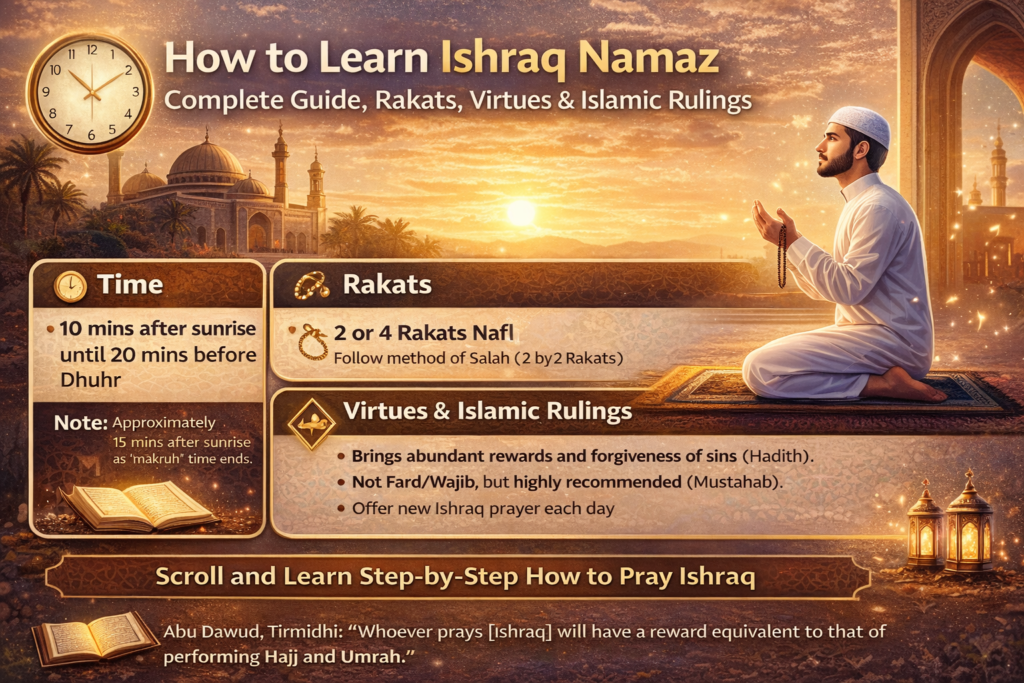
Ishraq Namaz is a voluntary (Nafl) prayer consisting of 2 to 12 rak‘ahs, offered about 15–20 minutes after sunrise, once the sun has fully risen. Its time begins shortly after sunrise and continues until just before Zawal (midday). It is performed in sets of 2 rak‘ahs like other Sunnah or Nafl prayers. Ishraq is especially rewarding when a person prays Fajr and then remains seated in the same place, engaged in dhikr, tasbih, or Qur’an recitation until sunrise, and then offers the prayer.
The Prophet Muhammad ﷺ mentioned that the one who performs Fajr in congregation, remains in remembrance of Allah until sunrise, and then prays two rak‘ahs receives a reward equivalent to a complete Hajj and Umrah. Ishraq brings immense blessings, forgiveness of sins, and spiritual benefits. It is also considered the early time of Salat al-Duha (Chasht), with some scholars describing it as the beginning portion of Duha prayer.
Qur’an References Related to Ishraq Namaz
Although Ishraq namaz is not mentioned by name in the Qur’an, its time and virtue are supported by general verses encouraging morning remembrance and prayer.
Allah says:
“So glorify Allah when you reach the evening and when you reach the morning.”
(Surah Ar-Rum 30:17)
This verse highlights the importance of remembering Allah in the morning hours, which includes voluntary prayers like Ishraq and Duha.
Allah also says:
“And glorify Him in the early morning and afternoon.”
(Surah Al-Ahzab 33:42)
Scholars explain that this includes nafl prayers performed after sunrise, such as Ishraq and Duha.
Hadith References on Ishraq Namaz
Hadith on Reward Equal to Hajj and Umrah
The Prophet ﷺ said:
“Whoever prays Fajr in congregation, then sits remembering Allah until the sun rises, then prays two rakats, will have a reward like that of Hajj and Umrah, complete, complete, complete.”
(Tirmidhi, Hadith 586 – Hasan)
This hadith is the strongest evidence for the virtue of Ishraq prayer.
Hadith on Duha Prayer Recommendation
The Prophet ﷺ said:
“Charity is due on every joint of a person each day the sun rises, and two rakats of Duha suffice for that.”
(Sahih Muslim, Hadith 720)
This hadith shows that Duha (which includes Ishraq time) is highly recommended.
Hadith on Regular Practice of Duha
Abu Hurairah (RA) reported:
“My beloved Prophet ﷺ advised me to fast three days every month, to pray two rakats of Duha, and to pray Witr before sleeping.”
(Bukhari & Muslim)
This proves that Duha prayer was a regular Sunnat practice.
What Is Ishraq namaz?
Ishraq prayer is a voluntary prayer offered when the sun has fully risen. It is prayed by those who remain in dhikr after Fajr until sunrise. The word “Ishraq” refers to the shining or rising of the sun.
Ishraq Namaz and Duha Prayer
Ishraq and Duha prayers are closely related and often considered the same in essence. Ishraq is prayed at the early time of Duha, soon after sunrise. Duha prayer can also be offered later in the morning.
Ishraq Prayer: Sunnat or Obligatory?
Ishraq prayer is not obligatory. It is a nafl (voluntary) prayer encouraged through authentic hadith. Performing it regularly brings reward but missing it carries no sin.
Duha Prayer Recommended in Islam?
Yes, Duha prayer is highly recommended in Islam. The Prophet ﷺ advised his companions to perform Duha prayer regularly. It is a means of charity for the body and a source of blessings.
Ishraq namaz benefits
Best Time to Perform Ishraq Namaz
The time for Ishraq prayer begins about 10–15 minutes after sunrise. The sun should be clearly above the horizon. This time marks the start of Duha prayer as well.
Number of Rakats in Ishraq Namaz
The minimum rakats for Ishraq namaz are two. More rakats can be offered as Duha prayer later in the morning. Most people pray two rakats for Ishraq.
Ishraq Namaz Method
After Fajr, remain seated while remembering Allah or reciting the Qur’an until the sun has fully risen.
Once the sun has risen, make a sincere intention and offer two rakats of nafl (Ishraq) prayer like any regular salah.
In each rakat, recite Surah Al-Fatihah followed by any other Surah.
- Intention (Niyyah): Make a sincere intention in your heart to pray two rakats of Ishraq for the sake of Allah.
- Start the Prayer: Begin the prayer by saying Takbir (Allahu Akbar).
- Recitation: Recite Surah Al-Fatihah, followed by any short surah.
- Ruku (Bowing): Bow down calmly, placing your hands on your knees.
- Sujud (Prostration): Perform two sujud with humility and focus.
- Second Rakat: Stand up and repeat the same steps for the second rakat.
- Tashahhud and Taslim: Sit for Tashahhud, then end the prayer by saying Taslim (As-salamu alaykum) on both sides.
Ishraq namaz table chart
| Topic | Details |
|---|---|
| Prayer Name | Ishraq (Duha) Prayer |
| Prayer Type | Nafl (Voluntary) |
| Time | 10–15 minutes after sunrise |
| Minimum Rakats | 2 Rakats |
| Maximum Rakats | No fixed limit (Duha can be up to 8 or more) |
| Before Which Prayer | After Fajr |
| Method | Same as normal nafl prayer |
| Ruku & Sujud | Yes |
| Surah to Recite | Surah Al-Fatihah + any Surah |
| Best Place | Mosque or home |
| Reward | Like Hajj and Umrah (as mentioned in Hadith) |
| Obligation | Not compulsory |
| Alternative Name | Early Duha / Chasht |
| Common Mistake | Praying before sunrise |
Common Mistakes to Avoid in Ishraq Namaz
One of the most common mistakes is Ishraq namaz before the sun has fully risen. Ishraq prayer can only be offered after sunrise, when the sun is clearly above the horizon; praying it earlier is not valid. Another serious mistake is intentionally missing the Fajr prayer and then performing Ishraq. Ishraq prayer does not replace Fajr, and the reward mentioned in hadith is linked to offering Fajr first.
Some people also mistakenly believe that Ishraq prayer is compulsory (farz or wajib). In reality, Ishraq is a nafl (voluntary) prayer, and leaving it does not carry any sin. It should be performed with sincerity and love, not as an obligation. Additionally, one should avoid rushing the prayer without proper concentration and avoid fixed assumptions about exact minutes; it is safer to wait a short time after sunrise before praying Ishraq.
Conclusion
Ishraq (Duha) prayer is a beautiful and highly rewarding nafl prayer that helps a believer begin the day with remembrance of Allah. By praying Fajr on time and offering two rakats of Ishraq after sunrise, a Muslim gains spiritual peace, discipline, and great reward. Though it is not obligatory, making Ishraq part of daily life brings barakah and closeness to Allah.
Call to Action
Start your day tomorrow with Fajr and Ishraq prayer and experience its spiritual benefits yourself. Make it a habit, even if only two rakats, and feel the positive change in your daily routine. If you found this guide helpful, share it with others and continue learning more about Islamic prayers and Sunnah practices.
How to pray Ishraq namaz?
Pray Fajr first, then sit in dhikr until sunrise. After sunrise, pray 2 rakats nafl.
Faqs-Ishraq Namaz
What are the benefits of Ishraq namaz?
It brings great reward, peace of heart, and blessings in daily life.
Is Ishraq namaz nafl?
Yes, Ishraq namaz is a nafl (voluntary) prayer.
What are common mistakes in praying Ishraq?
Praying before sunrise, missing Fajr intentionally, and thinking it is compulsory.
Is Ishraq 2 or 4 rakat?
Ishraq is 2 rakats. More rakats belong to Duha prayer.
What is the main purpose of Ishraq prayer?
To remember Allah in the morning and gain reward.
What surah to read in Ishraq?
After Surah Al-Fatihah, any surah may be recited.
What is the best time for Ishraq prayer?
About 10–15 minutes after sunrise.
Is it mandatory to pray Ishraq?
No, it is not mandatory.
Can I sleep between Fajr and Ishraq?
Yes, but staying awake brings more reward.
Can we pray Ishraq and Chasht together?
Yes, Ishraq is the early part of Duha (Chasht).
What are the rules for Ishraq prayer?
Pray after sunrise, after Fajr, with sincere intention.
What are the 3 forbidden times to pray?
At sunrise, at midday, and at sunset.
What is the reward of Ishraq?
Reward equal to Hajj and Umrah (as mentioned in hadith).
What time is it forbidden to sleep in Islam?
No fixed forbidden time, though sleeping after Fajr is disliked by some.
Can you pray both Ishraq and Duha?
Yes, Ishraq is part of Duha prayer.
How many minutes after sunrise is Ishraq?
Around 10 to 15 minutes.
What are the benefits of Ishraq prayer?
Peace, forgiveness, and barakah in the day.
What is the forbidden time for Fajr prayer?
After sunrise, Fajr time ends.
How many rakat are in Ishraq prayer?
Ishraq prayer has 2 rakats.