
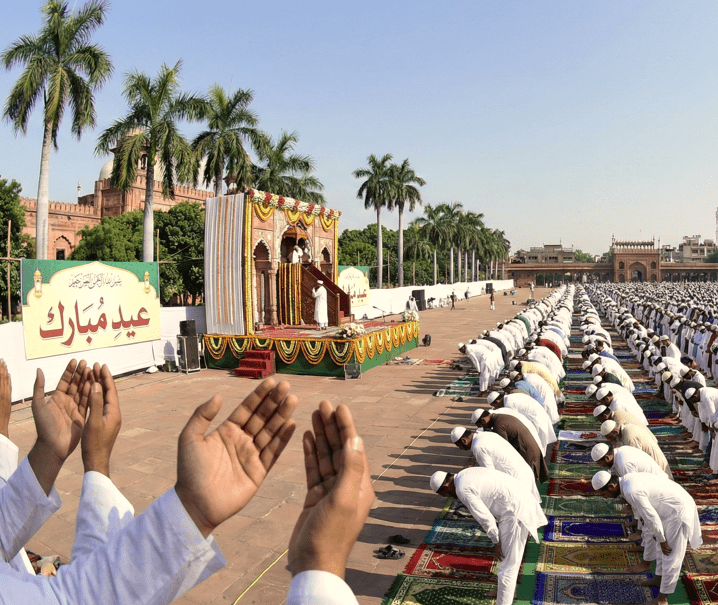
Eid ul Fitr Namaz marks the joyful end of Ramadan. However, since this prayer happens only once a year, many people forget the correct method, Niyyat, or the number of extra Takbeers.
This complete guide for Eid al-Fitr Namaz covers everything you need to know. We explain the step-by-step Hanafi method, the exact Niyyat (Intention), essential Sunnahs, and answer common questions like “What if I join late?”. Read on to ensure your Eid prayer is performed perfectly.
What is Eid al-Fitr Namaz and Its Significance?
Eid ul Fitr Namaz is not just a festival; it is a significant act of worship (Ibadah) performed to express gratitude to Allah for the blessings of Ramadan. After fasting for 29 or 30 days, Muslims gather to offer this special prayer as a sign of submission and thankfulness.
The word “Fitr” means “breaking the fast.” Therefore, this prayer marks the official end of Ramadan and the beginning of the month of Shawwal. It serves as a spiritual celebration where the community unites to glorify Allah (Takbeer) and seek His acceptance for their month-long fasting and prayers.
Author activity: “As an author and a Muslim, I have always made it a priority in my life never to miss the Eid ul Fitr Namaz. For me, it is not just a ritual, but a profound moment of gratitude to Allah after Ramadan that brings immense peace to the heart.
I sincerely urge all my readers to make a special effort for this prayer as well. Perform it yourself, bring your friends along, and do not deprive yourself of the immense blessings of this day.”
Is Namaz Farz, Wajib, or Sunnah?
There is often confusion regarding the ruling of Eid prayer because different schools of thought (Madhabs) classify it differently. It is important to know the ruling according to your school of thought:
- Wajib (Mandatory): According to the Hanafi school (followed by the majority in South Asia like India, Pakistan, Bangladesh), Eid prayer is Wajib. This means it is necessary to perform it, and leaving it without a valid excuse is considered sinful.
- Sunnah Mu’akkadah (Confirmed Sunnah): According to the Shafi’i and Maliki schools, Eid prayer is a highly emphasized Sunnah. While not obligatory, it is strongly recommended not to miss it.
- Fard Kifayah (Communal Obligation): According to the Hanbali school, it is a communal obligation. If enough people in a community perform it, the obligation is lifted from the others.
Verdict: regardless of the technical classification, every Muslim male should make every effort to attend the Eid congregation to uphold the symbol of Islam.
related post
| Namaz Rakat Guide Table |
| fajr namaz rakat |
| zohar namaz rakat |
| asr namaz rakat |
| maghrib namaz rakat |
| isha namz rakat |
| practicaly method namaz |
| witr namaz |
| sunnat namaz |
| jumma namaz rakat |
| nafl namaz |
| namaz e janazah dua |
Namaz Date and Time 2026
- Expected Date: Eid al-Fitr 2026 is expected to fall on Thursday, March 19, 2026, or Friday, March 20, 2026.
- Note: The exact date depends on the sighting of the moon (Chand Raat) for the month of Shawwal.
- Best Time for Namaz: The time for Eid prayer begins approximately 15 to 20 minutes after sunrise (when the sun has risen to the height of a spear) and lasts until Zawal (just before the Dhuhr prayer time).
- Location: It is Sunnah to perform the Eid prayer in an open field (Eidgah), but it can also be performed in large mosques if necessary.
Preparation and Sunnahs for Namaz
Before rushing to the Eidgah, there are several spiritual and physical preparations that a Muslim should undertake. Following the Sunnah of the Prophet Muhammad (PBUH) not only rewards you but also prepares your heart and mind for this blessed occasion.
13 Sunnahs of Eid Day (Ghusl, itar, Miswak)
To make your Eid day truly blessed, try to follow these 13 Sunnahs:
- Wake up early: Rise early to perform Fajr prayer and prepare for the day.
- Perform Fajr at the local Masjid: Before the Eid prayer, ensure you have prayed Fajr.
- Use Miswak: Clean your teeth with a Miswak (tooth-stick).
- Perform Ghusl: Take a ritual bath (Ghusl) to clean your body.
- Wear your best clothes: It is Sunnah to wear the best clothes you possess (new or clean ones).
- Apply Itar: Men should apply itar.
- Eat something sweet: Unlike Eid ul Adha, it is Sunnah to eat something sweet (preferably an odd number of dates) before leaving for Eid ul Fitr prayer.
- Pay Sadaqat-ul-Fitr: Ensure this is paid before the prayer (details below).
- Go to the Eidgah: Perform the prayer in an open ground (Eidgah) rather than inside a mosque, unless there is a valid excuse (like rain).
- Go by foot: If possible, walk to the place of prayer.
- Change your route: Return home via a different route than the one you took to go.
- Recite Takbeer: Recite the Takbeer while going to the prayer area.
- No Nafl Prayer: Do not pray any Nafl prayer at the Eidgah before or after the Eid prayer.
Payment of Sadaqat-ul-Fitr (Before Prayer)
Sadaqat-ul-Fitr (also known as Fitrana) is a charitable obligation that must be paid by every Muslim who has the means.
- Purpose: It serves two purposes: it purifies the fasting person from any indecent act or speech committed during Ramadan, and it provides food for the poor so they can also celebrate Eid.
- Timing: The best time to pay it is before the Eid prayer. If paid after the prayer, it is treated merely as general charity (Sadaqah) and loses the special reward of Fitrana.
Reciting Takbeer-e-Tashreeq on the way to the Eidgah
It is a Sunnah to recite the Takbeer while walking or driving to the prayer ground. This proclaims the greatness of Allah.
The words of the Takbeer are:
arabic:
اللَّهُ أَكْبَرُ، اللَّهُ أَكْبَرُ، لَا إِلَهَ إِلَّا اللَّهُ، وَاللَّهُ أَكْبَرُ، اللَّهُ أَكْبَرُ، وَلِلَّهِ الْحَمْدُ
Transliteration: Allahu Akbar, Allahu Akbar, La ilaha illallahu wallahu Akbar, Allahu Akbar, wa lillahil hamd.
Translation: “Allah is the Greatest, Allah is the Greatest. There is no god but Allah and Allah is the Greatest. Allah is the Greatest and to Allah belongs all praise.”
Note: For Eid ul Fitr, it is recommended to recite this softly (to oneself), whereas for Eid ul Adha, it is recited aloud.
Niyyat for Eid ul Fitr Namaz (Intention)
The most common confusion among worshipers arises regarding the specific words of the Niyyat. It is important to understand that in Islam, Niyyat refers to the intention of the heart. While articulating the words with your tongue is allowed to help focus your mind, the validity of the prayer rests on the resolve in your heart.
Niyyat in Arabic Text
For those who prefer to make the intention in Arabic, the following words are commonly used:
نَوَيْتُ أَنْ أُصَلِّيَ لِلَّهِ تَعَالَى رَكْعَتَي صَلَاةِ الْعِيدِ الْفِطْرِ مَعَ سِتِّ تَكْبِيرَاتٍ وَاجِبَةٍ لِلَّهِ تَعَالَى إِقْتَدَيْتُ بِهَذَا الْإِمَامِ مُتَوَجِّهًا إِلَى جِهَةِ الْكَعْبَةِ الشَّرِيفَةِ اللَّهُ أَكْبَرُ
Niyyat in English/Transliteration
If you cannot read Arabic, you can make the intention in your own language (English, Urdu, Hindi, etc.).
Transliteration: “Nawaitu an usalliya lillahi ta’ala, rak’atayi salatil Eid-il-Fitr, ma’a sittati takbeeratin, wajibulla-hi ta’ala, iqtadaitu bi-hadhal imam, mutawajjihan ila jihatil Ka’bah-tish-sharifah, Allahu Akbar.”
English Translation: “I intend to perform two Rakats of the Eid ul Fitr prayer, with six extra Takbeers, Wajib for Allah Almighty, following this Imam, with my face turned towards the Holy Kaaba. Allah is the Greatest.”
Is verbal intention necessary? No, uttering the words is not mandatory (Farz). If you stand in the row behind the Imam and your heart knows that you are here to offer the Eid ul Fitr prayer, your Niyyat is valid and the prayer will be accepted.
How to make Niyyat behind the Imam?
When praying behind an Imam, your intention must include the fact that you are following him. Here is the simple breakdown of what your intention should be:
- The Prayer: 2 Rakats of Eid ul Fitr.
- The Method: With extra Takbeers (usually 6 Takbeers in the Hanafi method or 12 in others).
- The Following: “I am following this Imam.”
Simple Formula: Just say in your heart: “Oh Allah, I intend to pray 2 Rakats of Eid ul Fitr with extra Takbeers behind this Imam for Your sake.” Then, when the Imam says “Allahu Akbar,” you lift your hands and join the prayer.
How to Perform Eid ul Fitr Namaz in Hanafi
The method of Eid Salah differs slightly from the regular daily prayers due to the addition of Extra Takbeers (Takbeerat-e-Zawaid). Since this prayer is offered only twice a year, it is common to forget the exact sequence. Below is the detailed Hanafi method.
How many Rakats and Takbeers are in Eid Prayer?
- Rakats: The Eid prayer consists of 2 Rakats.
- Adhan/Iqamah: There is no Adhan and no Iqamah for this prayer.
- Takbeers: In the Hanafi school, there are a total of 6 Extra Takbeers.
- 3 Extra Takbeers in the First Rakat.
- 3 Extra Takbeers in the Second Rakat.
Procedure for the First Rakat
- Takbeer-e-Tahreema: The Imam will say Allahu Akbar (1st Takbeer). You will raise your hands to your ears and then fold them below the navel.
- Thana: Recite Subhanaka Allahumma… silently.
- Extra Takbeers: Now, the Imam will call out the extra Takbeers.
- 1st Extra Takbeer: Imam says Allahu Akbar. Raise your hands to your ears and let them hang by your sides.
- 2nd Extra Takbeer: Imam says Allahu Akbar. Raise your hands to your ears and let them hang by your sides.
- 3rd Extra Takbeer: Imam says Allahu Akbar. Raise your hands to your ears and fold them (tie your hands) again.
- Recitation: The Imam will now recite Surah Al-Fatiha and another Surah aloud. Listen silently.
- Ruku and Sujood: Perform Ruku and two Sujoods as normal, then stand up for the second Rakat.
Procedure for the Second Rakat
- Recitation First: In the second Rakat, the Imam will first recite Surah Al-Fatiha and another Surah. Keep your hands folded and listen.
- Extra Takbeers (Before Ruku): After the recitation is complete, the Imam will not go into Ruku immediately. He will say the extra Takbeers.
- 1st Extra Takbeer: Imam says Allahu Akbar. Raise your hands to your ears and let them hang by your sides.
- 2nd Extra Takbeer: Imam says Allahu Akbar. Raise your hands to your ears and let them hang by your sides.
- 3rd Extra Takbeer: Imam says Allahu Akbar. Raise your hands to your ears and let them hang by your sides.
- Going into Ruku:
- 4th Takbeer: The Imam will say Allahu Akbar for the fourth time. Do not raise your hands; go directly into Ruku.
Method of Sajdah and Salam
- Complete the Ruku and perform two Sujoods as usual.
- Sit for Tashahhud (Attahiyat).
- Recite Durood-e-Ibrahim and Dua-e-Masura.
- The Imam will turn his face to the right and then to the left saying Assalamu Alaikum wa Rahmatullah.
- You should follow the Imam in turning your face to end the prayer.
Hanafi Method (6 Takbeers)
To summarize and help you remember the specific count for the Hanafi method, use this simple formula:
- First Rakat: 3 Extra Takbeers BEFORE Qirat (Reading).
- (Hands are folded after the 3rd extra takbeer).
- Second Rakat: 3 Extra Takbeers AFTER Qirat (Reading).
- (Hands are dropped after the 3rd extra takbeer, and you go to Ruku on the 4th takbeer).
Total Extra Takbeers = 6.
Khutbah (Sermon) and Dua After Namaz
Unlike the Friday (Jumu’ah) prayer, where the sermon is delivered before the prayer, the Eid Khutbah is delivered after the prayer. Once the Imam finishes the 2 Rakats of Eid Salah, he will stand up to deliver a sermon in two parts, sitting briefly in between. This sermon typically addresses the importance of charity, unity, and staying steadfast on the path of Islam after Ramadan.
Is listening to the Eid Khutbah Wajib (Mandatory)?
There is often a rush to leave the Eidgah immediately after the Salam, but it is important to know the ruling:
- Sunnah to Listen: Listening to the Eid Khutbah is a Sunnah. It is not a condition for the validity of the prayer (meaning if you leave, your prayer is still valid), but leaving without a valid reason is considered Makruh (disliked).
- Respecting the Sermon: If you choose to stay (which is highly recommended), you must listen silently. Talking, using your phone, or praying Nafl during the Khutbah is prohibited, just as it is during the Jumu’ah Khutbah.
- Conclusion: It is best to remain seated until the Imam finishes the sermon and makes the final collective Dua. This ensures you receive the full blessings of the gathering.
Special Dua to ask after Eid Namaz
While there is no single fixed Dua that must be recited, the time immediately following the Eid prayer and Khutbah is considered a time of acceptance (Qabooliyat).
Recommended Duas:
- Acceptance of Ramadan: Pray that Allah accepts your fasting (Siyam), prayers (Qiyam), and charity given during the past month.
- Forgiveness: Ask for forgiveness for any shortcomings or mistakes made during Ramadan.
- Ummah and Peace: Pray for the well-being, peace, and protection of the Muslim Ummah globally.
The Sunnah Greeting (A Dua in itself): The Companions of the Prophet (Sahaba) used to greet each other on Eid with a specific supplication. It is excellent to recite this:
تَقَبَّلَ اللهُ مِنَّا وَمِنكُم (Taqabbal Allahu Minna wa Minkum)
Translation: “May Allah accept (good deeds) from us and from you.”
This greeting serves as both a celebration and a prayer for one another.
Eid ul Fitr Namaz Rules for Women (Ladies)
In recent years, there has been a growing interest in understanding the rulings regarding women’s participation in Eid prayers. While cultural practices vary, the religious guidelines are clear.
Can Women perform Eid Prayer?
Yes, women are permitted to perform the Eid prayer.
- Prophetic Tradition: During the time of the Prophet Muhammad (PBUH), women were not only permitted but actively encouraged to attend the Eid gathering. Even women who were menstruating (and thus excused from prayer) were advised to go to the Eidgah to witness the gathering and participate in the Dua, while sitting away from the prayer area.
- Current Ruling: In many parts of the world, separate arrangements are made for women at Eidgahs or Mosques. If proper segregation (Purdah) and security are available, women should be encouraged to attend. However, in the Hanafi school (dominant in South Asia), due to the lack of proper arrangements in some areas, it is often preferred for women to pray at home, though attending is permissible if the environment is suitable.
Method of Eid Namaz for Ladies at Home
If women are praying at home in a congregation (Jama’at)—for example, if the male head of the household is leading the prayer for his family due to illness or lockdown—the method is exactly the same as for men.
- The Imam (Mahram male): He will lead the prayer.
- The Followers (Women): They will stand behind the Imam.
- The Procedure: They will follow the Imam in the 2 Rakats with 6 Extra Takbeers (as explained in the previous section).
- Khutbah: If praying at home, the Khutbah is not required.
How to pray Eid Namaz alone at home? (In case of emergency/lockdown)
This is a very common question: “How do I pray Eid Namaz alone?”
The Ruling: According to the majority of scholars (especially in the Hanafi school), Eid Prayer is a congregational prayer (requires a Jama’at). It cannot be performed individually.
What to do instead (Salat-ush-Shukr / Chast): If a woman is alone at home, or if a man misses the Eid congregation, they cannot offer the technical “Eid Salah” with extra Takbeers alone. Instead, they should offer 2 or 4 Rakats of Nafl Prayer (Salat-ud-Duha / Chasht) to express gratitude to Allah.
Step-by-Step Method for Solo Prayer:
- Niyyat: “I intend to pray 2 Rakats Nafl (Chasht) for the pleasure of Allah.” (Do not make Niyyat for Eid Salah).
- Takbeers: Perform the prayer like a normal daily prayer (Fajr/Zohar style). Do not add the extra 6 Takbeers.
- Recitation: Recite Surah Fatiha and any Surah as usual.
- Completion: Complete the prayer and make Dua for Eid blessings.
Note: This Nafl prayer fulfills the spiritual need of the day in the absence of the congregation.
Table of Eid al-Fitr Namaz rakat
| Feature | Details |
| Prayer Name | Eid ul Fitr Salah (Salat al-Eid) |
| Ruling (Hukm) | Wajib (Mandatory) in Hanafi Fiqh |
| Number of Rakats | 2 Rakats |
| Extra Takbeers | 6 Takbeers (3 in 1st Rakat, 3 in 2nd Rakat) |
| Adhan & Iqamah | None (Not recited) |
| Khutbah (Sermon) | Delivered After the Prayer (Sunnah to listen) |
| Prayer Time | 15-20 mins after Sunrise until Zawal (Before Dhuhr) |
| Qaza (Make-up) | No Qaza for individuals (Requires Congregation) |
Author request: We have made every effort to ensure the accuracy of the rulings and methods mentioned in this article according to the Quran and Sunnah. However, human error is possible.
If you find any mistake in the content, or if you feel a significant topic is missing, please inform us immediately via the comment section or our contact page. We will verify and correct it as soon as possible. May Allah forgive our shortcomings and accept our efforts.
Conclusion
Eid ul Fitr Namaz is not merely a ritual; it is a magnificent celebration of spiritual achievement. After a month of fasting, self-discipline, and worship, this day comes as a divine reward from Allah. Performing the Eid ul Fitr Namaz correctly, with the right Niyyat and following the Sunnahs, ensures that our gratitude is expressed in the best possible manner.
As you prepare for this blessed day, remember that the true spirit of Eid lies in unity and compassion. Do not forget the less fortunate; ensure your Sadaqat-ul-Fitr reaches the needy before the prayer so that they, too, can share in the joy. Embrace your brothers, forgive past grievances, and let this Eid be a fresh start for your connection with Allah and your community.
May Allah accept our Ramadan, our fasting, and our Eid prayers. Eid Mubarak to you and your loved ones!
📢 Share the Knowledge!
Don’t let your friends and family be confused about the 6 Takbeers or the Niyyat. Share this complete guide on WhatsApp and Facebook now to help everyone perform their Eid Namaz with confidence and correctness.
FAQs Eid ul Fitr Namaz 2026
1. Is Eid ul Fitr Namaz Farz or Wajib?
According to the Hanafi school of thought, Eid prayer is Wajib (mandatory), meaning missing it without a valid reason is sinful. In the Shafi’i and Maliki schools, it is considered Sunnah Mu’akkadah (Confirmed Sunnah).
2. What is the correct time for Eid Prayer?
The time for Eid prayer begins approximately 15-20 minutes after sunrise (when the sun rises to the height of a spear) and lasts until Zawal (just before the time for Dhuhr prayer begins).
3. Should we eat anything before Eid ul Fitr Prayer?
Yes, it is Sunnah to eat something sweet (preferably dates in an odd number) before leaving for the Eid ul Fitr prayer. This distinguishes it from Eid ul Adha, where it is Sunnah to eat after the prayer.
4. Is there Adhan and Iqamah for Eid Prayer?
No, there is no Adhan and no Iqamah for the Eid prayer. The Imam stands up directly to start the prayer.
5. How many Takbeers are in Eid ul Fitr Namaz?
In the Hanafi method, there are a total of 6 Extra Takbeers (3 in the first Rakat before recitation, and 3 in the second Rakat before Ruku). In the Ahle Hadees and other schools, there are usually 12 extra Takbeers.
6. Is it necessary to say the Niyyat (Intention) verbally?
No, Niyyat refers to the intention of the heart. If your heart knows that you are present to offer Eid prayer, that is sufficient. However, saying it verbally is permitted to help focus the mind.
7. When should we raise hands during Eid Takbeers?
In the Hanafi method:
- First Rakat: Raise hands to ears for the 3 extra Takbeers and drop them to the sides. Fold them after the 3rd one.
- Second Rakat: Raise hands to ears for the 3 extra Takbeers and drop them. On the 4th Takbeer, go directly into Ruku without raising hands.
8. If I miss the Eid prayer, can I pray it alone at home?
No, Eid prayer requires a Jama’at (congregation). If you miss the congregation, you cannot perform Qaza for Eid Salah alone. Instead, you should offer 2 or 4 Rakats of Nafl (Chasht/Duha) prayer at home.
9. What should I do if I join late and miss the first Rakat?
Join the Imam. When the Imam says Salam to end the prayer, do not say Salam. Stand up, recite Surah Al-Fatiha and another Surah first. Then perform the 3 Extra Takbeers (raise and drop hands), and then go into Ruku.
10. What if I join the Imam in Ruku?
If you join while the Imam is in Ruku, say the Takbeer-e-Tahreema (start) and go into Ruku. Instead of the usual Tasbeeh, quickly say the 3 Extra Takbeers (without raising hands). If the Imam stands up before you finish, the remaining Takbeers are forgiven.
11. Is it mandatory to listen to the Eid Khutbah?
Listening to the Eid Khutbah is Sunnah, but once the sermon starts, it becomes Wajib to listen to it silently. It is discouraged to leave immediately after the prayer without listening to the sermon and participating in the Dua.
12. Can women go to the Eidgah?
Yes, Islam permits women to attend the Eidgah, and this is established by Sunnah. However, the condition is that there must be proper segregation (Purdah) and a safe environment.
13. Can we pray Eid Namaz at home?
If there are 4 or more adult males at home (e.g., during a lockdown or illness), they can form a Jama’at and pray Eid Salah at home. However, a single individual cannot pray Eid Namaz alone at home.
14. What is the ruling if Friday (Jumu’ah) and Eid fall on the same day?
In the Hanafi school, you must perform both Eid and Jumu’ah prayers. Some other scholars believe that if one attends Eid, the obligation of Jumu’ah is lifted, and they can pray Dhuhr instead. However, the safest and most rewarding practice is to attend both.
15. What should be recited on the way to the Eidgah?
It is Sunnah to recite Takbeer-e-Tashreeq on the way: “Allahu Akbar, Allahu Akbar, La ilaha illallahu wallahu Akbar, Allahu Akbar, wa lillahil hamd.” (For Eid ul Fitr, this should be recited softly/silently).