
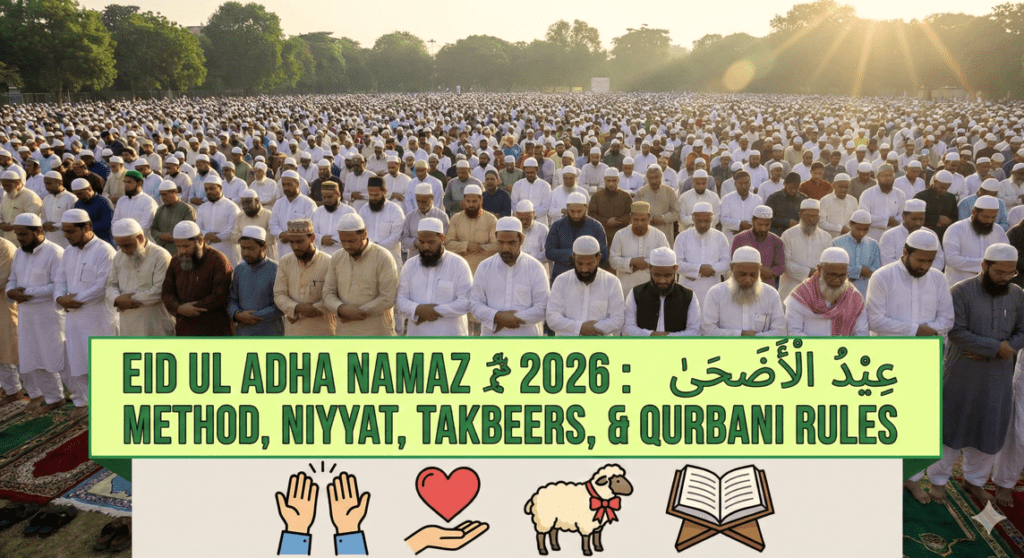
Eid ul Adha Namaz, commonly known as Bakrid or the “Festival of Sacrifice,” is the second significant celebration in Islam. While Eid-ul-Fitr marks the end of fasting, Eid-ul-Adha commemorates the absolute submission and obedience of Prophet Ibrahim (A.S), who was willing to sacrifice his son Prophet Ismail (A.S) solely for the sake of Allah.
This day coincides with the completion of the Hajj pilgrimage in Mecca. The prayer offered on this day is not just a ritual; it is a renewal of our pledge to obey Allah’s commands above our own desires. Following the prayer, Muslims perform Qurbani (Udhiyah) to keep the tradition of Prophet Ibrahim (A.S) alive and to feed the poor.
Author request : “As an Imam, I have prepared this article with extensive research and reference to authentic sources. I sincerely request you to read the entire article and remember me in your du‘as.”
Is Eid ul Adha Namaz Wajib, Sunnah, or Farz?
Just like Eid-ul-Fitr, the ruling for Eid ul Adha Namaz varies slightly among the different schools of Islamic jurisprudence:
- Wajib (Mandatory): According to the Hanafi school (followed by the majority in South Asia), the Eid-ul-Adha prayer is Wajib. Leaving it without a genuine excuse is considered sinful.
- Sunnah Mu’akkadah (Emphasized Sunnah): According to the Shafi’i and Maliki schools, it is a highly emphasized Sunnah.
- Fard Kifayah: According to the Hanbali school, it is a communal obligation.
Verdict: Every adult Muslim male should make every effort to attend this congregation, as it is one of the visible symbols (Sha’air) of Islam.
Eid ul Adha Namaz Date and Time 2026
- Expected Date: Eid-ul-Adha 2026 is expected to fall on Wednesday, May 27, 2026, or Thursday, May 28, 2026.
- Note: The exact date depends on the sighting of the moon for the month of Dhul Hijjah. It is celebrated on the 10th of Dhul Hijjah.
- Prayer Time: The time for Eid prayer begins approximately 15 to 20 minutes after sunrise and lasts until Zawal (just before Dhuhr time).
- Early Preference: It is Mustahab (preferred) to perform the Eid-ul-Adha prayer earlier in the morning compared to Eid-ul-Fitr. This is to allow maximum time for people to return home and perform the Qurbani (sacrifice).
What is the difference between Eid-ul-Fitr and Eid ul Adha Namaz?
While the method of the prayer (Rakats and Takbeers) is exactly the same, there are three key differences in the etiquette of the day:
- Eating: On Eid-ul-Fitr, it is Sunnah to eat (something sweet) before the prayer. On Eid-ul-Adha, it is Mustahab not to eat anything before the prayer, so that the first meal can be from the meat of the Qurbani.
- Takbeer: On Eid-ul-Fitr, the Takbeer on the way to the Eidgah is recited softly. On Eid-ul-Adha, the Takbeer-e-Tashreeq must be recited loudly by men while going to the prayer.
- Financial Obligation: Eid-ul-Fitr involves paying Sadaqat-ul-Fitr (cash/grain), whereas Eid-ul-Adha involves offering a physical sacrifice (Qurbani) of an animal.
Sunnahs and Preparation for Eid ul Adha Namaz Day
The preparation for Eid ul Adha Namaz begins long before the prayer starts. To truly honor the “Festival of Sacrifice,” a Muslim should strive to align their appearance, behavior, and schedule with the Sunnah of Prophet Muhammad (PBUH). These acts are not merely rituals; they are a means to mentally and physically prepare oneself for the great congregation and the act of Qurbani.
Refraining from eating before the Prayer (Mustahab Act)
This is the most distinct difference between the two Eids, and many people often get confused here.
- The Ruling: Unlike Eid-ul-Fitr, where it is Sunnah to eat dates before leaving the house, on Eid-ul-Adha, it is Mustahab (Desirable) not to eat anything in the morning until after the Eid prayer is performed.
- The Wisdom (Hikmah): The spiritual logic behind this act is that a believer desires their first meal of the day to be a “Gift from Allah”—specifically, the meat of their own Qurbani (Udhiyah). By delaying breakfast, one shows eagerness for the command of sacrifice.
- Clarification on Fasting: It is important to understand that this is not a Fast (Roza).
- If someone eats due to hunger, habit, or health reasons (like diabetes or low blood pressure), it is not sinful nor Makrooh (disliked).
- However, if one has the health and capacity to wait, delaying the meal brings extra reward.
- Tip: If the Eid prayer is scheduled very late in your locality, light tea or water is perfectly acceptable to maintain energy.
Performing Ghusl, using Miswak, and applying Perfume
Since Eid is a massive public gathering where Muslims stand shoulder to shoulder, Islam places extreme importance on personal hygiene and presentation.
- Ghusl (Ritual Bath): It is an emphasized Sunnah to perform Ghusl on the morning of Eid. This goes beyond regular cleaning; it is an act of glorifying the day. The Ghusl should be performed after Fajr, though doing it slightly before is also valid.
- Using Miswak: The use of Miswak (tooth stick) is highly recommended before every wudu, but especially on Eid. It ensures that your mouth smells fresh, preventing any discomfort to the angels and fellow worshipers standing next to you in the congregation.
- Wearing Best Clothes: The Prophet (PBUH) used to wear his best cloak for Eid.
- Note: “Best clothes” does not strictly mean “New clothes.” If you cannot afford new garments, simply wearing your cleanest, most presentable washed clothes fulfills the Sunnah completely.
- Fragrance (Itr): For men, applying good-quality perfume (non-alcoholic Itr) is a Sunnah. It contributes to the pleasant atmosphere of the Eidgah.
Reciting Takbeer-e-Tashreeq Loudly on the way to Eidgah
The journey to the prayer ground is not an ordinary commute; it is a procession of glorification.
- Loud Recitation: On Eid-ul-Fitr, the Takbeers are recited softly. However, on Eid-ul-Adha, the ruling changes. It is Wajib for men to recite the Takbeer-e-Tashreeq in a loud, audible voice while going to the Eidgah. This loud declaration serves as a reminder to the community of the greatness of Allah.
- The Words: You should continuously recite: “Allahu Akbar, Allahu Akbar, La ilaha illallahu wallahu Akbar, Allahu Akbar, wa lillahil hamd.”
- Changing Routes: It is also a beautiful Sunnah to take one route to go to the Eidgah and return via a different route.
- Reason: This is done so that both paths will bear witness to your worship on the Day of Judgment, and to spread the greetings of Salam to people living in different areas.
related post–
| Namaz Rakat Guide Table |
| fajr namaz rakat |
| zohar namaz rakat |
| asr namaz rakat |
| maghrib namaz rakat |
| isha namz rakat |
| practicaly method namaz |
| witr namaz |
| sunnat namaz |
| jumma namaz rakat |
| nafl namaz |
Eid ul adha namaz references quran hadis
1. Reference for Significance & Prayer (Introduction)
Quran: فَصَلِّ لِرَبِّكَ وَانْحَرْ “Fasalli li rabbika wanhar.” Translation: “So pray to your Lord and sacrifice [to Him alone].” (Surah Al-Kawthar, 108:2)
2. Reference for Not Eating Before Prayer (Sunnah Section)
Hadith: كَانَ النَّبِيُّ صلى الله عليه وسلم لاَ يَخْرُجُ يَوْمَ الْفِطْرِ حَتَّى يَطْعَمَ وَلاَ يَطْعَمُ يَوْمَ الأَضْحَى حَتَّى يُصَلِّيَ Translation: “The Prophet (PBUH) would not go out on the day of Fitr until he had eaten, and he would not eat on the day of Adha until he had prayed.” (Jami` at-Tirmidhi: 542)
3. Reference for Changing Routes (Sunnah Section)
Hadith: كَانَ النَّبِيُّ صلى الله عليه وسلم إِذَا كَانَ يَوْمُ عِيدٍ خَالَفَ الطَّرِيقَ Translation: “On the day of Eid, the Prophet (PBUH) used to return by a different route from the one he had taken when going out.” (Sahih Al-Bukhari: 986)
4. Reference for Best Clothes and Ghusl (Preparation)
Hadith (Practice of Sahaba): أَنَّ عَبْدَ اللَّهِ بْنَ عُمَرَ كَانَ يَغْتَسِلُ يَوْمَ الْفِطْرِ قَبْلَ أَنْ يَغْدُوَ إِلَى الْمُصَلَّى Translation: “Abdullah ibn Umar (R.A) used to take a bath (Ghusl) on the day of Fitr before going to the prayer ground.” (Muwatta Imam Malik)
5. Reference for Takbeer-e-Tashreeq
Quran: وَاذْكُرُوا اللَّهَ فِي أَيَّامٍ مَعْدُودَاتٍ “Wazkurullaha fee ayyamin ma’doodat.” Translation: “And remember Allah during [specific] numbered days.” (Surah Al-Baqarah, 2:203)
Intention (Niyyat) for Eid ul Adha Namaz
The validity of any act of worship in Islam depends on the intention (Niyyat). For the Eid prayer, the intention distinguishes it from ordinary voluntary prayers.
It is important to understand that Niyyat is an act of the heart. If you know in your heart that you are standing behind the Imam to offer the Eid-ul-Adha prayer, your intention is valid. However, many scholars allow articulating it verbally to help focus the mind.
Eid ul Adha Namaz Niyyat in Arabic Text
If you prefer to make the intention in Arabic, you can recite the following words:
نَوَيْتُ أَنْ أُصَلِّيَ لِلَّهِ تَعَالَى رَكْعَتَيْ صَلَاةِ عِيدِ الْأَضْحَى مَعَ سِتِّ تَكْبِيرَاتٍ، وَاجِبَةً لِلَّهِ تَعَالَى، مُقْتَدِيًا بِهَذَا الْإِمَامِ، مُتَوَجِّهًا إِلَى جِهَةِ الْكَعْبَةِ الشَّرِيفَةِ. اللَّهُ أَكْبَرُ
Eid ul Adha Namaz Niyyat in English/Transliteration
If you cannot read Arabic, you can memorize this transliteration or simply say the meaning in your own language.
Transliteration: “Nawaytu an usalliya lillahi ta’ala, rak’atay salati Eid-il-Adha, ma’a sitti takbeeratin, wajibatan lillahi ta’ala, muqtadiyan bi hazal Imam, mutawajjihan ila jihatil Ka’bati-sh shareefah. Allahu Akbar.”
Translation (Meaning): “I intend to offer two Rakats of Eid-ul-Adha prayer, with six extra Takbeers, Wajib for the sake of Allah, following this Imam, facing towards the Holy Kaaba. Allah is the Greatest.”
How to make Niyyat behind the Imam?
You do not need to memorize difficult words. The simplest way to make your Niyyat behind the Imam is to say (in your heart or softly with your tongue):
- Specify the Prayer: “I am performing Eid-ul-Adha Prayer.”
- Specify the Takbeers: “…with 6 extra Takbeers.”
- Follow the Imam: “…behind this Imam.”
- For Allah: “…for the sake of Allah Almighty.”
How to Perform Eid ul Adha Namaz Hanafi
The method of Eid-ul-Adha prayer is exactly the same as Eid-ul-Fitr. It consists of 2 Rakats without any Adhan or Iqamah. However, the addition of “Extra Takbeers” often confuses people.
Below is the standard method according to the Hanafi School of Thought, which is followed by the majority of Muslims in South Asia (India, Pakistan, Bangladesh).
How many Takbeers are in Eid ul Adha Namaz?
Before starting, it is important to know the number of Takbeers to avoid confusion during the prayer:
- Hanafi Method: Total 6 Extra Takbeers. (3 in the first Rakat, 3 in the second Rakat).
- Shafi’i / Ahle Hadees Method: Total 12 Extra Takbeers (7 in the first Rakat, 5 in the second).
- Rule of Thumb: You must follow the Imam leading the prayer at your mosque. If he says 12, follow 12. If he says 6, follow 6. Do not differ from the Jama’at.
Procedure for the First Rakat
- Start (Takbeer-e-Tahrima): The Imam will say Allahu Akbar. You raise your hands to your ears and fold them below the navel (as usual).
- Thana: Recite Subhanaka Allahumma… silently.
- The 3 Extra Takbeers (Crucial Step): The Imam will now say the extra Takbeers.
- 1st Takbeer: Imam says Allahu Akbar. Raise your hands to your ears and drop them to your sides.
- 2nd Takbeer: Imam says Allahu Akbar. Raise your hands to your ears and drop them to your sides.
- 3rd Takbeer: Imam says Allahu Akbar. Raise your hands to your ears and fold them (tie them).
- Recitation: Now, listen silently as the Imam recites Surah Al-Fatiha and a Surah.
- Ruku & Sujood: Perform Ruku and Sujood as per normal prayer rules.
Procedure for the Second Rakat
- Standing Up: Rise for the second Rakat. The Imam will first recite Surah Al-Fatiha and a Surah. Do not raise your hands yet; just listen.
- The 3 Extra Takbeers (Before Ruku): After the recitation is finished, the Imam will say the extra Takbeers.
- 1st Takbeer: Imam says Allahu Akbar. Raise hands to ears and drop them.
- 2nd Takbeer: Imam says Allahu Akbar. Raise hands to ears and drop them.
- 3rd Takbeer: Imam says Allahu Akbar. Raise hands to ears and drop them.
- The 4th Takbeer (Going to Ruku):
- The Imam will say Allahu Akbar for the 4th time.
- Do NOT raise your hands. Instead, go directly into Ruku.
- Completion: Complete the Ruku and Sujood as normal.
Method of Sajdah and Salam
- After the two Sajdahs of the second Rakat, sit for Tashahhud.
- Recite Attahiyat, Durood-e-Ibrahim, and Dua-e-Masura.
- When the Imam turns his face to the right saying Assalamu Alaikum wa Rahmatullah, you do the same. Then turn to the left.
- Important: Do not leave immediately. Sit and listen to the Khutbah (Sermon), as listening to it is Wajib (Mandatory) and part of the Eid blessings.
Takbeer-e-Tashreeq and Khutbah Rules In Eid ul Adha Namaz
Unlike Eid-ul-Fitr, where the specific recitations end with the prayer, Eid-ul-Adha introduces a special form of remembrance called Takbeer-e-Tashreeq. This continues for several days after Eid.
What is Takbeer-e-Tashreeq
The Takbeer-e-Tashreeq is a declaration of Allah’s greatness. It originates from the legacy of Prophet Ibrahim (A.S).
Arabic Text:
اللَّهُ أَكْبَرُ، اللَّهُ أَكْبَرُ، لَا إِلَهَ إِلَّا اللَّهُ، وَاللَّهُ أَكْبَرُ، اللَّهُ أَكْبَرُ، وَلِلَّهِ الْحَمْدُ
Transliteration: “Allahu Akbar, Allahu Akbar, La ilaha illallahu wallahu Akbar, Allahu Akbar, wa lillahil hamd.”
Translation: “Allah is the Greatest, Allah is the Greatest. There is no deity but Allah, and Allah is the Greatest, Allah is the Greatest. And to Allah belongs all praise.”
Is reciting Takbeer Wajib during Days of Tashreeq
Yes, according to the Hanafi school, reciting this Takbeer is Wajib (Mandatory) upon every adult Muslim.
- When does it start? It begins from the Fajr prayer of the 9th of Dhul Hijjah (Day of Arafah).
- When does it end? It continues until the Asr prayer of the 13th of Dhul Hijjah.
- Total Duration: It covers a total of 23 Prayers.
- The Rule: Immediately after performing the Fard Salam of every prayer during these days, you must recite this Takbeer once.
- Men vs. Women:
- Men: Must recite it in a loud audible voice.
- Women: Must recite it softly (so that only she can hear herself).
Listening to the Khutbah and reciting Takbeer
After the Imam finishes the Eid prayer (Salam), he will likely lead the congregation in reciting the Takbeer-e-Tashreeq aloud. Following this, he will stand up to deliver the Khutbah (Sermon).
- Silence is Wajib: Once the Khutbah begins, it is Wajib to listen to it silently. Talking, using a phone, or leaving during the sermon is strictly prohibited and sinful.
- Content: The Eid-ul-Adha Khutbah usually explains the history of Prophet Ibrahim (A.S), the virtues of Qurbani, and the laws regarding meat distribution.
- Completion: The prayer gathering officially concludes after the Khutbah and the collective Dua. Only then should you leave to perform your Qurbani.
Rules of Qurbani in Relation to Eid ul Adha Namaz
The validity of the Qurbani (Udhiyah) is strictly tied to the timing of the Eid-ul-Adha Namaz. It is not just about the date (10th Dhul Hijjah), but the specific time of the day relative to the congregational prayer.
Can we perform Qurbani (Sacrifice) before the Eid Prayer?
For those living in cities and towns where Eid prayer is held, the rule is strict.
- The Ruling: No, you cannot perform the Qurbani before the Eid prayer.
- Consequence: If an animal is slaughtered before the Eid prayer is completed, it is NOT counted as Qurbani. It will be considered merely as meat for consumption, and the person must slaughter another animal to fulfill the obligation.
- Hadith Evidence: The Prophet Muhammad (PBUH) said:
“Whoever slaughtered the sacrifice before the prayer, he just slaughtered it for himself (as food), and whoever slaughtered it after the prayer, he offered his sacrifice properly and followed the way of the Muslims.” (Sahih Al-Bukhari) - Best Practice: It is safer to wait until the Imam finishes the Khutbah (Sermon) to be absolutely sure that the prayer obligations are complete.
Rules for Villages (Dehat) where Eid ul Adha Namaz is not held
In Islamic jurisprudence (Fiqh), specific conditions are required for Eid and Jumu’ah prayers to be valid (e.g., a certain population size, permission from authorities, etc.). In small villages or remote rural areas (Dehat) where these conditions are not met, Eid prayer is not performed.
- The Timing: For people in these locations, the time for Qurbani begins as soon as Fajr time ends (Sunrise) on the 10th of Dhul Hijjah.
- No Wait Required: They do not need to wait for the prayer to finish in the nearby cities.
- Practical Application: If you live in a city (like New York or Mumbai) but you have arranged for your Qurbani to be done in a remote village (where Eid prayer is not held), the slaughter can be done there early in the morning, even before you have prayed your Eid Salah in the city.
Eating the meat of Qurbani after the prayer (Sunnah)
Once the prayer is finished and the sacrifice is made, the etiquette of eating begins.
- First Meal: As mentioned in the preparation section, it is a Sunnah to eat from the meat of your own Qurbani as the first meal of the day.
- The Liver (Kaleji): Historically, the liver is the easiest and fastest part of the animal to cook. Therefore, many Muslims follow the tradition of cooking the liver immediately and sharing it with the family to break their morning “fast.”
- Blessing (Barakah): Eating from the sacrifice is an act of gratitude, acknowledging that the provision comes from Allah alone.
Rules for Women Eid ul Adha Namaz
While Eid is a communal celebration, the specific rules regarding the prayer and the Takbeers differ slightly for women. Here are the most common clarifications.
Can Women perform Eid ul Adha Namaz?
There is often confusion regarding whether women should go to the Eidgah or pray at home.
- The Sunnah: During the time of the Prophet Muhammad (PBUH), women were encouraged to attend the Eid gathering to witness the blessings and the supplications of the Muslims. Even menstruating women went to the Eidgah but sat away from the prayer area.
- Hanafi Ruling: In the Hanafi school (common in India/Pakistan), it is traditionally preferred for women to pray at home to avoid overcrowding or discomfort (Fitnah). However, if a mosque or Eidgah provides proper, separate, and secure arrangements for women, they are permitted to attend.
- Praying at Home: Important to note—Eid Prayer is a congregational prayer. Women cannot perform “Eid Namaz” individually at home. If they do not go to the Eidgah, they do not pray any specific Eid Salah at home. Instead, they should perform their usual morning remembrance or Chasht prayer.
Is Takbeer-e-Tashreeq Wajib for Women?
Yes, the obligation of remembering Allah applies to women as well, but the method is different.
- The Ruling: According to the most accepted view in Fiqh, reciting the Takbeer-e-Tashreeq after every Fard prayer during the days of Tashreeq (9th-13th Dhul Hijjah) is Wajib for women just as it is for men.
- The Difference:
- Men: Must recite it loudly.
- Women: Must recite it softly (in a whisper) so that only she can hear her own voice. It is not modest for her voice to be raised loudly.
What to do if you miss the Eid ul Adha Namaz?
Since Eid prayer is only valid in a congregation (Jama’at), you cannot make it up (Qaza) individually like a normal Fard prayer.
- Scenario 1: You missed the Jama’at at your local mosque.
- Action: Immediately try to find another mosque nearby where the prayer is scheduled for a later time (e.g., if you missed the 7:00 AM Jama’at, look for one at 8:00 AM).
- Scenario 2: You missed the prayer completely.
- Action: If you cannot find any congregation, there is no Qaza for Eid prayer. You cannot pray 2 Rakats of Eid Salah alone.
- The Solution: It is recommended to perform 4 Rakats of Salat al-Duha (Chasht) at home. This serves as a spiritual compensation and consoles the heart, though it does not replace the Wajib obligation of the Eid prayer.
- Does this affect Qurbani? No. If you missed the prayer (even intentionally, which is sinful), your Qurbani (Sacrifice) is still valid. You can proceed with the slaughter after the local Eid prayer has finished.
Table Of Eid ul Adha Namaz
| Islamic Date | 10th of Dhul Hijjah | |
| Expected Date (2026) | Approx. May 27th or 28th, 2026 | Subject to actual Moon Sighting. |
| Ruling (Hukm) | Wajib (Mandatory) for adult males (Hanafi School). | Considered Sunnah Mu’akkadah in Shafi’i & Maliki schools. |
| Eid ul Adha Namaz Time Window | Starts ~20 mins after sunrise, ends at Zawal (before Dhuhr). | Preferred to offer it early to allow time for Qurbani. |
| Eating Before Prayer | Mustahab NOT to eat anything before the prayer. | Unlike Eid-ul-Fitr. The first meal should ideally be Qurbani meat. |
| Key Pre-Prayer Sunnahs | Ghusl (bath), Miswak, best clothes, Itr (perfume for men). | Use different routes going to and returning from the Eidgah. |
| On the Way to Eidgah | Recite Takbeer-e-Tashreeq LOUDLY (Men only). | “Allahu Akbar, Allahu Akbar, La ilaha illallahu wallahu Akbar…” |
| Prayer Structure | 2 Rakats in congregation. No Adhan or Iqamah. | Followed by a Wajib Khutbah (Sermon). |
| Number of Takbeers | Total 6 Extra Takbeers (Hanafi Method). | 3 in 1st Rakat (before recitation); 3 in 2nd Rakat (before Ruku). |
| Takbeer-e-Tashreeq Duration | Wajib after every Fard prayer from Fajr 9th Dhul Hijjah to Asr 13th Dhul Hijjah. | Men recite loudly; Women recite softly. |
| Qurbani Timing (City) | Must be performed AFTER the Eid Prayer is finished. | If slaughtered before the prayer, it is invalid as Qurbani. |
| Missed Prayer (Qaza) | No Qaza for missing Eid congregation. | Recommended to pray 4 Rakats Salat al-Duha (Chasht) at home as solace. |
Author note: This guide follows the Hanafi Fiqh method (6 Takbeers). While we strive for accuracy, please verify specific rulings with a local scholar, as human error is possible. The final date depends on the moon sighting.
As human beings, making mistakes is possible. If you notice any religious error, please let us know in the comments so we can correct it.
Conclusion Eid ul Adha Namaz
Eid ul Adha Namaz is not just about the ritual of Namaz or the Qurbani of an animal; it commemorates the absolute submission of Prophet Ibrahim (A.S).
Remember, the physical act is only a symbol. As Allah says in the Quran: “It is not their meat nor their blood that reaches Allah: it is your piety (Taqwa) that reaches Him.” (Surah Al-Hajj, 22:37).
The real essence of this day is to purify our hearts, obey Allah’s commands, and serve humanity by sharing food with the poor and needy.
May Allah accept your prayers and sacrifice. Eid Mubarak!
FAQs: Eid ul Adha Namaz & Qurbani Rules
Is Eid ul Adha Namazz Farz or Wajib?
According to the Hanafi school, Eid-ul-Adha Namaz is Wajib (Mandatory) for every adult Muslim male. In other schools (Shafi’i/Maliki), it is Sunnah Mu’akkadah.
How many Takbeers are in Eid ul Adha Namaz?
In the Hanafi method, there are 6 Extra Takbeers (3 in the first Rakat before Qira’at, and 3 in the second Rakat before Ruku).
Can I eat before Eid ul Adha Namaz?
It is Mustahab (Preferred) NOT to eat anything before the prayer on Eid-ul-Adha. The Sunnah is to break your “fast” with the meat of the Qurbani after the prayer.
Can we perform Qurbani before the Eid prayer?
No. If you live in a city where Eid prayer is held, Qurbani done before the prayer is invalid. You must wait until the prayer is finished.
What is Takbeer-e-Tashreeq?
It is the recitation of “Allahu Akbar, Allahu Akbar, La ilaha illallahu wallahu Akbar, Allahu Akbar, wa lillahil hamd.” It is Wajib to recite this after every Fard prayer from 9th to 13th Dhul Hijjah.
Can women perform Eid ul Adha Namaz?
Yes, it is permissible for women to attend if there are proper arrangements. However, in the Hanafi school, it is traditionally preferred for them to pray at home.
Is Takbeer-e-Tashreeq Wajib for women?
Yes, women must also recite the Takbeer-e-Tashreeq after Fard prayers during the days of Tashreeq, but they should recite it softly (silently), unlike men who recite it loudly.
What if I miss the Eid ul Adha Namaz?
There is no Qaza for Eid prayer. If you miss the congregation, you cannot pray it alone. It is recommended to pray 4 Rakats of Salat al-Duha (Chasht) at home instead.
Can I pray Eid Namaz at home alone?
No, Eid Namaz is a congregational prayer (Jama’at) and cannot be performed individually at home.
Is there Adhan or Iqamah for Eid prayer?
No, there is neither Adhan nor Iqamah for the Eid-ul-Adha prayer. The Imam starts directly with the intention.
When does the time for Eid Namaz end?
The time for Eid prayer ends at Zawal (when the sun reaches its zenith, just before Dhuhr time starts).
How to make Niyyat for Eid Namaz behind the Imam?
You can simply intend in your heart: “I intend to pray 2 Rakats of Eid-ul-Adha Wajib with 6 Extra Takbeers, behind this Imam, for the sake of Allah.”
What is the difference between Eid-ul-Fitr and Eid ul Adha Namaz?
The method is the same. The differences are: on Eid-ul-Adha, you should not eat before prayer, you recite Takbeers loudly on the way, and you perform Qurbani afterwards.
Is it compulsory to listen to the Eid Khutbah?
Yes, listening to the Khutbah after the Eid prayer is Wajib. Walking away or talking during the sermon is sinful.
Can I cut my hair or nails before Eid ul Adha Namaz?
If you are intending to do Qurbani, it is Mustahab (Preferred) not to cut your hair or nails from the 1st of Dhul Hijjah until your animal is sacrificed. However, it is not Haram to do so.