
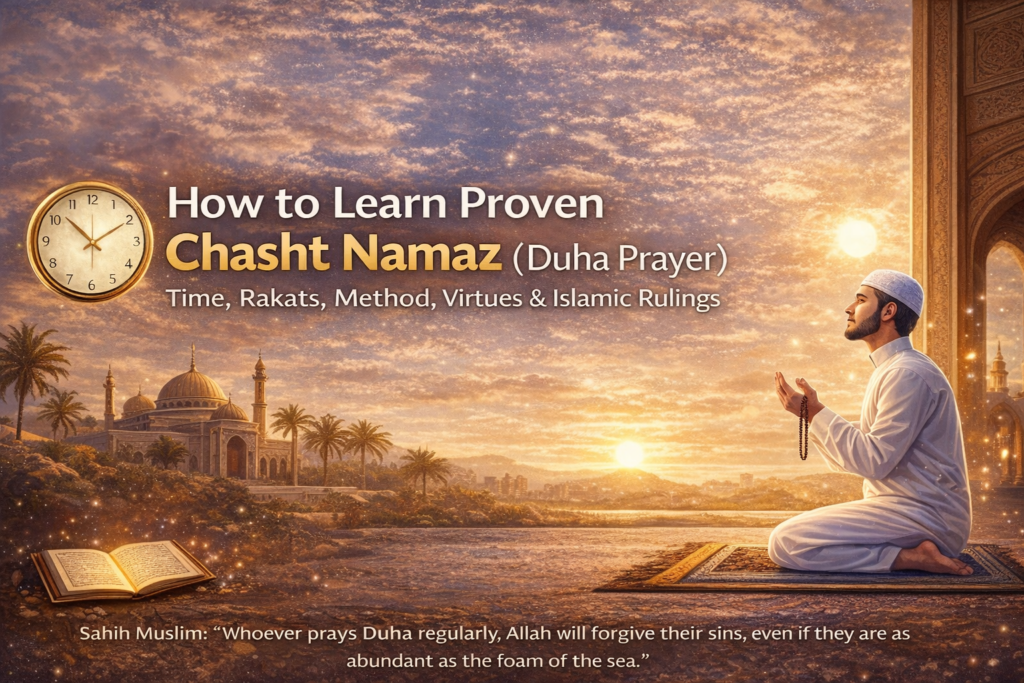
Chasht Namaz, also known as Salat al-Duha (Dhuha), is a voluntary (nafl) prayer performed after sunrise and before Zuhr. It consists of 2 to 12 rakats, offered in sets of two like other nafl prayers. The time for Chasht begins about 15 minutes after sunrise and continues until just before Zawal (midday), though the most virtuous time is mid-morning when the sun has risen higher and its warmth is felt, generally between 9:00 AM and 11:00 AM.
This prayer is often associated with seeking barakah in sustenance (rizq) and protection from financial hardship. It may be prayed as 2, 4, 8, or even 12 rakats depending on one’s ability. Some scholars differentiate between Ishraq and Chasht by time, considering Ishraq as the early portion and Chasht as the later portion of the same Duha prayer, while many regard them as one and the same voluntary prayer prayed within the Duha time.
Chasht is performed like any regular nafl prayer in units of two rakats, with sincere intention and devotion.
What Is Chasht Namaz?
Chasht Namaz, also known as Duha Prayer, is a voluntary prayer offered in the morning after sunrise. The Qur’an encourages remembering Allah in the forenoon hours, as Allah says: “By the forenoon (Duha)” (Surah Ad-Duha 93:1). The Prophet ﷺ also recommended this prayer, saying that two rakats of Duha are sufficient as charity for the body (Sahih Muslim).
Meaning and Definition of Chasht (Duha) Prayer
Chasht Prayer, commonly known as Duha Prayer, refers to a voluntary salah performed during the morning hours after the sun has risen. The word Duha means the time of early daylight when the sun becomes bright. In Islamic terms, Chasht is a nafl prayer offered to seek Allah’s pleasure, gratitude, and blessings at the start of the day.
Chasht Namaz: Sunnah or Nafl?
Chasht Namaz is classified as a nafl (voluntary) prayer in Islam. It is not obligatory, but it is strongly encouraged through the practice and advice of the Prophet ﷺ. Performing it regularly brings reward and closeness to Allah, while leaving it carries no sin.
Importance of Chasht Namaz in Islam
Chasht Namaz holds special importance as it helps a believer begin the day with gratitude and remembrance of Allah. It strengthens the connection between a servant and the Creator during the busy hours of the morning. This prayer also serves as a source of spiritual balance, bringing peace, focus, and barakah into daily life.
Virtues and Rewards of Chasht Namaz
The prayer of Chasht is Mustahab, it is 2 Rakats and the maximum is 12 Rakats. It is said in Tirmizi and Ibn Majah that Prophet Sayyid Alam (peace be upon him) said: Whoever protects two Rakats of Chast, his sins will be forgiven if they are equal to the foam of the sea.
References: fatawa razawiyya
Best Time to Pray Chasht Namaz
Importance of Chasht Namaz in Islam
Chasht Namaz holds special importance as it is a means of showing gratitude to Allah for health, time, and daily blessings. It helps a believer remain connected to worship even outside the obligatory prayers. Regularly praying Chasht Namaz brings spiritual balance, inner peace, and barakah in one’s daily life.
time Chasht Namaz
The time for Chasht Namaz begins after the sun has fully risen and continues until just before midday (zawal). The best and most rewarding time is when the sun has risen higher and the heat becomes noticeable. Praying during this period reflects devotion and brings greater reward.
Number of Rakats in Chasht Namaz
Chasht Namaz is prayed in a minimum of 2 rakats. There is no fixed maximum, but it is commonly offered as 4, 6, or 8 rakats.
Chasht namaz table chart
| Topic | Details |
| Prayer Name | Chasht Namaz (Duha Prayer) |
| Prayer Type | Nafl (Voluntary) |
| Time | Mid-morning until before zawal |
| Minimum Rakats | 2 Rakats |
| Maximum Rakats | No fixed limit (commonly up to 8) |
| Method | Same as normal nafl prayer |
| Surah Recitation | Surah Al-Fatihah + any Surah |
| Obligation | Not compulsory |
| Alternative Name | Duha Prayer |
| Main Benefit | Reward, gratitude, and barakah |
How to Pray Chasht Namaz – Step-by-Step Method
- Step 1: Make Niyyah for Chasht Namaz
I intend to perform two rakats of Chasht (optional) prayer for the sake of Allah Almighty, facing the Qibla. Allahu Akbar.
Niyyah refers to the intention of the heart.
- Step 2: Start Prayer with Takbir
Then, saying “Allahu Akbar,” tie your hands below your navel as is customary, and then recite the Sana’ (opening supplication) as you do in all prayers.
- Step 3: Recite Surah Al-Fatihah and Another Surah
Then, after reciting Ta’awwuz and Tasmiyah, recite Surah Al-Fatiha, and then recite Bismillah and recite any other Surah.
- Step 4: Perform Ruku and Sujud
Then perform the bowing (ruku’) and prostration (sujud) as you do in every prayer, reciting the prescribed glorifications (tasbeeh).
- Step 5: Complete the Remaining Rakats
Complete the second rak’ah in the same way.
- Step 6: Sit for Tashahhud and End with Salam
After this, just like in every prayer, sit down and recite the Tashahhud, Durood-e-Ibrahimi, and any prescribed supplication, then turn your head to the sides to complete the prayer. Your two rak’ahs of prayer are now complete.
Difference Between Chasht, Ishraq, and Duha Prayer
Ishraq prayer is offered soon after sunrise, while Chasht is prayed later in the morning. Duha is the general name that includes both Ishraq and Chasht prayers. In practice, all three are voluntary morning prayers with slightly different timings.
Common Mistakes to Avoid in Chasht Namaz
One common mistake is praying Chasht too early, before the sun rises properly. Some people think it is compulsory, which is incorrect. Rushing the prayer without concentration or skipping Fajr intentionally are also mistakes to avoid.
Conclusion
Chasht Namaz is a beautiful voluntary prayer that brings spiritual calm, gratitude, and blessings into daily life. Though not obligatory, it is highly recommended and easy to perform. Making Chasht Namaz a habit helps a believer stay connected with Allah throughout the day.
Call to Action
Try to include Chasht Namaz in your daily routine, even if it is only two rakats. Share this knowledge with others so they can also benefit from this rewarding prayer. Keep learning and practicing Sunnah and nafl acts to strengthen your
Faqs- About Chasht Namaz
How to pray Chasht (Duha) namaz?
Pray 2–12 rakats after the sun rises well (about 15–20 minutes after sunrise) until before zohar, like normal nafl prayer.
What are common mistakes in praying Ishraq?
Praying before sunrise, not praying Fajr first, or praying without proper niyyah.
Is Chasht namaz Sunnah or Nafl?
It is Nafl (recommended Sunnah practice, not obligatory).
Does sperm break salah?
Yes. If sperm comes out, wudu breaks and ghusl is required before salah.
How many rakats are in Qaza namaz?
Same as the missed Farz prayer (e.g., Fajr 2, Zuhr 4, etc.).
Can I touch my wife’s breast during fasting?
Yes, if it does not lead to ejaculation.
Why is the Chasht prayer important?
It brings forgiveness, rewards, and gratitude to Allah.
What Surah to read in Ishraq?
Any Surah. Commonly Surah Fatiha + Surah Ikhlas.
Can I kiss my wife’s private parts in Islam?
Scholars differ. Many say it is allowed between spouses but not recommended.
Is it haram to taste sperm?
Yes, it is considered impure (najis) by most scholars.
What is haram to do in bed?
Anal intercourse, intimacy during menstruation, and harming your spouse.
Which dhikr 1000 times?
Commonly: “SubhanAllah”, “Astaghfirullah”, or “La ilaha illallah”.
How to get a dua 100% accepted?
Make dua sincerely, with halal earnings, patience, and trust in Allah.
Are Ishraq and Duha the same?
Yes. Ishraq is Duha prayed early, just after sunrise.
How to offer Chasht ki namaz?
Pray 2–12 rakats nafl after sunrise until before Zuhr.
Should you pray Tahajjud in 2-2-2-2?
Yes. Tahajjud is prayed in sets of two rakats.
How do Ahmadis pray?
They follow a different interpretation; Sunni Muslims do not follow their method.
Which namaz is powerful?
Tahajjud, because it is prayed in the last part of the night.
Is Chasht Sunnah or Nafl?
It is Nafl.
What is Awwabin namaz?
A Nafl prayer prayed after Maghrib, usually 6 rakats.
As an imam of a mosque, I wrote this post.As an Imam of a mosque, I have written this post.
If you have any questions regarding any prayer, this humble servant is at your service.