Namaz Rakat Guide Table: Complete List & Step-by-Step Method (2026)

Namaz Rakat Guide Table: Complete List & Step-by-Step Method (2026)
Namaz Rakat Guide Table-image

Namaz is obligatory for every Muslim, but many beginners and children often feel confused about how many rakats are performed in each daily prayer. In this complete Namaz Rakat Guide Table, we have explained the full rakat details of all prayers—from Fajr to Isha and Jummah—according to Hanafi Fiqh.
Along with this, the guide also includes the correct practical method of wudu, ghusl, and performing Namaz, so that your worship is complete and accurate.

Namaz and Its Importance: A Complete Overview

In Islam, Namaz (Salah) is not just an act of worship; it is the foundational pillar of the Deen. According to Fiqh-e-Hanafi, Namaz is obligatory for every sane and mature Muslim.
In the Qur’an, Allah repeatedly commands believers to establish prayer, because Namaz creates a direct connection between the servant and Allah, bringing peace to the heart and spiritual satisfaction to the soul.

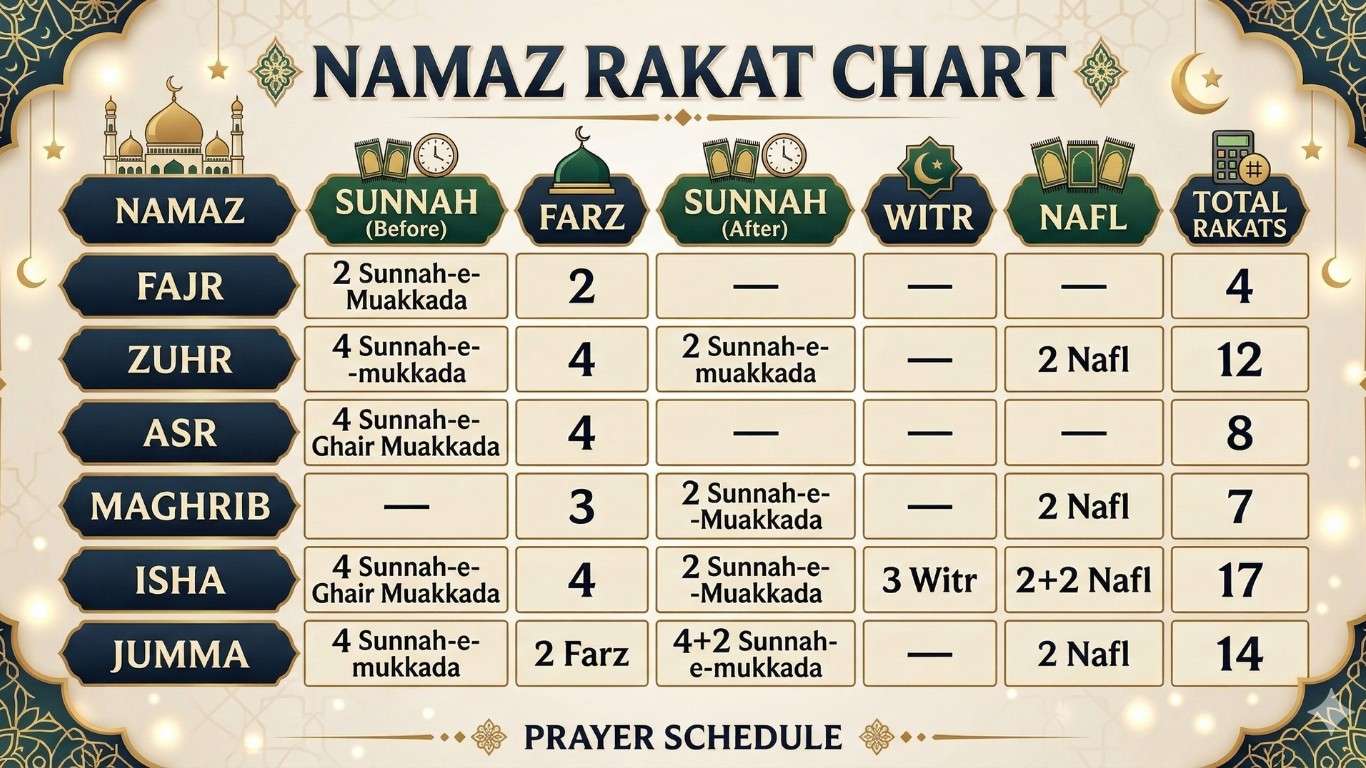
Namaz Rakat Chart: Summary Table of the Five Daily Prayers

Understanding the rakats of Namaz is essential for every Muslim. Below is a concise table of the five daily prayers, designed to help you easily remember the correct rakat structure:

Taharat and Purification (Pre-requisites of Namaz)

Before starting Namaz, it is mandatory for the body and the place of prayer to be pure. For this, it is essential to understand the basic rules given below:

Wudu Steps: The Correct Way to Perform Ablution

Wudu is the key to Namaz, and without it, prayer is not accepted. In Islam, there are four obligatory (Farz) acts of Wudu: washing the face, washing both arms up to the elbows, performing Masah (wiping) of the head, and washing both feet up to the ankles. Following these steps in the correct order and according to the Sunnah ensures both spiritual and physical purity.

Ghusl in Islam: Mandatory and Sunnah Rules of Bathing

The purpose of Ghusl (bathing) is to purify the entire body from major impurity. There are three obligatory (Farz) acts in Ghusl: rinsing the mouth thoroughly, putting water into the nose up to the soft bone, and pouring water over the entire body such that not a single hair’s breadth of space remains dry. Adopting the Sunnah method of Ghusl brings blessings and vitality to your worship.

Obligatory Acts and Pillars of Prayer (Farayez-e-Namaz)

There are certain acts within Namaz without which the prayer is not valid. These are called “Arkan-e-Namaz.” If even one of these is missed, the prayer must be performed again:

Takbire Tahrima: The Beginning of Prayer

Takbire Tahrima is the first obligatory act of Namaz, where one raises both hands to the ears and says “Allahu Akbar.” This signifies that you have now prohibited all worldly affairs upon yourself and dedicated yourself entirely to the worship of Allah.

Qiyam Meaning: The Importance of Standing in Prayer

Qiyam means standing upright during Namaz. In Farz (obligatory) and Wajib (necessary) prayers, Qiyam is a mandatory pillar. It reflects the servant’s humility and focus before Allah.

Qirat in Namaz: Rules of Quranic Recitation

Qirat refers to the recitation of Quranic verses during Namaz. It is obligatory to recite at least one long verse or three short verses. Through this, the worshiper establishes a direct connection with the Word of Allah.

Ruku in Namaz: The Correct Way to Bow and Its Tasbeeh

In Ruku, one bows down while acknowledging the greatness of the Lord. The back should be perfectly straight, and the hands should grasp the knees. The Tasbeeh of Ruku, “Subhana Rabbiyal Azeem,” is recited at least three times.

Sajdah in Namaz: Virtue and Method of Prostration

Sajdah is the stage of Namaz where a person is closest to Allah. In this position, the forehead and nose are placed on the ground. The Tasbeeh of Sajdah is “Subhana Rabbiyal A’la,” which expresses the servant’s ultimate humility.

Qa‘dah Akhirah: Essential Supplications of the Final Sitting

The final sitting after completing the Rakats of Namaz, in which Attahiyat, Durood-e-Ibrahim, and Dua-e-Masura are recited, is called Qa‘dah Akhirah. Sitting for as long as it takes to complete the Tashahhud is obligatory.

Khuruj-bi-Sunn’ihi: The Sharia Method of Ending the Prayer

To complete the Namaz and exit from it, it is necessary to perform the Salam (turning the face to the right and left). This act is called Khuruj-bi-Sunn’ihi, which marks the formal conclusion of the prayer.

Sharait-e-Namaz: 6 Essential Conditions to Start Prayer

Before starting Namaz, 6 conditions (Sharaait) must be fulfilled: Niyyat (Intention), Purity (purity of the body, purity of the clothes, and purity of the place of prayer), Satr (covering the body), the correct Time of prayer, Facing the Qibla, and Takbire Tahrima. Without these, the Namaz cannot be initiated.

Daily 5 Times Namaz Rakat (Detailed Guide)

Every prayer has its own specific Rakats and virtues. You can click on the links below to read the complete details for each Namaz:

Fajr Namaz Rakat: Calculation of Sunnah and Farz

Fajr is the first prayer of the day, performed at dawn (Subah Sadiq). It consists of a total of 4 Rakats: first 2 Rakats of Sunnah-e-Muakkada and then 2 Rakats of Farz. The virtue of the Fajr Sunnah is so great that it has been described as better than the world and everything in it.

Zohar Namaz Rakat: Details of Four Farz and Sunnahs

Zohar prayer is performed in the afternoon and consists of a total of 12 Rakats. The sequence is: first 4 Rakats of Sunnah, then 4 Rakats of Farz, followed by 2 Rakats of Sunnah, and finally 2 Rakats of Nafl. It is forbidden to skip the first 4 Sunnahs of Zohar as they are Sunnah-e-Muakkada.

Asr Namaz Rakat: Asr Farz and Preceding Sunnahs

Asr prayer is performed in the late afternoon and consists of a total of 8 Rakats. In this, 4 Rakats of Sunnah-e-Ghair Muakkada are performed first, followed by 4 Rakats of Farz. Consistency in the Asr prayer is essential for blessings in sustenance and the safety of one’s faith (Iman).

Maghrib Namaz Rakat: Details of Farz, Sunnah, and Nafl

Maghrib prayer is performed immediately after sunset, which is why its time is short. It consists of a total of 7 Rakats: first 3 Rakats of Farz, then 2 Rakats of Sunnah-e-Muakkada, and finally 2 Rakats of Nafl. Remember that in Maghrib, the Farz prayer is performed first.

Isha Namaz Rakat: Farz, Sunnah, Witr, and Nafl

Isha is the final prayer of the day and has the highest number of Rakats, totaling 17 Rakats. The breakup is: 4 Sunnah (Ghair M.), 4 Farz, 2 Sunnah (Muakkada), 2 Nafl, 3 Witr Wajib, and 2 Nafl. The Isha prayer is a means for peaceful sleep and the forgiveness of sins.

Explanation of Witr, Sunnah, and Nafl Namaz

Apart from the obligatory (Farz) prayers, Witr, Sunnah, and Nafl prayers complete our worship and bring us closer to Allah.

Witr Namaz: Its Importance and Method of Performance

Witr prayer is performed after the Farz and Sunnah of Isha. In Hanafi Fiqh, Witr is Wajib (necessary), meaning skipping it is a sin. It consists of 3 Rakats, and in the third Rakat, it is mandatory to recite Dua-e-Qunoot before going into Ruku. Witr is performed as the final worship of the day, concluding our entire day’s prayers.

Sunnah Namaz: Difference Between Muakkada and Ghair Muakkada

Sunnah prayers are those performed by the Prophet ﷺ. There are two major types:

  • Sunnah-e-Muakkada: Prayers that the Prophet ﷺ always performed and emphasized (e.g., the 2 Sunnah Rakats of Fajr). Skipping them intentionally is a sin.
  • Sunnah-e-Ghair Muakkada: Prayers that the Prophet ﷺ performed sometimes and left at other times (e.g., the 4 Sunnah Rakats of Asr). There is a reward for performing them, but no sin for skipping them.

Nafl Namaz: Voluntary Worship for Extra Rewards

Nafl prayer is what a person performs voluntarily for the pleasure of Allah. There is no compulsion, but the reward is immense. Prayers like Tahajjud, Ishraq, Chasht, and Awwabin are included in Nafl worship. On the Day of Judgment, when there is a deficiency in Farz prayers, these Nafl prayers will fill that gap.

Jumma Namaz Rakat: Virtues and Table

Friday (Jumma) is the “Eid of the Believers.” This prayer is obligatory for every adult male living in a city. Jumma prayer is performed at the time of Zohar, and through its blessings, the sins of the entire week are forgiven.

Jumma Namaz Rakat Chart

There are a total of 14 Rakats in Jumma prayer. The sequential breakup is given below:

The most important condition of Jumma prayer is the Khutbah (sermon), which the Imam delivers before the Farz prayer. It is strictly forbidden to talk or interrupt someone during the Khutbah.

Practical Method Namaz: The Correct Way to Pray

The correct way to perform Namaz is the one taught by the Messenger of Allah ﷺ. If you want to learn Namaz from the very beginning or correct your posture, read the steps carefully. Performing every position (Rukan) with tranquility and correctness is essential for the acceptance of prayer.

Namaz FAQs: Questions and Answers

People often have questions regarding the rulings of Namaz, such as what to do if the time has passed or how to perform Sajda-e-Sahw. Below are answers to commonly asked questions for each prayer time:

  • Fajr Namaz FAQs: When does Fajr time end? How to pray Qaza if the sun has risen? Detailed answers are available here.
  • Zohar Namaz FAQs: Is it necessary to pray the first 4 Sunnahs before Farz? How to complete the prayer alone if the congregation is missed?
  • Asr Namaz FAQs: When does the Makruh (disliked) time for Asr start? Can Nafl be prayed after Asr Farz?
  • Maghrib Namaz FAQs: Why is Maghrib prayer performed so quickly? Is it a sin to skip Maghrib Sunnahs?
  • Isha Namaz FAQs: Until when can Witr be performed? What to recite if you don’t remember Dua-e-Qunoot?
  • Jumma Namaz FAQs: Is Jumma obligatory for women? If the Jumma congregation is missed, do you pray Zohar?

Explanation of Witr, Sunnah, and Nafl Namaz

Apart from obligatory prayers, Sunnah and Nafl worship elevate our spiritual ranks. In this section, we have included all those voluntary prayers that are proven by the Sunnah of the Prophet ﷺ:

Tahajjud Namaz: Worship in the Final Part of the Night

Waking up in the silence of the night to ask from Allah is the best means of Tahajjud. To know its virtues, the correct time, and Rakat details, see our complete guide. This prayer brings a servant closest to Allah.

Voluntary Prayers of the Day: Ishraq, Chasht, and Awwabin

From sunrise until nightfall, the reward for these Nafl prayers performed at different times is immense. Performing Ishraq after sunrise, Chasht when the sun gets warmer, and Awwabin after Maghrib brings blessings to your day’s worship.

Voluntary Prayers for the Mosque and Wudu

Whenever you perform Wudu, ensure you pray 2 Rakats of Tahiyyatul Wudhu. Similarly, when you enter the mosque, performing Tahiyatul Masjid before sitting down is a Sunnah and mustahab (recommended) act that fulfills the right of the mosque.

Special Namaz: According to Need and Occasion

Many times in life, we need to turn toward Allah during specific goals or times of distress. Special prayers have been taught in Islam for these occasions:

Salat-ul-Hajat and Istikhara Namaz

When you have a specific need (Hajat) or are at a difficult crossroads, seek help from Allah through Salat-ul-Hajat. Meanwhile, when you are confused about making a decision in a permissible matter (like marriage or business), performing Istikhara is the best way to choose the right path.

Salatul Tauba and Salatul Tasbeeh

It is natural for humans to sin, but the best are those who repent. Salatul Tauba is a special way to seek forgiveness for sins. On the other hand, Salatul Tasbeeh is that great prayer about which the Prophet ﷺ said it forgives all past and future sins of one’s life.

Prayers for Difficult Times: Salatul Kusuf and Salatul Istisqa

When a solar or lunar eclipse (Kusuf/Khusuf) occurs, Salatul Kusuf is performed while remembering the fear and majesty of Allah. Similarly, during a severe drought when rain is desperately needed, the entire community gathers in an open field to perform Salatul Istisqa, crying and beseeching Allah.

Guide for Eid, Janaza, and Travel Namaz

Rules of prayer change during specific occasions in life and during travel. It is essential for every Muslim to have knowledge of these special prayers:

Eid-ul-Fitr and Eid ul Adha Namaz

Performed twice a year, the Eid prayers are a way to offer gratitude. These consist of 6 additional (extra) Takbeers. You can find the correct method and essential rulings for Eid-ul-Fitr and Eid-ul-Adha prayers in these guides.

Taraweeh Namaz: Special Worship of Ramadan

Performed after Isha during the nights of Ramadan-ul-Mubarak, 20 Rakats of Taraweeh is Sunnah-e-Muakkada. Listening to and reciting the Quran during this time is an act of great reward. The Rakats and complete method are available here.

Namaz-e-Janazah Dua: The Final Supplication for the Deceased

The funeral prayer is “Farz-e-Kifaya,” which does not have Ruku or Sajdah; instead, it is performed while standing with 4 Takbeers and supplications. Special Duas for adult males/females and minor children are included in this guide.

Qasar Namaz and Qaza Namaz

Allah has created ease for the traveler (Musafir) in prayer, which is called Qasar Namaz. In this, 4-Rakat obligatory prayers are reduced to 2 Rakats. Additionally, if a prayer is missed for any reason, you can find information here on how to perform Qaza Namaz and the correct way to calculate them.

Commonly Asked Questions About Namaz (General FAQs)

Q1: How many total Rakats are there in the daily prayers? Ans: In the five daily prayers, there are a total of 48 Rakats (according to Hanafi Fiqh). This includes 17 Farz, 20 Sunnah, 3 Witr, and 8 Nafl. However, fundamentally, people consider the 17 Farz and the Witr as the most essential.

Q2: Is the prayer valid if Sunnah prayers are skipped? Ans: Intentionally skipping Sunnah-e-Muakkada (such as the 2 Rakats of Fajr) is a sin and leaves the prayer incomplete. There is no sin in skipping Sunnah-e-Ghair Muakkada or Nafl prayers, but it results in a loss of spiritual reward.

Q3: What should be done if one forgets the number of Rakats during prayer? Ans: If you forget the number of Rakats performed (e.g., whether you prayed 3 or 4), it is necessary to perform Sajda-e-Sahw at the end of the prayer. This compensates for the deficiency in the prayer.

Q4: Is it permissible to pray without Wudu? Ans: Prayer is absolutely not accepted without purity and Wudu. If you forgot that you didn’t have Wudu and performed the prayer, it is obligatory (Farz) to perform Wudu and repeat the prayer once you remember.

Q5: How should one pray while traveling? Ans: In Islam, there is a command for Qasar Namaz for the traveler (Musafir). In this, the 4-Rakat Farz prayers (Zohar, Asr, Isha) are shortened to only 2 Rakats. There is no reduction in the Maghrib and Fajr prayers.

Q6: Is there a difference between the Rakats for men and women? Ans: No, the number of Rakats is the same for both men and women. There is only a slight difference in the method of performance (postures), which we have explained in our Practical Method Namaz guide.

Conclusion

Namaz is not just an act of worship but the identity of a Muslim and the path to spiritual success. The purpose of this Namaz Rakat Guide Table was to provide you with every small and large detail related to prayer in one place. Whether it is the calculation of Rakats for the five daily prayers, the method of Wudu, or prayers for special occasions, correct knowledge makes our worship better.

We hope this guide proves helpful for you and your family. Be regular in your prayers and share this page to spread this religious knowledge to others. May Allah accept the worship of all of us. (Ameen)

Author Notes & Disclaimer

Assalamu Alaikum, I am your friend and the creator of this blog. My only goal in preparing this Namaz Rakat Guide Table is so that our brothers, sisters, and children can correctly understand the basic rulings of prayer and the number of Rakats.

  • Research & Accuracy: All the information provided on this page has been collected in the light of famous Hanafi Fiqh books (such as Fatawa Alamgiri and Noorul Idah) and the statements of respected Ulema (scholars).
  • Constant Updates: We have tried to keep this guide simple and error-free according to 2026, but human error is possible.
  • Consult Scholars: If you have doubts about any technical detail or a major Sharia issue, please consult the Imam of your local mosque or a qualified Islamic scholar.

I hope this effort helps make your worship better. If you have benefited from this guide, please share it with your friends and family members.

Request for Prayers!

Leave a Comment

Your email address will not be published. Required fields are marked *

Scroll to Top