
Ghusl in Islam is a mandatory ritual bath in Islam required to remove major impurity and make acts of worship like salah valid. Islam teaches a simple Sunnah method of ghusl that ensures complete purity. In this guide, you will learn the correct step-by-step ghusl method, its basic rules, and important points every Muslim should know.
What Is Ghusl in Islam?
Ghusl is the ritual bath required in Islam to remove major impurity (Hadath Akbar). Without ghusl, acts of worship such as salah, tawaf, and touching the Quran are not permissible in certain situations.
Ghusl Method (Step-by-Step Sunnah Way)
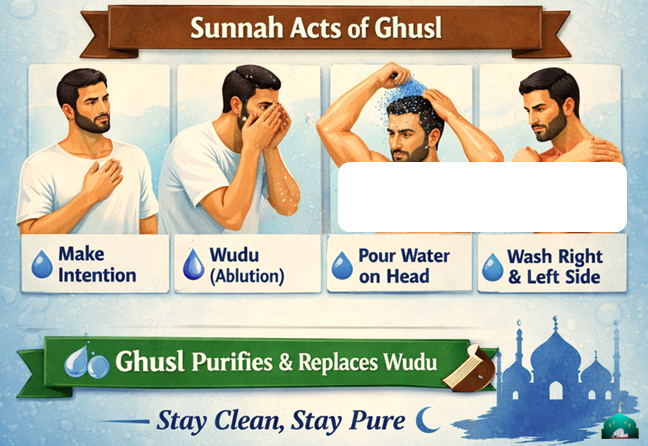
After fulfilling the three obligatory acts (farāʾiz) of ghusl, it is Sunnah to perform ghusl in the manner taught by the Prophet ﷺ. These actions are not compulsory, but following them brings greater reward and completes the Sunnah method.
- Make the intention (niyyah) in the heart to remove major impurity (janābah).
- Say Bismillah.
- Wash both hands up to the wrists three times.
- Wash the private parts thoroughly and remove any impurity.
- Perform complete wudu as done for salah (washing feet can be delayed until the end).
- Pour water over the head three times, ensuring it reaches the roots of the hair.
- Wash the entire body, starting from the right side and then the left.
- Ensure no part of the body remains dry, including armpits, behind knees, navel, ears, and between toes.
- If feet were not washed during wudu, wash them at the end.
👉 After completing this, ghusl is valid, and one may pray without a separate wudu (unless wudu is broken later).
Namaz-related post:
Obligatory Acts (Faraʾiz) of Ghusl According to Hanafi Fiqh
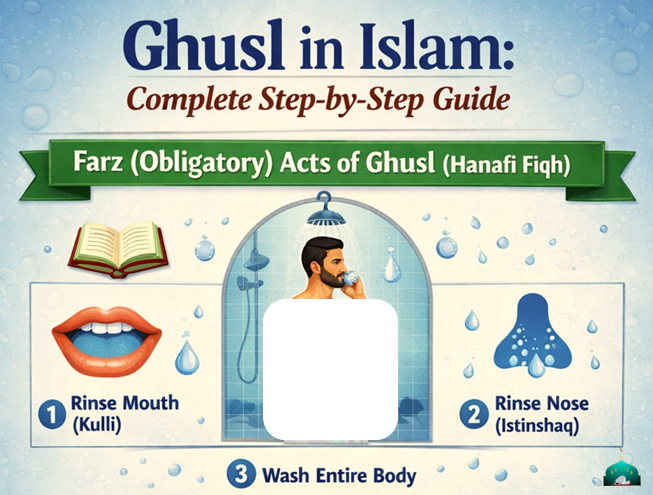
According to Hanafi fiqh, there are three obligatory (farḍ) acts of ghusl. If any one of these is missed, the ghusl is not valid, and a person is not purified from major impurity (ḥadath akbar).
1️⃣ Rinsing the Mouth (Madmaḍah)
It is obligatory to ensure that water reaches all parts of the mouth, including:
- Inside the cheeks
- Under the tongue
- Between the teeth
If any part of the mouth remains dry, the ghusl will not be valid.
2️⃣ Rinsing the Nose (Istinshāq)
It is obligatory to pass water into the nose up to the soft bone.
- Simply washing the outside of the nose is not sufficient
- Any dried mucus inside the nose must be removed so that water can reach the required area
3️⃣ Washing the Entire Body
It is obligatory to wash the entire body with water, ensuring that:
- Water reaches the roots of the hair
- No part of the body is left dry
Special care should be taken with areas such as:
- Armpits
- Behind the knees
- Inside the navel
- Behind the ears
- Between the fingers and toes
If water does not reach any part of the body, the ghusl is incomplete.
Common Mistakes That Invalidate Ghusl (According to Hanafi Fiqh)
Ghusl becomes invalid if any of its obligatory (farḍ) acts are missed. Below are the most common mistakes people make that can invalidate ghusl:
1️⃣ Not Rinsing the Mouth Properly
Many people only splash water on the lips.
- Water must reach all parts inside the mouth
- Areas under the tongue and between the teeth must also be wet
❌ If any part remains dry, the ghusl is invalid.
2️⃣ Not Rinsing the Nose Up to the Soft Bone
Simply washing the outside of the nose is not sufficient.
- Water must go inside the nose up to the soft bone
- Dried mucus must be removed first
❌ Failure to do this invalidates ghusl.
3️⃣ Leaving Any Part of the Body Dry
Even a small dry area invalidates ghusl.
Commonly missed areas include:
- Behind the ears
- Inside the navel
- Armpits
- Between fingers and toes
- Behind the knees
4️⃣ Water Not Reaching the Roots of the Hair
- Water must reach the roots of the hair, not just the surface
- This applies to both men and women
❌ If the roots remain dry, ghusl is invalid.
5️⃣ Tight Rings, Bangles, or Nail Barriers
- Rings or bangles that prevent water from reaching the skin
- Nail polish, glue, or substances that block water
❌ If water does not reach the skin, ghusl is invalid.
6️⃣ Assuming Wudu Alone Is Sufficient
Wudu does not replace ghusl in cases of major impurity.
❌ Praying with only wudu when ghusl is required is invalid.
7️⃣ Ignoring Hidden Body Folds
- Skin folds due to body shape must be washed properly
- Water must reach all concealed areas
Important Reminder
In Hanafi fiqh, ghusl is valid only when all three farāʾiz are fulfilled.
Any mistake that prevents these farāʾiz from being completed will invalidate the ghusl.
Evidence from the Sunnah: Ghusl of the Prophet ﷺ
Sayyidah ‘Aishah (may Allah be pleased with her) narrated that when the Messenger of Allah ﷺ performed ghusl for janābah, he would wash his hands, then perform wudu as for prayer, after which he would wash his body. He would then run his fingers through his hair, and when he was sure that the water had reached the roots, he would pour water over his head three times, and finally wash the rest of his body.
(Narrated by al-Bukhari 248; Muslim 316)
She also reported that when the Prophet ﷺ performed ghusl from janābah, he would take water in his palms, starting with the right side of his head, then the left, and then pour water over his entire head using both hands.
(Narrated by al-Bukhari 258; Muslim 318)
These authentic narrations clearly describe the complete and preferred Sunnah method of ghusl practiced by the Prophet ﷺ.
Important Ruling: Does Ghusl Replace Wudu?
One important ruling related to ghusl is that ghusl for major impurity takes the place of wudu. A person who has performed ghusl—whether the acceptable (minimum) or the complete (Sunnah) form—does not need to perform wudu again, unless he does something during ghusl that invalidates purity, such as passing wind.
Author’s Note:This article has been written to present the rulings of ghusl in a clear, authentic, and easy-to-understand manner, based on Qur’an, Sahih Hadith, and the explanations of reliable scholars, with special attention to Hanafi fiqh where specified. The aim is to help readers perform ghusl correctly and avoid common mistakes that may affect the validity of purification and worship.
While scholarly differences exist in some details, this guide focuses on widely accepted opinions supported by strong evidence. Readers are encouraged to follow the teachings of their own madhhab and consult qualified scholars for personal or complex situations.
May Allah accept our efforts, grant us correct understanding, and allow us to worship Him with complete purity. Ameen.
Frequently Asked Questions (FAQs) About Ghusl
1. What is ghusl in Islam?
Ghusl is a ritual bath in Islam required to remove major impurity (janābah) so that acts of worship like salah become valid.
2. When does ghusl become obligatory?
Ghusl becomes obligatory after sexual intercourse, ejaculation, menstruation, postnatal bleeding, and upon embracing Islam.
3. What are the farz of ghusl in Hanafi fiqh?
According to Hanafi fiqh, the farz of ghusl are:
- Rinsing the mouth
- Rinsing the nose
- Washing the entire body
4. Is intention (niyyah) necessary for ghusl?
Yes, intention is required and is made in the heart. There is no need to say it aloud.
5. Does ghusl replace wudu?
Yes. If ghusl is performed correctly, wudu is included, unless something occurs during ghusl that breaks wudu.
6. Is ghusl required after a wet dream?
Yes, ghusl is required only if discharge is found. If there is no discharge, ghusl is not necessary.
7. Can I pray without ghusl?
No. If ghusl is obligatory and not performed, prayer is invalid.
8. Is ghusl different for men and women?
The method is the same for both. Women must ensure water reaches the roots of the hair, but they do not need to undo braids if water can reach the scalp.
9. What mistakes invalidate ghusl?
Common mistakes include:
- Not rinsing the mouth or nose properly
- Leaving any part of the body dry
- Water not reaching hair roots
10. Does ghusl break the fast?
No. Performing ghusl does not break the fast.
11. Can ghusl be done without water?
If water is unavailable or harmful, tayammum may replace ghusl.
12. Is ghusl Sunnah on Fridays?
Yes. Performing ghusl for Jumu‘ah is a highly emphasized Sunnah.
13. How long should ghusl take?
There is no fixed time. Ghusl should be done calmly and thoroughly, ensuring all obligatory acts are fulfilled.
14. Is it allowed to delay ghusl?
It is allowed to delay ghusl temporarily, but prayer must not be delayed beyond its time.
15. Can I perform ghusl in the shower?
Yes. Ghusl can be performed under a shower, as long as all farz acts are completed.