
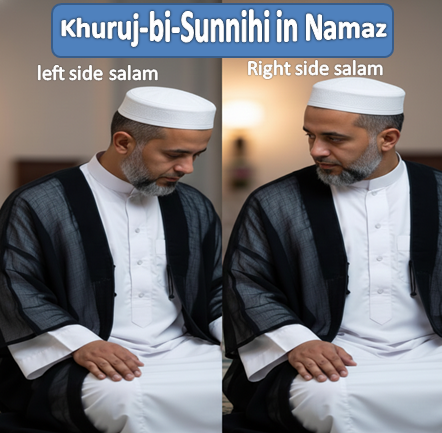
This document explains the legal ruling and performance of Khuruj-bi-Sunnihi in Namaz, the required intentional action to exit the formal state of ritual prayer (Salah) according to the Hanafi school of Islamic jurisprudence.
Khuruj-bi-Sunnihi in Namaz
Definition and Legal Status
According to the Hanafi school, once a person has sat for the duration of Tashahhud in the final sitting, the essential pillars (Arkan) of the prayer are complete. However, to officially exit the prayer, the worshipper must perform an intentional action.
- The Act: Usually, this is the saying of the Salam (Assalamu alaikum wa rahmatullah).
- Legal Ruling: While the final sitting is a Fard (obligatory) act, the Khuruj-bi-Sunn’ihi (the intentional exit) is considered Wajib (necessary).
The Significance of Intentionality
The term emphasizes that the person must exit the prayer by their own choice.
- If the prayer ends due to an involuntary factor (such as the time for the next prayer starting or a sudden loss of Wudu after the Tashahhud), the prayer is technically valid but the Wajib act of intentional exit has been missed.
- By performing the Salam, the worshipper fulfills this requirement and concludes the worship in the manner prescribed by the Sunnah.
How it is Performed
While any intentional action that contradicts prayer (like speaking or standing up) could technically count as “exiting,” the Sunnah method is the Double Salam:
- First Salam (to the right): This is the primary act that fulfills the Wajib requirement of exiting.
- Second Salam (to the left): This is a Sunnah act that completes the ritual beauty of the prayer.
Practical Implications
- If you forget: If a person forgets the Salam and simply stands up or walks away after the final Tashahhud, the prayer is valid (the Fard was completed by sitting), but they have committed a Makruh (disliked) act by omitting a Wajib element.
- Prostrations of Forgetfulness (Sajdah Sahw): If one realizes they haven’t performed the Salam before doing anything that breaks the prayer, they should perform the Salam. If the omission was accidental, Sajdah Sahw is generally required to compensate for the delayed Wajib.
Here is a summary of the key features of the Khuruj-bi-Sunn’ihi:
| Feature | Classification |
|---|---|
| Timing | After completing the final Tashahhud. |
| Hanafi Ruling | Wajib (obligatory). |
| Preferred Method | Saying “Assalamu alaikum wa rahmatullah” to the right. |
| Purpose | To intentionally transition from a state of worship to a worldly state. |
related post:
Juristic Views on Ending Salah (Khuruj-bi-Sunnihi)
Imam Shāfiʿī (RA), Imam Mālik (RA), Imam Aḥmad bin Ḥanbal (RA), and Imam Abū Yūsuf (RA) are of the view that ending the ṣalāh with salām is farḍ. According to them, if a person completes his prayer without performing salām, then his ṣalāh is not valid.
However, Imam Abū Ḥanīfah (RA) holds the opinion that sitting until the end of the Tashahhud (Qa‘dah Akhirah) is farḍ, while ending the ṣalāh with salām is only wājib, not farḍ.
Therefore, according to the Ḥanafi school, if a person completes the Tashahhud and then terminates the ṣalāh through an action that invalidates prayer—such as speaking, turning away from the Qiblah, or similar acts (this is known as Khurūj bi-Sunnatihi)—then the ṣalāh will be valid. However, it will be wājib (obligatory) to repeat the prayer within its prescribed time.
(Dars Tirmidhī, vol. 1, p. 495)
The Ḥanafi jurists base this ruling on the ḥadīth narrated by Sayyidunā ʿAbdullāh ibn Masʿūd (RA), in which the Messenger of Allah ﷺ said:
“When you sit in ṣalāh for the Qa‘dah Akhirah (final sitting), then if you say this or do this, your ṣalāh is complete.”
(Sunan Abī Dāwūd, vol. 1, p. 146)
Note: If you are researching this for a specific guide or blog post, ensure it is categorized under the “Legal Rulings of Salah” to help readers distinguish between the Fard (sitting) and the Wajib (exiting).
FAQs Khuruj-bi-Sunnihi in namaz
1. What is Khurūj-bi-Sunnihi in salah?
Khurūj bi-Sunnatihi means ending the prayer according to the Sunnah, which is done by saying salām to the right and left after completing the final sitting (Qa‘dah Akhirah).
2. Is salām farḍ or wājib to end the salah?
According to Imam Shafi‘i, Imam Malik, Imam Ahmad bin Hanbal, and Imam Abu Yusuf (RA), ending the salah with salām is farḍ. However, Imam Abu Hanifah (RA) holds that salām is wājib, while sitting until the end of Tashahhud is farḍ.
3. Is salah valid without salām in Hanafi fiqh?
Yes. In Hanafi fiqh, if a person completes the Qa‘dah Akhirah and then exits the prayer without salām due to an invalidating action, the salah is valid, but it must be repeated within its time.
4. What happens if someone talks after Tashahhud without salām?
If someone talks after completing Tashahhud without saying salām, the salah is considered valid in Hanafi fiqh, but wājib repetition of the prayer is required during its prescribed time.
5. What is the ruling if a person turns away from the Qiblah after Tashahhud?
Turning away from the Qiblah after completing Tashahhud is considered Khurūj bi-Sunnatihi. The prayer remains valid, but repeating it within the prayer time is wājib according to the Hanafi school.
6. Do all four madhāhib agree on Khurūj bi-Sunnihi?
No. The Hanafi school differs from the other three madhāhib. While Hanafis consider salām wājib, the other schools regard salām as farḍ to end the salah.
7. Is saying salām once sufficient to end the prayer?
Saying salām once to the right is sufficient to exit the prayer. Saying salām to both sides is Sunnah Mu’akkadah.
8. What is Qa‘dah Akhirah in namaz?
Qa‘dah Akhirah is the final sitting position in salah in which Tashahhud is recited before ending the prayer.
9. Which hadith supports the Hanafi view on ending salah?
The Hanafi ruling is based on the hadith of Sayyiduna Abdullah ibn Mas‘ud (RA), where the Prophet ﷺ stated that after completing the final sitting, the prayer is complete.
10. Should a prayer be repeated if salām is missed intentionally?
Yes. In Hanafi fiqh, if salām is intentionally omitted, the prayer remains valid but must be repeated within its time, as salām is wājib.
Namaz related post: