
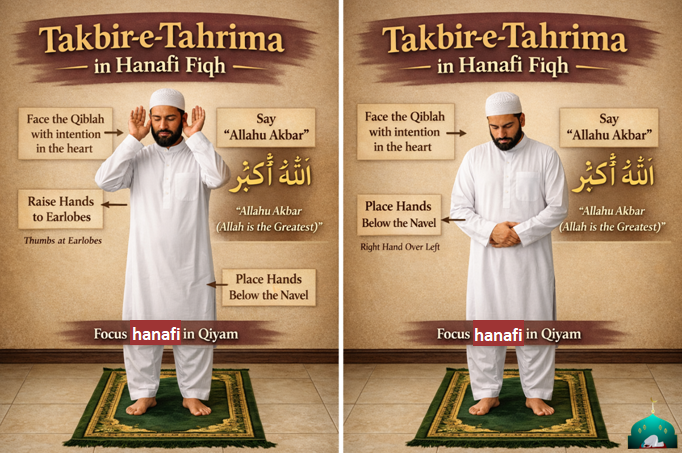
The very first words with which a Muslim begins the prayer are called Takbeer-e-Tahrima. By saying “Allahu Akbar,” a worshipper formally enters into Salah, and actions that were permissible before (such as speaking, moving, or looking around) become prohibited within the prayer. This article explains the meaning, ruling, method, Qur’anic and Hadith evidence, juristic views, common mistakes, and a beginner-friendly guide to Takbir-e-Tahrima.
What Is Takbeer-e-Tahrima? Definition and Meaning
Takbeer-e-Tahrima (also known as Takbeer-ul-Iftitah) is the opening “Allahu Akbar” said to begin the prayer.
- Takbeer means to proclaim the greatness of Allah by saying “Allahu Akbar.”
- Tahrima comes from the word Haraam (prohibited). It is called this because, once you say it, worldly actions like talking, eating, or moving unnecessarily become “prohibited” until the prayer ends.
The Legal Ruling: Is Takbeer-e-Tahrima Farz?
According to Hanafi Fiqh, Takbeer-e-Tahrima is a Shart (condition) or a Rukn (pillar) of Salah. Without saying it out loud (at least loud enough for you to hear yourself), the Namaz does not begin. If a person forgets to say it and starts the prayer, the prayer is invalid.
How to Perform Takbeer-e-Tahrima (Step-by-Step)
For Men:
- The Niyyah (Intention): Make a firm intention in your heart for the specific prayer.
- Raising Hands: Raise both hands up to the earlobes.
- Position: Your palms should face the Qibla, and your thumbs should touch or be near your earlobes.
- The Proclamation: Say “Allahu Akbar” (Allah is the Greatest) while standing straight.
- Folding Hands: Immediately bring your hands down and tie them below the navel (right hand over the left).
For Women:
- Raising Hands: Women should raise their hands only up to their shoulders.
- Position: The hands should remain inside the shawl/garment, and palms should face the Qibla.
- Folding Hands: After saying the Takbeer, women should place their hands on their chest (right hand over the left).
namaz rerelated post:
Essential Conditions for a Valid Takbeer
To ensure your Takbeer-e-Tahrima is accepted, the following must be met:
- Stand Straight (Qiyam): You must say the Takbeer while standing (unless you have a valid medical excuse).
- Correct Pronunciation: It must be “Allahu Akbar.” Stretching the ‘A’ in Allah (e.g., Aaallahu) or the ‘A’ in Akbar (e.g., Akbaaar) changes the meaning and can invalidate the prayer.
- Audibility: You must say it with your tongue. Thinking it in your heart without moving your lips is not sufficient.
Common Mistakes to Avoid
- Lowering the Head: Some people bow their heads while saying the Takbeer. You should look at the place of Sajdah.
- Late Joining (Masbuq): If you join the Imam while he is in Ruku, you must say “Allahu Akbar” while standing first, then go down. If you say the Takbeer while already bowing, your Namaz will not start.
- Fingers Position: Fingers should be naturally spread, not tightly closed or widely forced apart.
The Spiritual Significance
Takbeer-e-Tahrima is a boundary. By saying “Allahu Akbar,” you testify that Allah is greater than your business, your family, your worries, and the world. It is the moment you enter a private audience with the Lord of the Worlds.
Takbir-e-Tahrima in the Qur’an – References and Meaning
The Qur’an commands believers to establish prayer and to glorify Allah. Scholars explain that the act of beginning Salah with the proclamation of Allah’s greatness is rooted in these commands, and it is embodied in the opening takbeer of the prayer.
Hadith About Takbir-e-Tahrima
The Prophet ﷺ said:
“The key to prayer is purification, its entry is the takbeer, and its exit is the tasleem.”
This Hadith clearly shows that takbeer is what initiates the prayer.
Hand Position and Posture in Takbir-e-Tahrima
- Raising the hands:
- Hanafi: to the ears
- Shafi‘i: to the shoulders
- Folding the hands:
- Hanafi: below the navel
- Shafi‘i: on the ches.
- Posture: Stand straight, face the Qiblah, look toward the place of prostration, maintain humility.
Takbir-e-Tahrima vs Other Takbeers in Salah
- Takbir-e-Tahrima: The first takbeer—it starts the prayer.
- Other takbeers: Said while moving between positions (ruku‘, sujud, standing up).
Difference: Only the first takbeer legally enters one into Salah.
Role of Takbir-e-Tahrima as a Rukn (Pillar) of Salah
Takbir-e-Tahrima is a foundational pillar. Without it, the prayer does not come into existence in Islamic law, and the remaining actions (standing, bowing, prostration) do not count as Salah.
Types of Takbeer in Salah
- Takbir-e-Tahrima (Opening): Begins the prayer
- Takbeer-e-Intiqal (Transition): During movement between postures
- Takbeer-e-Tashreeq: Said after Farz prayers on specific days of Dhul-Hijjah
Takbir-e-Tahrima in Jumu‘ah and Congregational Prayer
- Jumu‘ah: Joining the imam with the opening takbeer is highly emphasized.
- Congregation: The follower should say the opening takbeer with or immediately after the imam.
- Joining Late: If one catches the ruku‘ after correctly pronouncing the opening takbeer, the rak‘ah is counted (details vary by fiqh).
Virtues of Beginning Salah with Takbir-e-Tahrima
- Sincerity (Ikhlas): Directs the heart solely to Allah.
- Humility (Khushu‘): Cultivates reverence in worship.
- Discipline: Observes the sacred limits of prayer.
- Unity: A universal beginning for Muslims worldwide.
Common Mistakes in Takbir-e-Tahrima
- Incorrect pronunciation of “Allahu Akbar.”
- Not uttering with the tongue (saying it only in the heart).
- Lack of focus or haste.
- Skipping the Sunnah of raising the hands.
- Breaking prayer rules immediately after the opening takbeer (speaking or unnecessary movement).
Understanding Takbir-e-Tahrima – A Beginner’s Guide
For beginners, remember three essentials:
- Intention in the heart
- Clear words on the tongue: “Allahu Akbar”
- Calm posture facing the Qiblah
From this moment, you are in Salah. With practice, posture, hand placement, and concentration will naturally improve.
Author’s Note
This article on Takbir-e-Tahrima has been written after careful study of authentic Islamic sources. I also strive to practice what is written here. If you find it beneficial, please remember me in your prayers and share it so others may benefit.
Takbeer-e-Tahrima: Frequently Asked Questions
1. What is the meaning of Takbeer-e-Tahrima?
Takbeer-e-Tahrima is the first “Allahu Akbar” said at the beginning of Namaz. It is called “Tahrima” because it makes worldly actions (like talking or eating) Haraam (prohibited) for the duration of the prayer.
2. Is Namaz valid without saying Takbeer-e-Tahrima?
No. According to Hanafi Fiqh, Takbeer-e-Tahrima is a Shart (condition) for the validity of Salah. If you do not say it, your prayer does not officially begin.
3. Should I say Takbeer-e-Tahrima out loud or in my heart?
You must move your lips and tongue so that the words are formed. Ideally, it should be loud enough for you to hear yourself. Simply thinking it in your heart is not sufficient to start the prayer.
4. Where should men and women raise their hands during the opening Takbeer?
- Men: Should raise their hands up to their earlobes, with thumbs touching or near the ears.
- Women: Should raise their hands up to the level of their shoulders, keeping them inside their veil or shawl.
5. What happens if I forget to say Allahu Akbar at the start?
If you forget to say the opening Takbeer and proceed with the prayer, your Namaz is invalid. You must start over from the beginning.
6. Can I say “Allahu Akbar” while bowing for Ruku if I joined the Jamat late?
No. This is a common mistake. You must say the first Takbeer (Tahrima) while standing perfectly straight. After that, you can say a second Takbeer to go down into Ruku. If you say the first Takbeer while you are already bending down, the prayer is not valid.
7. Does touching the ears break the Sunnah?
In Hanafi Fiqh, it is Sunnah for men to touch the earlobes with their thumbs or bring them close. This ensures the hands have been raised to the correct height.
8. Can I use words other than “Allahu Akbar”?
While some scholars suggest other words of praise might technically start the prayer, it is Makruh (disliked) to do so. Following the Sunnah by saying “Allahu Akbar” is the only recommended way.