
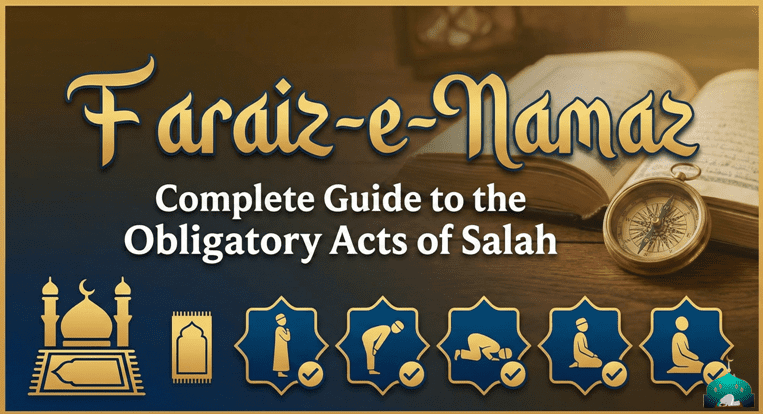
Faraiz e Namaz is the foundation of a Muslim’s daily worship, and its acceptance depends on fulfilling certain essential duties known as Faraiz e Namaz. These are not optional practices; they are the core acts that make prayer valid. Without observing them correctly, even a prayer that appears complete on the outside may not be accepted.
In this detailed guide, you will learn what Faraiz-e-Namaz are, why they are compulsory, how many there are, and how to perform them correctly according to Islamic teachings.
Author Note: I have written this article after thorough research, consulting authentic Islamic books and reliable sources. I also strive to practice what is mentioned here. If you find this information beneficial, please remember me in your prayers and share it with others.
Meaning of Faraiz e Namaz in Islamic Terminology
In Islamic law, Farz (Fard) namaz refers to an act that is strictly obligatory, proven by clear evidence from the Qur’an or authentic Hadith. Performing a Farz earns great reward, while deliberately neglecting it is a serious sin.
When we speak about Faraiz e Namaz, we mean those essential actions that form the backbone of Salah. These acts are so fundamental that if even one of them is missing, the prayer becomes invalid, regardless of how many Sunnah or Nafl actions are performed.
What Are the Obligatory (Fard) Acts in Islamic Prayer?
The obligatory acts in prayer are the minimum requirements that establish the structure of Salah. They define when the prayer begins, how it is performed, and how it is completed. These acts are not based on personal choice or habit but are derived directly from the Qur’an, the Sunnah of the Prophet ﷺ, and the understanding of Islamic scholars.
In simple terms:
If a Farz is missing, the prayer must be repeated.
Importance of the Faraiz e Namaz
Faraiz-e-Namaz are the foundation of prayer. Without a strong foundation, no building can stand—likewise, without Faraiz, Salah cannot be valid.
Allah commands in the Qur’an:
“Establish prayer…” (Surah Al-Baqarah 2:43)
This command shows that Salah is not merely recommended but obligatory.
The Prophet ﷺ said:
“The first deed for which a servant will be called to account on the Day of Resurrection is his prayer. If it is sound, the rest of his deeds will be sound.” (Tirmidhi)
This Hadith highlights that correct prayer—performed with its Faraiz—affects the acceptance of all other deeds.
Faraiz e Namaz – Complete Guide
If you want your Salah to be valid, it is essential to perform all the 7 Faraiz-e-Namaz (obligatory acts) in every prayer. Missing even one can make the prayer invalid. This guide explains each Farz clearly, so beginners and regular worshippers can understand and apply them properly.
1. What is Takbir e Tahrima? (Opening Takbir)
- To begin Salah, stand facing the Qiblah.
- Raise your hands to the ears (men) or shoulders (women) and say: “Allahu Akbar”.
- This Takbir officially enters you into prayer.
- Without Takbir-e-Tahrima, the prayer does not start and is invalid.
2. What is Qiyam? (Standing During Prayer)
- Standing is compulsory in Farz prayers for those who are able.
- If a person prays sitting without a valid excuse, the prayer is invalid.
- Women and men must both stand if possible.
- Exception: Nafl prayers can be offered sitting without an excuse.
3. What is Qira’at? (Recitation of the Qur’an)
- Recitation is obligatory in:
- The first two rak‘ahs of Farz prayers
- Every rak‘ah of Witr and Nafl prayers
- When praying alone, recite quietly but audibly to yourself.
- If the recitation is so silent that you cannot hear it yourself, the prayer is invalid.
4. What is Ruku‘? (Bowing)
- Minimum requirement: hands reach the knees.
- Proper Ruku‘: back straight, head aligned with the back (not raised or lowered).
- Ruku‘ is a pillar of Salah, and missing it invalidates the prayer.
5. What is Sajdah? (Prostration)
- The forehead must touch the ground firmly.
- At least one toe of either foot must touch the ground facing the Qiblah.
- If both feet are off the ground, or toes not properly placed, the prayer is invalid.
6. What is Qa‘dah Akhirah? (Final Sitting)
- After completing all rak‘ahs, sit for final Tashahhud.
- Recite “Attahiyyatu…” up to “wa Rasooluh”.
- Without this final sitting, the prayer is incomplete and invalid.
7. What is Khuruj-bi-Sun‘ihi? (Proper Ending of Salah)
- End the prayer deliberately by performing the prescribed action, e.g., saying Salam.
- If Salah is not ended properly, it is considered incomplete.
Summary Table – 7 Faraiz e Namaz
| No | Farz | Key Point | Search Intent |
|---|---|---|---|
| 1 | Takbir-e-Tahrima | Begin Salah properly | How to start Namaz |
| 2 | Qiyam | Standing in prayer | Can I pray sitting? |
| 3 | Qira’at | Recite Quran in each Farz rak‘ah | Is Quran recitation necessary? |
| 4 | Ruku‘ | Bow correctly | How to do Ruku’? |
| 5 | Sajdah | Forehead and toes on ground | Rules of Sajda |
| 6 | Qa‘dah Akhirah | Sit for Tashahhud | How to sit in final posture? |
| 7 | Khuruj-bi-Sun‘ihi | End prayer properly | How to end Salah? |
author request :“If you notice any mistakes or feel that something important is missing in this post, please let us know so we can improve it. We also humbly request you to remember us in your duas. If you find this post helpful, please share it with others. Jazakallahu Khairan.”
Conclusion
The Faraiz e Namaz are the foundation of every prayer. Without performing each one correctly, Salah is incomplete and may not be accepted by Allah. Understanding and following these essential acts—Takbir-e-Tahrima, Qiyam, Qira’at, Ruku‘, Sajdah, Qa‘dah Akhirah, and Khuruj-bi-Sun‘ihi—ensures that your prayers are valid, spiritually rewarding, and aligned with the teachings of the Qur’an and Sunnah.
By learning and practicing these Faraiz, you strengthen your connection with Allah, improve your focus during Salah, and fulfill one of the most important obligations of a Muslim’s daily life.
Frequently Asked Questions (FAQs) – 7 Faraiz e Namaz
1. What are the 7 Faraiz e Namaz?
The 7 Faraiz (obligatory acts) of Salah are:
- Takbir-e-Tahrima – Opening Takbir
- Qiyam – Standing
- Qira’at – Recitation of the Qur’an
- Ruku‘ – Bowing
- Sajdah – Prostration
- Qa‘dah Akhirah – Final sitting
- Khuruj-bi-Sun‘ihi – Proper ending of prayer
Performing all these in every prayer is necessary for Salah to be valid.
2. Why are Faraiz important in Namaz?
Faraiz are the essential pillars of Salah. Missing even one invalidates the prayer. They ensure the prayer is performed according to the Qur’an and Sunnah and are the foundation for spiritual acceptance and reward.
3. Can I pray sitting if I cannot stand?
Yes, if you are physically unable to stand due to illness or other valid reasons, you may pray sitting.
However, standing is compulsory for those able to do so.
Nafl prayers can also be offered sitting.
4. Is recitation of the Qur’an mandatory in every prayer?
- Farz prayers: Recitation is obligatory in the first two rak‘ahs.
- Witr and Nafl prayers: Recitation is required in every rak‘ah.
- If recitation is not audible to oneself, the prayer is invalid.
5. How should Ruku‘ be performed correctly?
- Keep your back straight and parallel to the ground.
- Head should be aligned with the back.
- Hands must reach at least to the knees.
Proper Ruku‘ is essential; improper bowing invalidates Salah.
6. How should Sajdah be done in Salah?
- Forehead must touch the ground firmly.
- At least one toe of either foot must touch the ground facing the Qiblah.
- Improper Sajdah invalidates the prayer.
7. What is Qa‘dah Akhirah?
- It is the final sitting after completing all rak‘ahs.
- You recite Attahiyyatu (up to “wa Rasooluh”) in this position.
- Without this sitting, the prayer is incomplete.
8. How do I properly end the prayer?
- Salah ends with Khuruj-bi-Sun‘ihi, usually by saying Salam to the right and left.
- This confirms the prayer is complete. Without it, the prayer is not properly concluded.
9. Can a prayer be valid if one Farz is missed?
No. If any one of the seven Faraiz is omitted, the prayer is invalid and must be repeated according to Hanafi fiqh.
10. How can I ensure I perform all Faraiz correctly?
- Learn the steps of Salah and practice regularly.
- Recite the Qur’an audibly to yourself.
- Follow proper postures for Ruku‘, Sajdah, and Qa‘dah Akhirah.
- Conclude the prayer with Salam.
Regular practice ensures Salah is valid and spiritually rewarding.