
If a person travels 92 km or more and intends to stay somewhere for less than fifteen complete nights, he remains a Shar‘i traveller (musāfir). In Islamic law, fifteen days means fifteen full nights. If someone does not intend to stay continuously for fifteen nights, he does not become a resident (muqīm). In the mentioned case, the person intended to stay fourteen nights in Medina, so he remained a traveller. The qaṣar namaz he performed during the first two dayswase valid. However, when he later offered full prayers instead of qaṣr intentionally, this was makrūh taḥrīmī (prohibitively disliked) because abandoning qaṣr while praying alone as a traveller means leaving a wājib act. It is therefore necessary for him to repent and repeat those full prayers.
About the gold given to a girl at the time of marriage as dowry, whatever jewellery or goods are given according to customary practice become the exclusive property of the girl. No one else, including in-laws, has any right over that gold. Preventing her from using it is not permissible in Sharī‘ah.
As for sewing the edges of the iḥrām sheets to prevent fraying, this is makrūh (disliked) but not forbidden. Such stitching does not fall under the category of prohibited stitched clothing (makhīṭ). Therefore, performing Ḥajj or ‘Umrah in such an iḥrām is valid, and no expiation or charity is required.
Regarding conveying a reward to a deceased pre-pubescent child, it is permissible. There is no distinction in Sharī‘ah between conveying reward to an adult or a child, or to a sinful or virtuous person. A Muslim may convey the reward of any good deed to any other Muslim. In the case of sinful individuals, the purpose is forgiveness, while for virtuous individuals and children, it is to elevate their ranks and increase mercy. Muslims have long conveyed reward even to the Prophets, especially to Muhammad ﷺ, despite their infallibility. Therefore, conveying a reward to a deceased child is allowed and beneficial.
What Is Qasar Namaz?
Qasar Namaz is the act of shortening certain obligatory prayers while travelling. It reduces four-rak‘at prayers to two, making worship easier during journeys and helping a traveller remain punctual and consistent in Salah without hardship.
Qasar(Travelling) Namaz Quran Hadis
References (Evidence for Qasar Namaz):
- Qur’an:
Allah says: “And when you travel through the land, there is no sin upon you to shorten the prayer…” (Surah An-Nisa 4:101) - Hadith:
Ya‘la ibn Umayyah (RA) reported that the Prophet ﷺ consistently shortened prayers during journeys, even in times of safety (Sahih Muslim, 686). - Scholars’ View:
Ibn ‘Umar (RA) said: “I accompanied the Messenger of Allah ﷺ during travel, and he never prayed more than two rak‘ahs.” (Sahih al-Bukhari, 1102)
Qasar Namaz – How to Pray When Travelling?
1. Who Is a Musāfir (Traveller) in Sharī‘ah?
A musāfir is a person who firmly intends to travel 92 km or more (three manzils) from his current location. He becomes a musāfir only after leaving the boundaries of his town or city. As long as he remains within city limits, he is not considered a musāfir.
If an airport lies within the connected boundaries of the city, the traveller is not a musāfir upon reaching it. However, if the airport is outside the city limits, he becomes a musāfir upon reaching it.
Principle: Merely travelling long distances in stages does not make a person a musāfir unless he intends from one place to travel 92 km or more in one journey.
2. Qasr (Shortened) Ṣalāh of a Musāfir
Once a person qualifies as a musāfir, he must perform Qasr Ṣalāh, which means offering two rak‘ahs instead of four for the Fard of Ẓuhr, ‘Aṣr, and ‘Ishā’. All other prayers remain unchanged.
Offering more than two rak‘ahs for these Fard prayers is incorrect.
- If four rak‘ahs are prayed with Tashahhud in the second rak‘ah, the first two count as Fard and the remaining two as Nafl, and Sajdah al-Sahw is required.
- If Tashahhud was not done in the second rak‘ah, all four rak‘ahs become Nafl, and the Fard prayer must be repeated.
3. Becoming a Muqīm (Resident)
A musāfir remains a traveller until he firmly intends to stay at one place for fifteen days or more. Once this intention is made, he becomes a muqīm and must offer four rak‘ahs for all four-rak‘ah Fard prayers.
Key rules:
- The intention must be clear and definite for fifteen days from the time it is made.
- If a person keeps extending his stay day by day without intending to stay fifteen days at once, he remains a musāfir, even if months pass.
- The fifteen-day stay must be at one place. If divided between two distant places (where each other’s adhān cannot be heard), he remains a musāfir in both.
- Close places where adhān can be heard are treated as one location.
- Once a person becomes a muqīm, changing his intention later does not make him a musāfir again unless he sets out on a new journey of 92 km or more.
Number of Rakats While Travelling
When a Muslim is a traveller (musafir), Islam allows specific obligatory prayers to be shortened to ease worship during the journey.
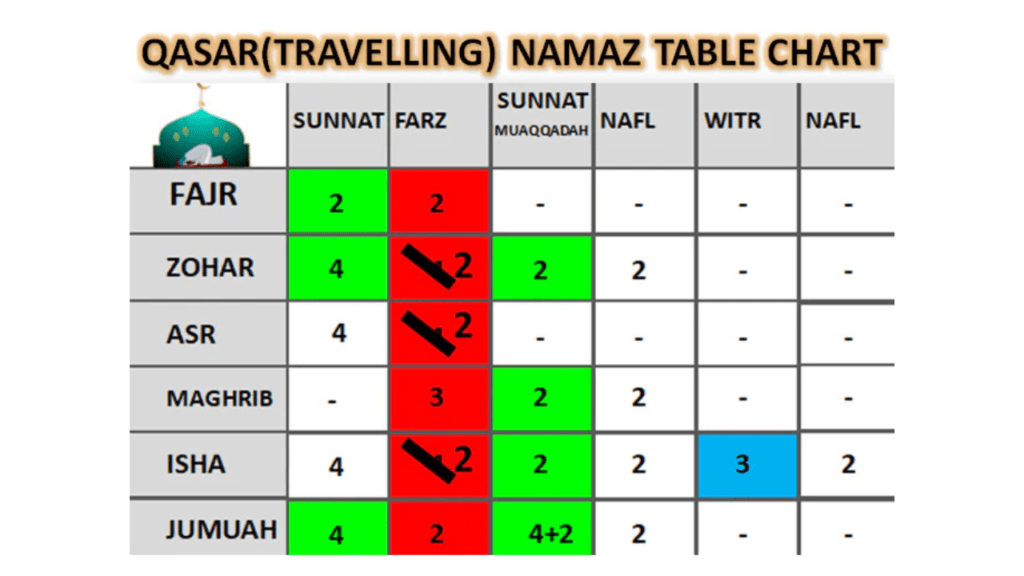
Which Prayers Are Shortened and table in Qasar?
- Fajr namaz rakat: Remains 2 rak‘ats (not shortened)
- Zohar namaz rakat Shortened from 4 to 2 rak‘ats
- Asr namaz rakat : Shortened from 4 to 2 rak‘ats
- Maghrib namaz rakat : Remains 3 rak‘ats (not shortened)
- Isha namaz rakat : Shortened from 4 to 2 rak‘ats
Only the four-rak‘at obligatory prayers are reduced in Qasar, while two- and three-rak‘at prayers stay the same.
Hanafi Qasar Namaz Distance
In the Hanafi school, Qasar Namaz becomes permissible when a person travels a specific minimum distance with the intention of journey.
Minimum Distance for Qasar
According to Hanafi fiqh, the minimum distance for Qasar is three days’ travel, which 92 kilometers (57 miles). Once this distance is intended beyond one’s city boundary, the traveller is considered a musafir and may shorten prayers.
Classical Hanafi References:
This ruling is recorded in authoritative Hanafi works such as Al-Hidayah, Bada’i as-Sana’i, and Radd al-Muhtar, where scholars define the travel distance based on traditional journey measurements accepted in early Islamic law.
How to Pray Qasar Namaz (Hanafi Method)
In the Hanafi school, Qasar Namaz is performed by shortening four-rak‘at obligatory prayers to two while maintaining all essential pillars of Salah.
Step-by-step method:
A musafir makes the intention for Qasar, prays two rak‘ats only for Dhuhr, Asr, and Isha, completes the prayer with tashahhud and salam, and does not add extra rak‘ats to the fard.
Niyyah guidance:
The intention is made in the heart, such as intending to pray two rak‘ats of the fard as a traveller; verbal declaration is not required.
Imam vs praying alone:
If a traveller prays behind a resident imam (muqeem), he must complete four rak‘ats. If he leads or prays alone, he performs two rak‘ats as Qasar.
Qasar Namaz in Native Place
Qasar Namaz cannot be prayed in one’s hometown or permanent residence, because a person is not considered a traveller there.
According to Hanafi fiqh, Qasar becomes valid only after crossing the city or village boundary with the intention of travel. If a person is still within the limits of their hometown, full Salah must be offered, even if the journey has already begun.
Essential Conditions Before Performing Prayer
For any prayer to be considered valid, including shortened prayers (Qasr), certain essential conditions must be met.
The person must be in a state of purity, meaning they must have performed ablution (Wudu) or a full ritual bath (Ghusl) if necessary. The prayer must be performed within its prescribed time, facing the Qibla (the direction of the Kaaba in Mecca), and with the body properly covered according to Islamic guidelines. Without these conditions, the prayer is not valid.
Note: If the traveler does not know the direction of the Qibla, and there is no one to guide them to the correct direction, then in this situation, they should pray facing the direction they believe to be the Qibla.
Example – Full Real-Life Application of Qasar Namaz (Hanafi)
Additional Rules: Combining Prayers (Jam‘) – Hanafi Position
In the Hanafi school, combining prayers during travel is not permitted in normal circumstances. A traveler shortens (Qasar) the prayers but does not combine them, except during Hajj at ‘Arafat and Muzdalifah, where Jam‘ is established by Sunnat.
Therefore, Dhuhr, ‘Asr, and ‘Isha must be prayed in their own times, each shortened to two rak‘ahs.
Evidence:
Allah allowed shortening the prayer during travel (Qur’an 4:101), and the Prophet ﷺ consistently prayed two rak‘ahs while traveling (Sahih al-Bukhari 1094; Sahih Muslim 689).
Praying Behind an Imam While Traveling
- Behind a resident (muqeem) imam:
A traveler must complete four rak‘ahs, because following the imam is obligatory. - Behind a traveler (musafir) imam:
The traveler prays two rak‘ahs (Qasar) with him.
(Established in Hanafi fiqh works such as Radd al-Muhtar)
Making Up Missed Prayers (Qada) During Travel
If a fard prayer is missed while traveling, it must be made up as Qasar (two rak‘ahs), even after returning home, because the ruling depends on the state in which the prayer became due.
(According to Darul Ifta Hanafi rulings)
Practical Real-Life Examples (Hanafi Based)
1. Road Trip: Shohratgarh to Lucknow (~200 km)
- City boundary crossed → person becomes a traveler
- Dhuhr, ‘Asr, ‘Isha → 2 rak‘ahs each
- Hotel stay less than 15 days → Qasar continues
- Upon re-entering hometown limits → full prayers resume
✔ Meets the 92+ km Hanafi distance rule
2. Flight: Delhi to Mumbai (~1200 km)
- After leaving city limits → traveler status applies
- If standing is difficult → prayer may be offered seated
- Layover less than 15 days → Qasar remains valid
- No combining; each prayer is performed in its time
3. Job Posting: 100 km Away, Stay Under 15 Days
- No intention of permanent residence
- Daily Qasar prayers are valid
- Once intention becomes 15 days or more, full prayers start immediately
4. Umrah or Hajj (Hanafi View)
- In Makkah or Madinah:
- Intention under 15 days → Qasar
- Intention 15 days or more → full prayers
The 15-day rule still applies even during sacred journeys according to Hanafi fiqh.
5. Daily Commute (40–50 km to Office)
- Returning home the same day
- Not considered a traveler
➡ Qasar is not allowed
6. Bride Visiting In-Laws (~80 km)
- Temporary stay under 15 days → Qasar allowed
- Permanent residence → full prayers required
Virtue and Proof of Qasar
The Prophet ﷺ always shortened prayers during travel
(Sahih al-Bukhari 1094; Sahih Muslim 689)
Ibn ‘Umar (RA) said:
“We prayed two rak‘ahs with the Messenger of Allah ﷺ while traveling.”
(Sahih al-Bukhari 1180)
➡ In Hanafi fiqh, deliberately praying full prayers while traveling is disliked (makruh).
Common Mistakes to Avoid
- Starting Qasar before leaving city limits
- Intentionally praying four rak‘ahs while traveling
- Assuming combining prayers is allowed in Hanafi travel
- Ignoring the 15-day intention rule
Practical Advice
- Use reliable apps to check distance and Qiblah
- Carry a prayer mat when traveling
- Teach family members correct Qasar rules
- For specific cases, consult a local Hanafi scholar
May Allah accept your efforts and grant ease in your worship. Ameen.
Conlusion
Qasar Namaz is a clear and well-established concession in Islam that allows travellers to shorten four-rak‘at prayers, provided the Hanafi conditions of distance, intention, and length of stay are met. It ensures that Salah remains consistent without burden during travel.
This ruling highlights the mercy and flexibility of Islam, showing that Allah does not intend hardship for believers while journeying.
Call to Action: Learn and apply the correct method of Qasar Namaz during travel, follow the Sunnah with confidence, and share this knowledge so others may also benefit from the ease Allah has granted.
FAQs – Qasar(Travelling) Namaz
What is the rule of Qasr prayer?
Qasr prayer allows a traveller to shorten four-rak‘at obligatory prayers to two as an ease during travel.
What is the condition for Qasar Namaz?
The person must travel at least 92 km, cross city limits, and not intend to stay 15 days or more at the destination.
How many days can you pray Qasar for?
Qasar can be prayed until you intend to stay 15 days or more. Before that, you remain a traveller.
Who is eligible for Qasar Namaz?
Any adult Muslim who travels the required distance with a temporary stay intention qualifies.
Can I pray if my period is more than 7 days?
No. A woman does not pray during menstruation, regardless of how many days it lasts. Prayer resumes after purity.
What are the 3 biggest sins in Islam?
Shirk (associating partners with Allah), murder without right, and false accusation of adultery are among the gravest sins.
What if I forget to pray Qasr?
If you prayed four rak‘ats instead of two by mistake, the prayer is valid. Deliberate full prayer while travelling is disliked.
Which 5 days are haram for fasting?
Fasting is forbidden on Eid al-Fitr, Eid al-Adha, and the three days of Tashreeq (11–13 Dhul-Hijjah).
How many km for Qasr prayer?
According to Hanafi fiqh, 92 km (57 miles).
How many rak‘ats are in Qasr?
Dhuhr, Asr, and Isha are shortened from 4 to 2 rak‘ats. Fajr and Maghrib remain unchanged.
Who qualifies as a Musafir?
A person who leaves city limits intending to travel 92 km and stays less than 15 days is a musafir.
Is Qasr mandatory?
In Hanafi fiqh, Qasr is wajib (necessary) for a traveller; intentionally praying full is disliked.
Can a wife go out without husband’s permission in Islam?
Islam encourages mutual respect; unnecessary restriction is discouraged, but family harmony and safety should be maintained.
When should I start praying Qasr?
You may start Qasr after crossing your city or village boundary.
How many days is the Qasr prayer valid for?
Qasr remains valid until the intention becomes 15 days or more.
Can I shorten my prayer when travelling?
Yes. If you meet the travel conditions, you should shorten the four-rak‘at obligatory prayers.