
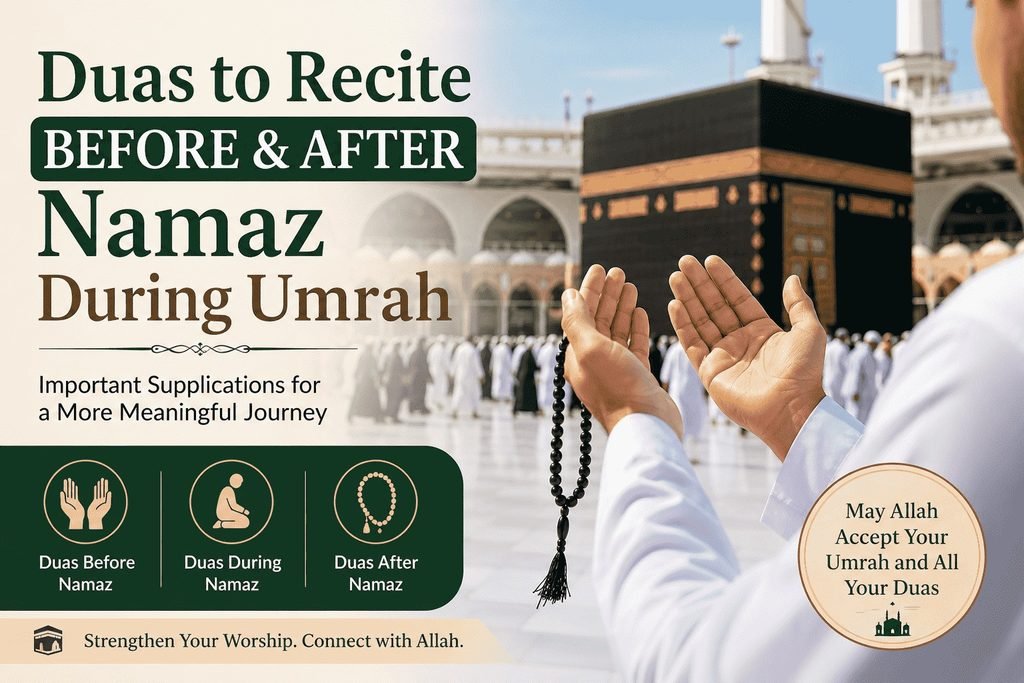
Performing Namaz during Umrah is a special opportunity to reconnect with Allah and increase your worship. Whether you are praying in Masjid al-Haram, Masjid an-Nabawi, your hotel, or another suitable place, making sincere Dua before and after Salah can help you remain spiritually focused throughout your journey.
For Muslims travelling from Britain, preparing in advance can make the pilgrimage more comfortable and organised. When comparing Umrah packages 2027 from UK, consider not only flights and accommodation but also the opportunity to spend meaningful time in Makkah and Madinah for Salah, Dhikr, Quran recitation, and Dua.
Why Are Duas Important During Umrah?
Dua is an important form of worship in Islam. During Umrah, pilgrims often have many personal matters they want to ask Allah about, including forgiveness, guidance, family, health, protection, and success in this life and the Hereafter.
There is no requirement to have a special Dua for every prayer during Umrah. You can make authentic supplications from the Quran and Sunnah and also ask Allah for your personal needs.
The most important thing is sincerity and understanding what you are asking Allah for.
Duas to Recite Before Namaz
Before the obligatory prayer begins, there are several forms of remembrance and supplication that a Muslim may recite.
1. Dua When Going to the Mosque
When travelling to the mosque, you can recite the supplication reported from the Prophet ﷺ:
Allahumma-j’al fi qalbi nuran, wa fi basari nuran, wa fi sam’i nuran, wa ‘an yamini nuran, wa ‘an shimali nuran, wa fawqi nuran, wa tahti nuran, wa amami nuran, wa khalfi nuran, waj’al li nuran.
This supplication asks Allah for light and guidance.
There is also a well-known Dua for entering the mosque:
Allahumma iftah li abwaba rahmatik.
Meaning:
“O Allah, open the gates of Your mercy for me.”
This is particularly meaningful when entering Masjid al-Haram or Masjid an-Nabawi.
2. Make Your Intention for Salah
Before beginning Namaz, make your intention in your heart for the particular prayer you are about to perform.
You do not need to announce your intention loudly. Simply know in your heart whether you are praying Fajr Namaz, Dhuhr Namaz, Asr Namaz, Maghrib Namaz, Isha Namaz, or a voluntary prayer.
3. Recite the Opening Supplication
After the opening Takbir and before reciting Surah al-Fatihah, a person may recite an opening Dua (Du’a al-Istiftah).
One commonly recited supplication is:
Subhanak Allahumma wa bihamdika, wa tabarakasmuka, wa ta’ala jadduka, wa la ilaha ghayruk.
Meaning:
“Glory is to You, O Allah, and praise is Yours. Blessed is Your Name, exalted is Your Majesty, and there is no deity worthy of worship except You.”
There are other authentic opening supplications as well.
Duas During Namaz
Although this article focuses on supplications before and after Salah, it is also important to remember that Dua can be made during certain parts of the prayer.
Dua in Sujood
Sujood is a particularly important position for supplication. The Prophet ﷺ encouraged Muslims to make abundant Dua during prostration.
You can say:
Subhana Rabbiyal A’la
Meaning:
“Glory is to my Lord, the Most High.”
You may also make additional supplications during Sujood, according to the applicable Islamic guidance.
Dua Before the Final Salam
Before completing Salah, there is an opportunity to seek Allah’s protection and make supplications.
One well-known Dua is:
Allahumma inni a’udhu bika min ‘adhabi jahannam, wa min ‘adhabil-qabr, wa min fitnatil-mahya wal-mamat, wa min sharri fitnatil-masihid-dajjal.
Meaning:
“O Allah, I seek refuge in You from the punishment of Hell, the punishment of the grave, the trials of life and death, and the evil trial of the Dajjal.”
This is among the authentic supplications that can be made before the final Salam.
Duas to Recite After Namaz
After completing the prayer, you can engage in Dhikr and make Dua. There are several well-known forms of remembrance reported from the Prophet ﷺ.
1. Say Astaghfirullah Three Times
After completing Salah, say:
Astaghfirullah.
Astaghfirullah.
Astaghfirullah.
Meaning:
“I seek forgiveness from Allah.”
This is a simple but powerful reminder of our need for Allah’s forgiveness.
2. Recite Ayat al-Kursi
Many Muslims recite Ayat al-Kursi (Surah Al-Baqarah 2:255) after the obligatory prayers.
It is a powerful Quranic verse describing Allah’s greatness, knowledge, authority, and protection.
If you have memorised it, take a moment after Salah to recite it with reflection and understanding.
3. Recite Tasbih, Tahmid and Takbir
After Salah, you can remember Allah by reciting:
SubhanAllah – Glory be to Allah.
Alhamdulillah – All praise belongs to Allah.
Allahu Akbar – Allah is the Greatest.
A commonly practised form is to recite SubhanAllah 33 times, Alhamdulillah 33 times, and Allahu Akbar 33 times, followed by the declaration of Allah’s oneness.
4. Make Personal Dua
After completing your Dhikr, you can make personal Dua.
Ask Allah for:
- Forgiveness for your sins
- Acceptance of your Umrah
- Guidance and steadfastness
- Good health and protection
- Blessings for your parents and family
- Success in your lawful affairs
- Mercy and forgiveness for deceased loved ones
- A good ending to your life
- Jannah and protection from Hellfire
You can make Dua in your own language when you are outside the formal prayer. Allah knows every language and understands what is in your heart.
Duas for Acceptance of Your Umrah
One of the most important things pilgrims can ask Allah for is the acceptance of their worship.
You can sincerely ask:
“O Allah, accept my Umrah, forgive my sins, accept my prayers and supplications, and allow me to return home with a stronger connection to You.”
You do not need a complicated formula. A sincere Dua from the heart can be deeply meaningful.
Dua for Family During Umrah
Many pilgrims use their time in Makkah and Madinah to make Dua for their families and loved ones. After arriving at Jeddah Airport, arranging a Jeddah Airport to Makkah taxi can make the journey to the holy city more convenient. A comfortable transfer allows pilgrims to focus on their spiritual journey while traveling from the airport to Makkah.
You can ask Allah to:
- Protect your parents
- Bless your spouse and children
- Guide your family
- Increase love and unity between family members
- Grant lawful provision
- Forgive the mistakes of your loved ones
- Give peace and happiness to your household
You can also remember friends, relatives, and the wider Muslim Ummah in your supplications.
Dua Between Prayers During Umrah
You do not have to restrict Dua to immediately after Salah.
During your stay in the Haram, you can make Dua at appropriate times throughout the day. For example, you may make personal supplications after completing your Quran recitation, while sitting quietly in the mosque, or during other permissible moments of worship.
However, avoid disturbing other worshippers, especially when people are praying or listening to the Imam.
Tips for Making Dua in Masjid al-Haram
Masjid al-Haram can become extremely busy, particularly during peak prayer times. Keep the following tips in mind:
Choose a Quiet Moment
You do not always need to make lengthy Dua immediately after the congregation finishes. If the area is crowded, complete your essential Dhikr and move to a suitable place where you will not obstruct others.
Understand What You Recite
Try to learn the meanings of the supplications you recite. Understanding the words can help you develop greater concentration and sincerity.
Make Dua for Others
Remembering other people in your Dua can make your supplications more meaningful. Pray for your parents, family, friends, and Muslims around the world.
Do Not Focus Only on Worldly Requests
It is permissible to ask Allah for worldly blessings, but remember to ask for forgiveness, guidance, faith, Paradise, and protection from the Hereafter as well.
Avoid Treating Dua Like a Checklist
Umrah is not simply about completing a list of supplications. Worship Allah sincerely and speak to Him with humility and hope.
Common Mistakes to Avoid
While making Dua during Umrah, pilgrims should avoid some common mistakes.
Do not believe that only Arabic Dua is accepted. You can make personal supplications in your own language outside Salah.
Do not disturb other worshippers. Speaking loudly or making extended group supplications that disturb people can affect the peaceful environment of the mosque.
Do not push people to reach a particular place. There is no need to put yourself or others at risk to make Dua in a specific location.
Do not assume every Dua has a fixed wording. There are authentic supplications from the Quran and Sunnah, but you can also ask Allah for your personal needs.
Preparing Spiritually Before Your Umrah
A successful Umrah is not only about arranging flights and accommodation. Spiritual preparation is equally important.
Before leaving the UK, consider learning the essential steps of Umrah, reviewing the rules of Ihram, improving your Salah, memorising important Duas, and learning the meanings of the supplications you plan to recite.
It can also be helpful to create a personal Dua list. Write down the names of family members and important matters you want to remember so that you do not forget them during your pilgrimage.
Planning Your Umrah From the UK
If you are arranging your pilgrimage through an agency, choose a provider that clearly explains the package, accommodation, flights, transport, visa arrangements, and other important services. Makkah Travel can be considered by UK pilgrims looking for Umrah travel support and package options.
Before travelling, always check the latest Saudi requirements and ensure that your passport, visa, and other necessary travel documents are valid. Requirements can change, so confirm the current rules close to your departure date.
Travel & Namaz During Your Umrah Journey
Umrah ke dauran pilgrims aksar Makkah aur Madinah ke darmiyan travel karte hain aur masjid mein namaz ke liye apna waqt organize karte hain. Agar aap Madinah mein stay kar rahe hain, to Madinah Airport to Hotel Taxi ka arrangement airport se hotel tak pahunchne mein madad kar sakta hai, jisse aap safar ke baad araam kar saken aur namaz ke liye tayyar ho saken.
Agar Umrah itinerary mein dono holy cities shamil hain, to Madinah to Makkah Taxi se travel karte waqt pilgrims apni duas aur zikr jaari rakh sakte hain. Makkah mein pahunchne ke baad Masjid al-Haram mein namaz aur ibadat ke liye waqt nikalna Umrah journey ka important hissa hota hai.
Similarly, jo pilgrims Umrah complete karne ke baad Madinah wapas ja rahe hain, unke liye Makkah to Madinah Taxi ek private travel option ho sakta hai. Safar ke dauran bhi dua, dhikr aur Allah ki yaad ko apne routine ka hissa banaya ja sakta hai.
Choosing Transport for a Peaceful Umrah Journey
Umrah ke safar mein reliable transportation ka intezam pilgrims ko airport, hotel aur dono holy cities ke beech travel planning mein asani de sakta hai. A suitable Umrah taxi service in Saudi Arabia choose karte waqt vehicle size, luggage space, pickup location aur journey requirements ko consider karna useful hai. Is tarah pilgrims transportation ki tension kam karke namaz, dua aur ibadat par zyada tawajjoh de sakte hain.
Final Thoughts
Dua is one of the most beautiful parts of an Umrah journey. Whether you are standing in Masjid al-Haram before Salah, sitting quietly after Fajr, or completing your Dhikr after Isha, use these moments to remember Allah and ask for His mercy.
Learn authentic supplications from the Quran and Sunnah, understand their meanings, and make sincere personal Dua for yourself and others. Most importantly, remember that Umrah is an act of worship, so approach every prayer with humility, patience, and devotion.
May Allah accept the Umrah, Salah, Duas, and good deeds of all pilgrims and grant them a safe journey home. Ameen.
Frequently Asked Questions (FAQs)
1. What Duas should I recite before Namaz during Umrah?
Before Namaz during Umrah, you can make sincere Dua and recite authentic supplications. When entering the mosque, you may say “Allahumma iftah li abwaba rahmatik”, meaning “O Allah, open the gates of Your mercy for me.” You should also make your intention for the particular Salah in your heart.
2. Is there a specific Dua for every prayer during Umrah?
No. There is no requirement to recite one special Dua for every prayer during Umrah. You can use authentic supplications from the Quran and Sunnah and ask Allah sincerely for your personal needs, forgiveness, guidance, protection, and acceptance of your worship.
3. What Dua can I make before starting Namaz?
After the opening Takbir and before Surah Al-Fatihah, you may recite an authentic opening supplication known as Du’a al-Istiftah. One commonly recited Dua begins with “Subhanak Allahumma wa bihamdika…”. There are also other authentic opening supplications.
4. Can I make Dua during Namaz while performing Umrah?
Yes. Dua can be made during certain parts of Salah. In particular, Sujood is an important position for making supplication. You can also make authentic supplications before the final Salam.
5. What Dua should I recite in Sujood?
You can say “Subhana Rabbiyal A’la”, meaning “Glory is to my Lord, the Most High.” Additional supplications may also be made during Sujood according to applicable Islamic guidance.
6. What Dua should I read before Salam in Salah?
Before completing Salah with Salam, you can seek Allah’s protection from the punishment of Hell and the grave, the trials of life and death, and the trial of the Dajjal. The article provides the well-known supplication beginning “Allahumma inni a’udhu bika…”.
7. What should I recite after Namaz during Umrah?
After completing Salah, you can say Astaghfirullah three times, recite Ayat al-Kursi, perform Dhikr such as SubhanAllah, Alhamdulillah and Allahu Akbar, and then make personal Dua.
8. What Dua should I make after Fajr during Umrah?
After Fajr, you can complete your regular post-Salah Dhikr and make personal Dua. You may ask Allah for forgiveness, guidance, protection, acceptance of your Umrah, blessings for your family, and goodness in this life and the Hereafter.
9. Can I make Dua in my own language during Umrah?
Yes. Outside the formal prayer, you can make personal Dua in your own language. You do not need to use Arabic for every personal supplication because Allah knows and understands what is in your heart.
10. What Dua should I make for acceptance of Umrah?
You can sincerely ask Allah to accept your Umrah, forgive your sins, accept your prayers and supplications, and strengthen your connection with Him. A complicated or fixed formula is not necessary for making a sincere personal Dua.
11. What should I pray for my family during Umrah?
You can make Dua for your parents, spouse, children, relatives, friends, and the wider Muslim Ummah. You may ask Allah for their protection, guidance, lawful provision, forgiveness, peace, family unity, and blessings.